Few early adopters have been as vindicated as those who were in on the ground floor of Industry. First released in the dark, lockdown days of November 2020, it was, by all accounts, one of the least-watched shows in HBO’s history.
Writers Mickey Down and Konrad Kay were novices who jumped from the City into running a TV show. (Down had been in M&A, Kay in Equities). But those who watched it knew they were witnessing something special.
Reviews were gushing, fans were hardcore. Each new season felt like a bonus, and its cult following grew every year. Jump to the release of season four in January, and it feels like it’s poised to hit even greater heights.
Thus far, the show has been a star-maker. The original graduate class included Myha’la, Marisa Abela, Harry Lawtey and David Jonsson, all relative unknowns now turned into household names.
Miriam Petche, the 24-year-old Gen Z import from season three quickly grew into one of the show’s most interesting new arrivals, and looks set to follow that same path. As we chat in Soho a few weeks before its January premiere, the excitement is real.
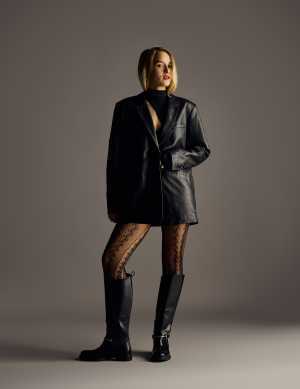
“It’s not a new show, but it’s definitely shifting into a different context,” Petche says when I ask her about season four. A symptom of writing every season like it’s the last is that there’s no need to keep any bullets in the chamber – every finale could have easily been the final episode of the show. “They like the challenge of writing themselves out of that corner,” Petche says.
Part of the show’s magic lies in its boldness. While some shows might feel content to take a beat, Industry is constantly playing offence, never taking its foot off the pedal. [Spoiler alert.] At the end of season three, Pierpoint & Co, the investment bank that serves as its bedrock, effectively shut its doors after being sold to a shady Egyptian investment firm. After season four was greenlit, the show had to undertake a soft reboot, drafting in a host of new faces along the way, including Max Minghella, Kiernan Shipka and Charlie Heaton, fresh from the Stranger Things finale.
As new characters come in, many who punctuated Pierpoint’s ruthless trading floor have fallen by the wayside. When I mention I was relieved to see Sweetpea, who turned into one of the standout new entries of season three, return, Petche laughs. “You and me both! I immediately texted my mum when I got the call.”
Thanks to a surge in viewership in season three, the show enters season four in a surprisingly secure position. While a fifth season hasn’t been announced yet, it feels more certain than ever, and with that might there be a temptation to pull the handbrake a bit, keep the powder dry for the next season? Not a chance. “Every episode feels like a finale,” Petche says.
Petche’s character, Sweetpea Golightly (a name inspired by increasingly ludicrous naming trends, “I met someone called Cinema the other day,” she adds) is all about subverting an obvious trope. “She has an outward bravado, but is inwardly terrified of failing, and she’s desperate to prove herself.” I ask if the Millennial showrunners have asked her for tips on how to write the character, mindful that there is nothing worse than a failed attempt at mimicking Gen Z speak. She laughs, but concedes, “Not in the words written on the page, but maybe in the delivery, and the speed I speak at.”

“Right at the beginning of the season, she’s a slightly more exaggerated version of Gen Z. The first time you see her she’s literally filming a TikTok on the trading floor.” That first glimpse is played as an eye-roll moment, almost deliberately baiting the viewer to see the character in the light of the broadest Gen Z generalisations. As the season progresses, this gets undercut, and Sweetpea instead turns into one of the more nuanced depictions of Gen Z there is on TV.
In many ways, Sweetpea acts as a counterbalance to Marisa Abela’s Yasmin, who, in the first two seasons in the grad role, takes out frustration at a lack of agency at work in her personal relationships. When Yasmin tries to dish out the same treatment downwards, she’s met with a generation much more in tune with what constitutes an acceptable workplace atmosphere. As the so-called adults in the room at Pierpoint flounder – Eric spiralling into a mid-life crisis, Rob falling into complete disillusionment, Rishi’s extracurriculars threaten to overwhelm him, and Yasmin getting used as a patsy in Harper’s play – it’s Sweetpea who first uncovers Pierpoint’s over-exposure that ultimately leads to the company’s downfall.
Now, in season four, Petche says, “She’s much closer to me,” before quickly clarifying, “Not in everything she does,” – a reference to some of the character’s more risqué side hustles. With the raft of new characters, Petche is enjoying being part of the established cast. “It was fascinating to come to that first read-through and welcoming everyone in. I still feel quite new – Myha’la and Marisa (Abela) have been in this world since 2019. If you look at it like school, I’m in my second year while others are getting their Masters.”


Petche landed the role while still in drama school, and says, “I truly think I finished training in that third season; now I feel like I’m ready to go.” Jumping onto the trading floor of Pierpoint straight out of school wasn’t her first experience on set – she had a role on the CBBC show The Worst Witch as a child, something she calls “a surreal vocation, although when you do it it’s the most normal thing ever,” – but found joining a cast firing on all cylinders exhilarating.
When preparing for her audition, she thought “If I ever get this part, I’m gonna need to learn a little bit more about finance. I was looking up words on Investopedia. When I first started I asked some of the other actors, “Do you know what you’re saying?” And they were like, “Absolutely not.” I love that it’s challenging, that it doesn’t patronise its audience.”
Ken Leung, who plays Eric, the unpredictable, renegade Managing Director at Pierpoint who stalks the trading floor with a baseball bat, was a favourite screen partner. “I felt like I was watching someone who’s just brilliant at their job, and was lucky to have that experience.”
So what’s to come in season four? “I understand her more, but I also love that there are bits that I don’t get about her, because that’s what human beings are like. When I first joined, I felt like I needed to know every detail about her – when was she born, what star sign is she – but I’ve learned that isn’t always helpful. TV forces you to be more playful and free, which is the greatest gift as an actor.” As for her reaction to a burgeoning status as a fan favourite? She doesn’t pay too much attention to it, but admits, “It was a very reassuring and lovely reaction.”

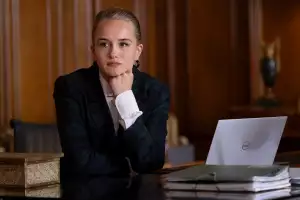
In episode one, we find Sweetpea is working at Harper’s startup fund – and the chance to work more directly with Myha’la was what she was most excited about. “We had that one scene in season three, and I really wanted to work with Myha’la.”
Fans of the show will know Harper’s almost pathological disregard for loyalty and, well, the law at times, and Petche says this season marks something of a crossroads for Sweetpea. “I think she really admires Harper, and what is really interesting about this season is seeing what happens when the idealised version of someone gives way to the real person. For Sweetpea, there’s a lot of coming to terms with who she wants to be, and who she thinks she actually is.”
One scene in particular, which Petche calls an ‘anchor’ for the season, promises to ratchet up the stakes. Trailer watchers can probably deduce it has something to do with her standing in front of the mirror with a blood-spattered face. She remains coy on details, but says, “I think it’s genius how it ends up there.”
Season four examines just how nefariously embedded the financial industry is in every corner of society. Class politics has always been central to Industry, but after dipping its toes into Westminster for a few seasons, it has now become a full interrogation of that overlap. The opening episode centres on a major plot strand involving Siren, a fictional OnlyFans-style platform that is raised in Parliament in the same week the Labour government grapples with Elon Musk’s Grok and its illegal image manipulation. Meanwhile, Petche says Sweetpea is embarking on an Erin Brockovich–style arc this season.
We move on to childhood inspirations. Who inspired her to get into acting? The first two names she cites growing up are Sharpay Evans from High School Musical and Ellen Ripley from Alien (Sigourney Weaver was an icon in her house growing up). When I mention how well this fits Sweetpea, who possesses both the surface-level bubbliness of Evans and steely grit of Ripley, it seems to resonate. “I’m absolutely obsessed with this,” she laughs. “I’m saving this on my phone.”
For life beyond Industry, Petche is still getting used to the business. Even after landing an HBO show while still in school, she knows that a thick skin is essential in the industry.
She’s found reassurance “in knowing that even people who I think are phenomenal at their job, are also every once in a while being rejected. I know I’m in an industry that is very competitive where timing and luck play a huge role”.
Self-taping is “a whole new world to get used to. Every audition I have is a self tape. I’m the Director, I’m the DoP, my mum is playing my love interest,” she laughs. Does Mum have any acting experience? “No,” she says. “Bless her, she’s trying to help out.”
Dream roles? Petche immediately goes to the Throne of Glass book series, a now worldwide phenomenon written by Sarah J Maas. “My Kindle has never worked as hard in its life since I discovered the series,” she says.
Like Sweetpea, it’s an answer that undersells a canny understanding of the industry she’s in – if plans aren’t already in motion, the book series will almost certainly be turned into a lucrative TV show before long.
For now, like most viewers finishing an episode of Industry, it’s time to take a deep breath.
Watch Industry on BBC 1 and BBC iPlayer.