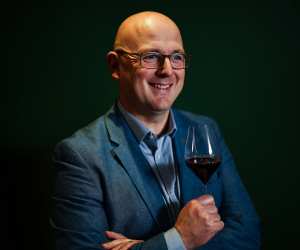
Few stories in modern Napa Valley are as compelling as that of Scott Becker. When Becker acquired Realm Cellars in 2012, it was a precarious, asset-light operation on the brink of collapse. What followed was not a quick fix, but a patient, principles-led rebuild – grounded in land ownership, long-term thinking and an almost obsessive belief in place.
Today, Realm stands among Napa’s most coveted producers, farming estate vineyards across Coombsville, Stags Leap District and Pritchard Hill, with wines prized for their balance, longevity and authority.
A former US Air Force officer turned vintner, Becker brings uncommon discipline to winemaking – marrying strategic rigour with deep respect for nature, people and culture.
Here, he reflects on the journey, the lessons, and why Realm’s most important chapter may still lie ahead.
Square Mile: What was your first ever experience of wine?
Scott Becker: I didn’t grow up around wine but both sets of my grandparents were dairy farmers in Wisconsin, so I did have some exposure to agriculture, and ultimately that became a spark for my interest in wine.
I went to college at the US Air Force Academy and served five years on active duty after graduation. My first duty station was in Florida and for some reason I started attending wine tastings at the nearby wine shop – and then I was hooked.
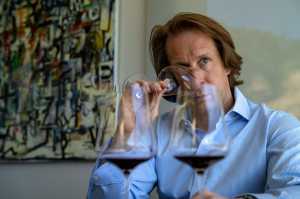
SM: What was the first wine you tasted which really caught your attention?
SB: It wasn’t so much a wine as it was a place – Barolo. In the aftermath of 9/11, I spent a fair amount of time overseas. Often Germany or Italy were a stopover point for personnel traveling between the US and Central Asia or the Middle East. After one of my deployments, I took some personal leave to visit Piedmont which was only a few hours drive from Aviano Air Base.
I remember checking into a small B&B in La Morra and going to visit a few producers. I certainly didn’t have context then for the great wines of the region but I was struck by the sense of place – how and why the wines tasted different in La Morra versus Serralunga, for example.
I was drawn to the rolling hills, the fog, trying to understand the intricacies of the place. The irony to me today is that I can see some similar influences and sensibilities between Barolo and the Napa Valley.
SM: When did you decide ‘I want to make wine’?
SB: By the time I left the military, I knew I was passionate about wine but I wasn’t sure exactly where or how to get started in the industry. I decided to first pursue business school as a way to learn some new skills and it would give me time to figure out what to do next.
It just so happened that my first week on campus there was a wine tasting being hosted by Jack Cakebread of Cakebread Cellars in Napa Valley. After the tasting, I spent a few minutes talking with Jack and we exchanged contact information. I had no idea then just how influential that encounter would turn out to be.
Jack and I stayed in touch; I ended up doing an internship at Cakebread while at business school. Jack became a mentor to me and helped shape my passion and curiosity for wine and for the business of wine. By the time I graduated, I knew I was moving to Napa Valley to find a job.
By the time I graduated, I knew I was moving to Napa Valley to find a job.
SM: Where and when was the first wine you ever worked on?
SB: When I moved to Napa, I started off working for a boutique advisory firm that handled mergers and acquisitions in wine. I met the two gentlemen who started the business, Vic Motto and Mike Fisher, through Jack Cakebread. I somehow convinced Vic and Mike to let me do all the grunt work.
Mike graduated from UC Davis with a winemaking degree in the late 1970s and later decided to go into finance instead. But he still liked to produce his own garage wine from time to time. So I would work with Mike during the day on spreadsheets and numbers, and then at night and on the weekends we made some ‘home brew’ together.
We made a 2008 Cabernet that turned out to be decent, but it was the act of working with my hands, learning by doing that was so captivating to me. I didn’t want to be an advisor, I knew I wanted to be an operator.
After working for Vic and Mike for a couple of years, I left to go work for Bill Harlan, whom I also met through Jack Cakebread. Bill was just starting to put the pieces together for the project that would ultimately become Promontory. It was an incredible experience learning from Bill, working with the Harlan Estate team to understand and shape the land, design and build a winery from scratch, watch the vision and identity of a project come together.
It was incredible, but I also knew it wasn’t mine and I would never feel a sense of ownership over the project.

Realm Cellars' Moonracer Estate
SM: Realm was on the brink of collapse when you acquired it in 2012. What convinced you to take the leap?
SB: After working for Bill for a few years, I realised I had these entrepreneurial leanings of my own. I wanted to go start something, build something. I knew the two guys who had started Realm and I invited them to lunch to learn about how they had started their business.
At the time, Realm was a virtual winery meaning there were no assets, no land, no winery – everything was rented. But I thought the wines were pretty good and the brand was starting to develop a following.
From the outside, things seemed solid. But after talking to the guys during lunch, I realised Realm was essentially bankrupt. The two founders weren’t really talking with one another, there were lots of unpaid liabilities stacking up, they were about to lose their Beckstoffer To Kalon grape contract. And that’s when the idea hit me that maybe instead of me starting from scratch, I could buy the Realm business (assume the liabilities) and essentially try to turn it around.
If I started from scratch, I couldn’t just immediately access To Kalon fruit – there was a waiting list of buyers – so I knew that was pretty special. Realm had wines in barrels already so that would give me a head start.
What convinced me to take the leap? Probably too much confidence and a little naivete. The turnaround was way harder than I imagined, and the liabilities were much greater than the sellers disclosed - but at least I had my hands on a business that I could try to shape in the years to come.
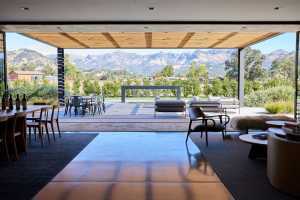
Realm Cellars' North Tasting Room
SM: You now farm in Stags Leap, Pritchard Hill and Coombsville – what unique character does each site bring to the glass?
SB: When we started, we didn’t own any land. As the business started to improve and become more financially solid, I knew the next move would be to acquire land. If you want to produce wines at the highest level, you need to own the land and farm it yourself. There’s just way more attention to detail when it’s yours compared to buying fruit or renting space in someone else’s winery.
We now have three estates that make up the Realm portfolio, and I think each one brings something different. The Realm Farella Estate in Coombsville is the coolest climate of our three sites, and the wines express some savory, earthy elements along with more pronounced tannins. The wines from Coombsville are more classic.
At Realm Moonracer Estate in the Stags Leap District, I find a lot of complexity and depth in the wines. A balance of red fruits and forest floor notes, the wines can be a bit more linear with great focus and length. I think the layers in this wine come from the diversity of the site – the vineyard blocks all have different elevations, soil types, aspects. Moonracer is very complex.
At Realm Houyi Estate on Pritchard Hill, it’s all about the higher elevation (1,300 ft) and the dense, volcanic rocks that are just below the surface. The Houyi vineyard faces mostly south so it’s a warm site and the resulting wines have lots of richness to them. Yet there’s also an interesting floral note to Houyi, so it’s a balance between richness and freshness.
Three very different sites that hopefully yield three different wines, different expressions of the diversity and greatness of Napa Valley.
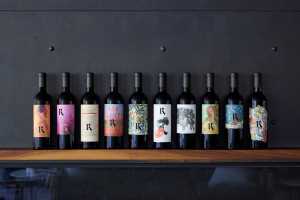
SM: Realm is fast becoming one of Napa’s most coveted wineries. What do you think drives its collectability beyond just scarcity?
SB: I hope the collectability ultimately comes from a belief in the quality of the wines, the integrity of the brand, and the longevity of our enterprise. To be relevant in today’s market, the wines need to be somewhat approachable in their youth but the ultimate measure of greatness is how these wines will evolve over time. I believe the wines we are making today will continue improving for decades.
We think of Realm as a journey, and I’d like to think our customers and collectors feel like they are part of that journey with us. Thirteen years ago, we were a struggling startup trying to make payroll. Today we farm three estates, 75 acres of vineyards and produce 15,000 cases of wine to share with customers around the world.
It’s been a remarkable journey, and yet I still believe our best days and our best wines are in front of us. We aspire for Realm to become one of the iconic wines of Napa Valley’s next generation, and it may well take me the rest of my life to try to realise that vision.
I hope the person collecting our wines today feels like Realm represents the epitome of both craft and culture – it’s the collective effort of a team to transform the best of nature into the best of humanity, and to share that with people around the world.
SM: What’s the most important lesson you’ve learnt in your career?
SB: “You're never as good as everyone tells you when you win, and you're never as bad as they say when you lose.” That was a quote from Lou Holtz, the coach of the Notre Dame football program back in the late 1980s and early 1990s.
Entrepreneurship is a roller-coaster so it’s important to somehow balance out the highs and lows. Frankly, winegrowing is like that too because nature is always challenging us.
Being able to keep your head, stay focused on the long-term, building resilience - those have been key elements of the Realm journey.
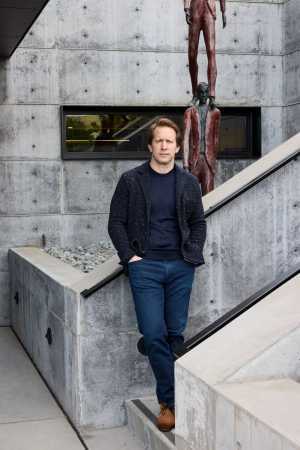
SM: What’s been one of your best memories from your career?
SB: So many sensational wines, meeting many inspiring people, earning our first 100-point score, closing on the purchase of our first estate - all those moments rank high in my book. But honestly, the very best memories come from seeing the impact we can have on others.
Watching our first employee, Eden Foley, who is still with me after 13 years, grow into a seasoned professional, supporting our vineyard and cellar crew who immigrated from Mexico or Guatemala – seeing them learn English and build a life for themselves and their families in winegrowing, hearing from customers who enjoyed a bottle of Realm to celebrate some of the greatest moments in their lives – that stuff is incredibly humbling and grounding.
I can’t emphasise it enough, just how gratifying it is to feel like my life’s work can be a force for good in others.
SM: If you could swap vineyards with any other region in the world for one harvest, where would it be?
SB: My wife would love for me to say Champagne because she loves to drink it so much! She would probably want me to be even more specific, in which case she would say Clos de Mesnil.
I share her passion for bubbles but I also think Cabernet runs through my veins. Bordeaux remains the most important wine region in the world and, despite current market headwinds, I think it remains one of the most intriguing regions as well.
I’m drawn to the limestone plateau in Saint-Emilion, so that’s probably where I would go. Who knows, maybe one day it will happen!
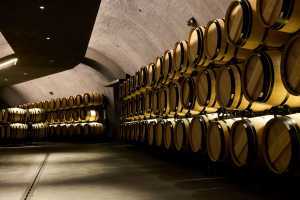
Realm Cellars' Houyi barrel room
SM: Who is your winemaking hero?
SB: So many examples in Napa Valley. Jack Cakebread, Joe Phelps, Jim Barrett were such pioneers in the 1970s. I’m honored to consider Bart Araujo a mentor – he was an incredible steward of the Eisele Vineyard, one of the first to introduce more sustainable and then biodynamic practices in the vineyard.
I wish I had the terroir instincts of David Abreu – he just intuitively senses which sites have great potential and which do not. I often talk about how Realm stands on the shoulders of giants. We wouldn’t be where we are today without the types of individuals I mention here.
SM: When you’re not drinking your own wines, what do you reach for – guilty pleasures included?
SB: Champagne of course – my wife loves it and it’s a palate refresher after tasting through young barrel samples of Cabernet! Lots of white Burgundy. Bordeaux for reference and context. Always hunting for 1970s Napa wines, many of which are still alive and well today.
SM: What’s the single best wine you’ve ever tasted?
SB: Impossible to articulate “the best” so instead I’ll share a couple special wines. Tasting 1975 Dom Perignon Oenotheque at the abbey of Hautvillers with Richard Geoffroy was incredible. The wine itself was so alive, such concentration… but the setting and the context with Richard made it special.
Closer to home, I feel lucky to have tasted a few of the iconic wines that defined Napa Valley’s early years – 1969 Chappellet, 1974 Heitz Martha’s Vineyard, 1978 Phelps Eisele - these wines stand out not only for their longevity, but their distinct sense of place.
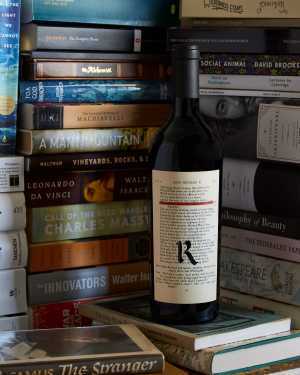
Realm Cellars The Bard
SM: What’s next for Realm – and for Napa – in an era of climate change, shifting palates and global demand?
SB: The irony of today’s Napa Valley is the wine market has never been softer and yet the wines themselves have never been better. I truly believe we are living in a new golden era for Napa Valley – there’s more diversity of styles, a real focus on sense of place, renewed emphasis on freshness and elegance. The collector has an incredible choice these days.
The criticism of pricing is fair and I expect we will see some sort of reset. There is still value if you know where and how to look.
Every winegrower loses sleep about a changing climate, but we also have more tools at our disposal to mitigate the extremes of nature. The 2020 vintage was a disaster but that’s behind us and most cellars are now full with some incredible vintages coming out in the next few years.
For Realm, the last decade was about transformation, whereas the next decade will be about refinement. We will continue refining our craft, really focusing on culture, to continue elevating both the quality of our wines and the longevity of our enterprise.
See more at realmcellars.com. Realm Cellars is available in the UK via flintwines.com.