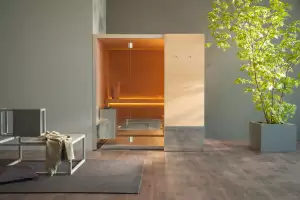
It may only be March, but it still feels like the longest year in history. So it’s time for a reset. You need something meaningful and long term that truly benefits mind, body and soul. You need a sauna.
Part of a deeply ingrained culture in the Nordic countries and Baltic states, sauna rituals are observed with near-religious devotion. These are places of routine, reverence and relaxation – so central to daily life that you could almost argue for their protected status in Finland alone. And over here in Britain, the sauna is no longer a passing wellness trend, either. Its appeal is fast broadening, its benefits better understood, and its place in modern life starting to take a more permanent shape.
The capital already has an array of these joyful pockets of heat and rejuvenation: most of the decent hotels across London are equipped with saunas and steam rooms and – not to sound like an insufferable elitist – if you haven’t been to the floating sauna on Regent’s Canal you’ve been seriously missing out.
So, let’s get down to it – how realistic is it to introduce a sauna into your own space? It might feel overwhelming at first, but the short answer on reflection is very…
Carve out some room
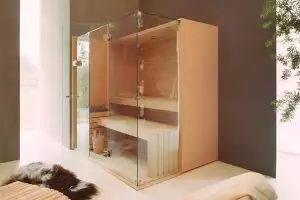
SMALL YET MIGHTY: Even modest footprints can accommodate a modern sauna.
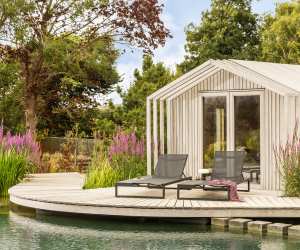
Space will always be at a premium in the city, it’s the nature of London life and high up the list of primary property concerns for most. Handily, a sauna can still become a seamless addition – at least, according to the design team at renowned maker Effe: “Contemporary saunas no longer require dedicated rooms. They can be seamlessly integrated into existing bathrooms, bedrooms, attics and basements, even the most compact areas, allowing the sauna to become a natural extension of the living space.” With sleek standalone designs that offer a modest footprint, the sauna doesn’t feel like such a huge commitment of precious floor space and can be tied into a gym or bathroom scheme. And of course, don’t dismiss an outdoor addition.
One of the UK’s most respected authorities on saunas – Jake Newport, CEO at Finnmark Sauna – explains the importance of the sense of flow and movement when positioning the sauna: “When we design a sauna for a home, we start by thinking about how it will fit into everyday life. A well-placed sauna feels natural to use and easy to return to. The layout matters more than people realise. You want a clear flow from heat to cool, with space nearby to shower, change or simply pause. When that movement feels calm, the whole experience feels balanced.”
This choreography of use – step in, warm up, cool down, rest – is what separates an exceptional experience from a sauna that’s rarely switched on. As demand grows, designers are responding in kind. Saunas are now treated with the same architectural sensitivity as kitchens or bathrooms, integrated seamlessly rather than added as an afterthought.
Should-a, wood-a
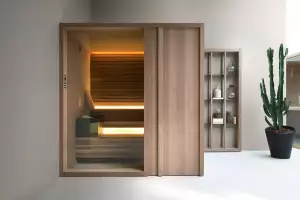
SIMPLY GLOWING: muted timber tones and indirect lighting can completely change the feel of your at-home sauna.
Think sauna and the mind instantly recalls a blond timber box inside a ski chalet, but the good news is there are so many more options for aligning the materials and design with your home than ever before, as Newport elaborates: “The materials shape how a sauna feels before the heat even starts to build. Calm timbers such as aspen or thermo-alder create an even, gentle warmth and a naturally light finish. Stone or tiled detailing adds contrast and a sense of permanence, while minimal trims and concealed fixings help to keep the look clean so the focus stays on the character and layout of the wood.”
“Glass doors can completely change the experience. They draw in light, make smaller spaces feel open and turn the heat into something welcoming rather than enclosed.” Paired with soft, adjustable lighting (do keep it indirect, nobody likes the ‘big light’ for a reason) in warm tones to create a harmonious scheme that you’ll be racing home to enjoy.
Branch out
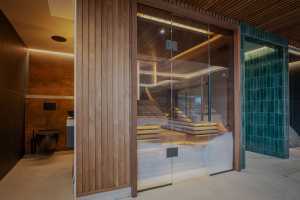
TURNING UP THE HEAT: A well-placed sauna feels integrated in both placement and materials palette.
The finishing touches shouldn’t be skipped: you’re investing in something spectacular for your health so an all-in approach helps when it comes to the senses. An integrated sound system for soundscapes as well as scent diffusion so that sessions can be adapted to suit day, mood or energy can make all the difference.
Add a well-designed ladle and bucket, some massage stones, along with handmade birch whisks and you’ll be a devoted follower. And as Newport says, “These details create environments that feel genuinely restorative rather than purely decorative.”
In 2026, luxury is no longer about having more, but about needing less and making it better. A home sauna offers both: a stripped-back space where warmth, stillness and intention quietly do the work.
Find out more at effe.it and finnmarksauna.com