As spring gathers momentum in the capital, do yourself a favour: step out of Kensington High Street Station and turn right. A short walk leads to Japan House, where some of the most refined but accessible expressions of Japanese art, craft and cuisine currently reside in London.
Continue to the measured perfection of Kyoto Garden in Holland Park – a gift from the city of Kyoto in 1991 – and you encounter something rarer still in our restless metropolis: calibrated calm and some friendly wildlife. Nearby streets (try Chepstow Villas, Ladbroke Road, and Gloucester Road) briefly dissolve into blossom each spring, their cherry trees another gesture of cultural exchange.
You may not reach Kyoto for sakura season this year, but a fragment of its atmosphere is already here to inspire, folded discreetly into the city’s fabric for those who know where to look.
That sensation – of disciplined precision enmeshed within urban intensity – offers an apt prelude to understanding why Japanese design continues to resonate so powerfully in contemporary interiors, and why I’m such an enormous fan.
When Western design culture blithely equates luxury with accumulation and decoration (guilty, as charged), the Japanese tradition proposes a subtler metric: coherence, proportion and emotional clarity.
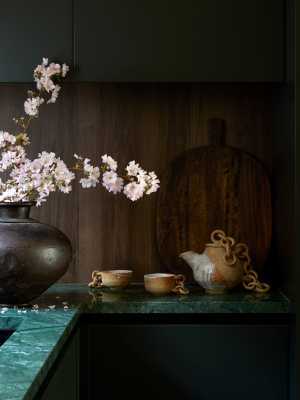
Sakura season is a fitting time to look to Japan for design inspiration.
Anna Stathaki
The comparison is almost scientific in its elegance: don’t embellish, but reveal the structures already present. Japanese interiors operate similarly. They don’t impose calm; they uncover the conditions in which calm naturally occurs.
Modern Japanese interior design is defined less by what it includes than by what it permits to remain absent, as evidenced by so many contemporary Japanese creatives.
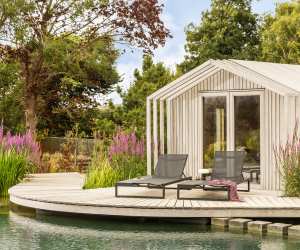
Yoko Kloeden is one such Japanese designer turning London homes into sanctuaries: “It prioritises restraint and depth over decoration. It’s built on principles like ma (meaningful space), hikari (designing with natural light), nagame (framing views), and shizen (honest, natural materials).
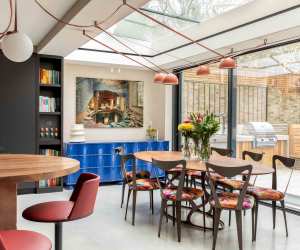
“In London homes, this means clean architectural lines, natural oak or stone, floor-to-ceiling glazing connecting to gardens, and careful restraint – investing in fewer, better things rather than filling every surface.”
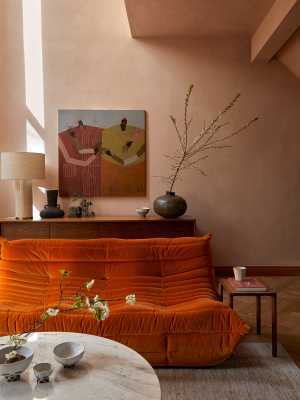
Yoko Kloeden’s designs invite us to take a breath and embrace a new season of hope with contemporary Japanese interior design.
Anna Stathaki
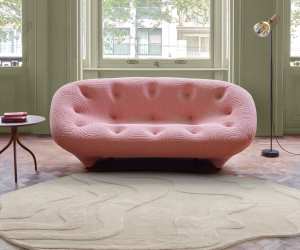
Translated for our Georgian, Victorian and Edwardian homes, these ideas feel unexpectedly practical. Period terraces benefit from spatial continuity and visual breathing space. Clean architectural lines replace ornamental excess.
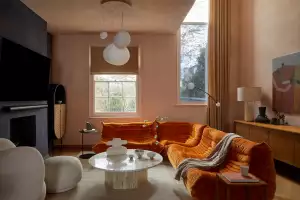
Kloeden also explains Japanese design’s enduring appeal to time-poor professionals seeking restoration at home: “It delivers what they need: calm. The Japanese concept of yūgen – subtle depth, beauty that’s felt rather than seen – creates spaces where you exhale when you walk through the door.
“It's also practical for London’s period properties and proves a sound investment. These aren’t trend-driven interiors that date – they're timeless environments built on centuries-old principles.”
It’s worth noting here that authentic Japanese interiors avoid the superficial and diluted hybridity often labelled ‘Japandi’ (no Swedish influence in this story, thank you very much) favouring instead earth-rooted tonalities and softened forms drawn from landscape and season.
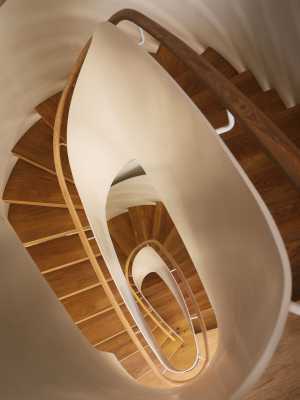
Anna Batchelor
Another designer in London taking cues from his cultural background is Charles Tashima – founder of Studio Tashima, based in Islington. He draws influence from his father’s “traditional Japanese” family as well as his mother’s German ancestry in a way he describes as “eclectic and responsive rather than stylistically fixed – creating a sense of comfort and atmosphere that arises from a simplicity that is not simple, but layered in complexity.”
“Natural materials used honestly,” he explains”. “A sensitivity to craft and care, acceptance of imperfection and ordered disorder, broken rhythms reflective of the natural world. Japanese architecture is in tune with the environment. I like to combine and contrast real materials.”
I’ve seen more spaces recently that reinforce this shift toward ‘grounded calm’. Rich slate and honed granite sitting with sleek steelwork, handmade ceramic tiles and fumed oak joinery to bring visual gravity, while ageing gracefully through touch and light.
Tashima agrees that “the ageing of materials, too, is embraced, celebrating imperfection, history, memory and use. It doesn’t matter where we are, in Japan or in England.”
“I’m equally charged by the experience of stepping on a worn stone step and onto the wooden porch of a Japanese garden pavilion as I am stepping onto a Moroccan cement tile or entry hall of an early Georgian home in North London.”

Studio Tashima uses woven brickwork – a nod to the existing architecture with cues from classic Japanese design.
Anna Batchelor
Across all these elements runs a unifying principle: choose materials that improve with time, though as Tashima notes, “importantly the materials do not need to be specifically Japanese. It’s about the essence of the material and what it communicates – how a piece of timber or stone relates to a coloured tile.” Like any good story, patina becomes the narrative rather than a definition of deterioration. Maintenance and use yield meaning and care rather than inconvenience, so our homes evolve alongside us.
What emerges from these exceptional design studios are projects attuned to longevity; emotional, environmental and aesthetic. Japanese interiors rarely aim to impress at first glance, as they’re not a showroom for taste, but a calibrated refuge aligned with human rhythm.
They bloom steadily and slowly, rewarding attention over years rather than moments. In a culture saturated with immediacy, such patience reads as a profound form of luxury.
Perhaps this is why its influence in London feels less like a trend than a tonic. Among traffic, density and perpetual motion, it presents palpable intervals of stillness. Like Kensington’s cherry blossom transforming an ordinary street, the effect is subtle yet unmistakable, offering us some hope as we shift towards brighter days.
Find out more at yokokloeden.com and studiotashima.com