
Try as hard as I might, it’s impossible to shake the cinematic theme when riding aboard the Orient Express. Everything before you seems to plunge you ever deeper into the protagonist role while the most famous train on Earth rumbles along at a pace of your own making. I can’t really stress just how immersive it is. There’s the costume changes into elegant evening attire, soundtrack from a live band, and a stellar cast of supporting actors whose role it would appear is to make you feel every bit the star of the silver screen that, for the duration of your journey at least, perhaps you are. It has the effect of making one feel rather important.
Before we embark, I feel under strict obligation to assure you that no murders took place on this particular Orient Express journey, nor did the stunningly appointed carriages of the new-for-2025 La Dolce Vita train arrive From Russia with Love, however if this is indeed the sequel to The Orient Express as we know it, there is no doubt that it’s just as box office as the original.
When Accor assumed full ownership of the Orient Express brand in 2022 (later joined by LVMH as a strategic partner in 2024), it set into motion a new direction of travel for the grande dame of locomotives. The 142-year-old icon is currently undergoing the fastest expansion in its storied history with the aim of creating a comprehensive luxury travel ecosystem that includes not only restored historic train services – such as the Orient Express La Dolce Vita we’ll be boarding shortly, as well as the recently announced Paris-to-Istanbul route launching in 2027 – but also luxury hotels in Rome and Venice, and the world's two largest sailing yachts set for introduction next year.
If this is indeed the sequel to The Orient Express as we know it, there is no doubt that it’s just as box office as the original
The Orient Express cinematic universe is growing at a rate of knots but the burning question, on my lips at least, was how could a newly designed train possibly capture the spirit of its Belgian entrepreneur Georges Nagelmackers? Following a visit to the United States in the late 1860s, the visionary creator of the Orient Express was enthralled by the sleeping cars of industrialist George Pullman and he dreamed of bringing this mode of long-distance transportation to Europe – only more refined and luxurious. By the time the Orient Express embarked on its maiden journey from Paris to Vienna on 5 June 1883, it’s safe to say that he and his Compagnie Internationale des Wagons-Lits had succeeded.
Travelling across Europe today is scarcely recognisable from that golden age of transportation. Budget airlines rule the skies, innumerable cars clog the roads, and high-speed trains are an inefficient hassle (I shan’t mention our own British rail network). Yet the Orient Express persists as a name synonymous with luxury, intrigue, and romance in European rail travel.
La Dolce Vita Orient Express, Italy’s first luxury train created in collaboration with the Arsenale Group, takes this concept and shapes it into a love letter to Italian culture and heritage. Traversing 14 regions, across eight exclusive itineraries and a grand total of 600 annual trips, the route takes in many of the nation’s most prized assets: whether that’s the canals of Venice, Portofino’s awe-inspiring coves, or the famed vineyards of Montalcino. This is Italy reflected through the lens of 1960s-1970s glamour and paired with the quintessential hospitality of which the Orient Express is best known.
Mr Tripper
Mr Tripper
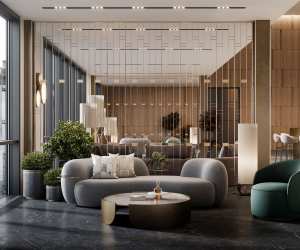
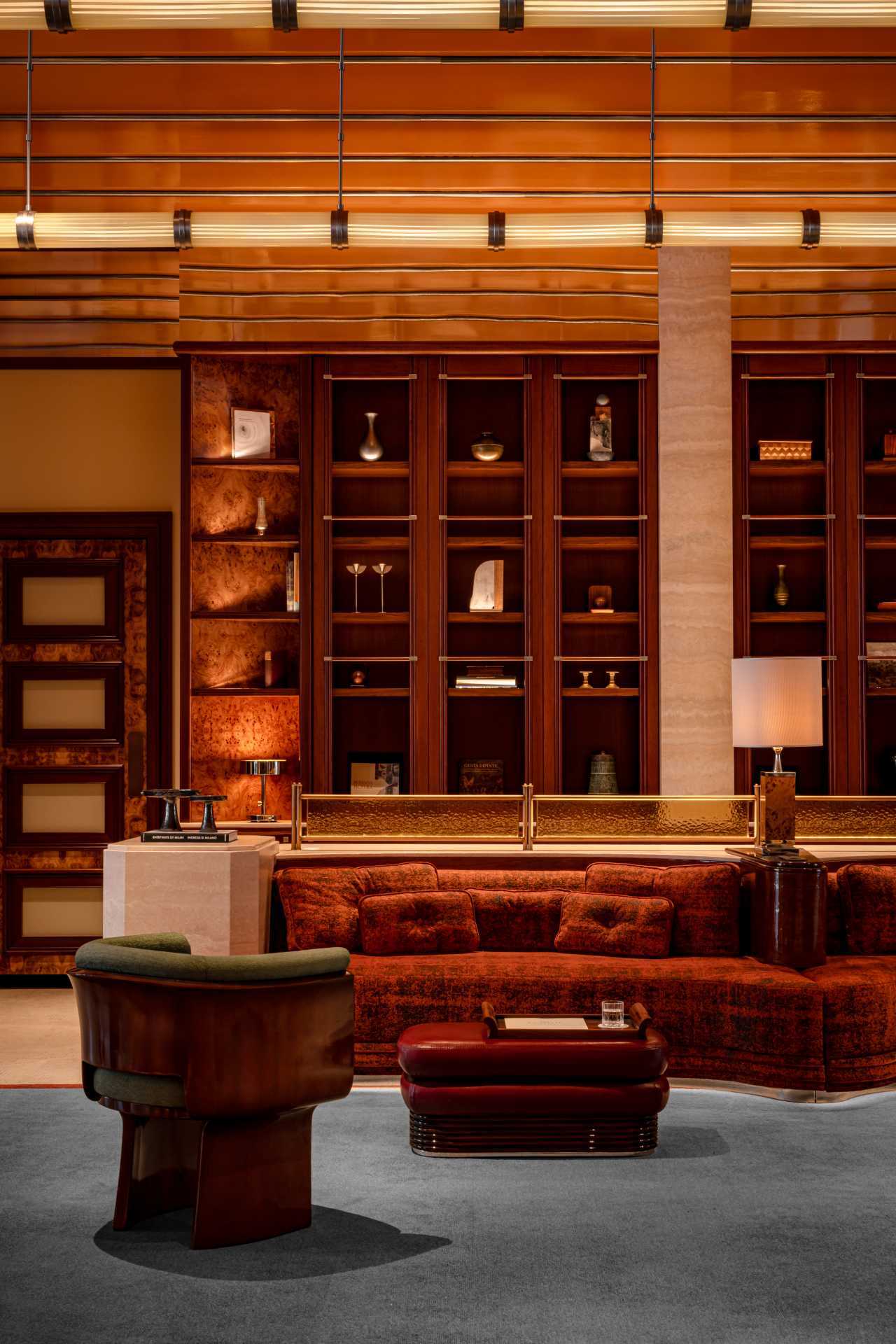
The opening scene, like any good movie, takes place in a grand room alive with activity. La Dolce Vita Lounge at Rome’s Ostiense Station was designed by French-Mexican architect and designer Hugo Toro who has deftly amalgamated 1960s Italian design into the historic space to create something that oozes sumptuous class out of every pore. Under a lacquered ceiling dressed with Murano-glass tubelights and silver fans reminiscent of old three-blade airplane propellers, train staff glide across the mosaic-tiled floor as guests chatter excitedly while sipping glasses of sparkling Franciacorta. There’s a pianist gently tinkering on the ivories, the grand piano’s glossy black surface the darkest shade in a room that features a melange of warm textiles, leather seating and varnished wood cabinetry. Somewhere woven into the fabric of it all is a crackling sense of anticipation that threatens to overwhelm the entire occasion. The whole thing conjures images of those foggy train station scenes from Noël Coward’s Brief Encounter and its star-crossed lovers. It wrenches you from the bustling metropolis of modern day Rome and suspends you in a time period far removed from our own. Gosh, is it a clever trick.
The old adage “It's not the destination, it's the journey” seems particularly appropriate for La Dolce Vita’s brand of opulent slow travel, but especially so when one considers that our start and end point should both be Rome. For the next three nights, we will meander through the train’s “Italian Swing” itinerary, a masterful combination of three of my favourite things: excellent cuisine, generous imbibement, and top-tier golf. It’s one of two golf-focused itineraries La Dolce Vita is hosting and, while it’s perhaps not a world first, it’s certainly one of the most unique experiences that any passionate enthusiast could wish to enjoy.
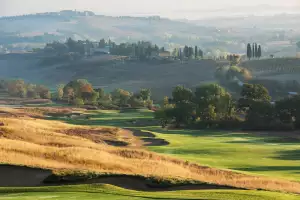
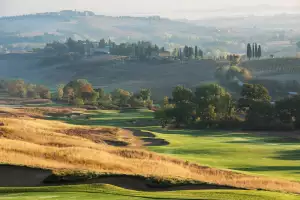
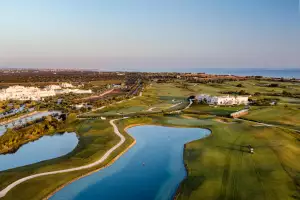
Italy is a perennially underrated golf destination in the pantheon of the global game, in spite of its successful hosting of the 2023 Ryder Cup at Marco Simone – our first stop of the itinerary. But La Dolce Vita delves beyond this well-publicised European Golf Design and Tom Fazio II layout to lesser-appreciated venues equally deserving of the attention of players everywhere. Puglia’s San Domenico course draws golfers in with its coastal location but its verdant agriculture leaves a lasting impression; The Club at Castiglion del Bosco shows off the spellbinding landscape of Tuscany in the shadow of Montalcino; while Argentario Golf & Wellness resort offers panoramic views of the Monte Argentario peninsula.
Aboard La Dolce Vita, golf is cunningly interlaced into a narrative that speaks proudly of its Italian heritage. I’ve written in the past about how golf has this wondrous ability to speak of a sense of place, a quality of existing in harmony with its surroundings rather than rebelling against nature (as some doth protest), but rarely have I been so certain of my assertions than in consuming four of Italy’s finest golf courses in one comprehensive gulp. If this is, indeed, a romantic movie, then golf herself is our leading lady.
Steve Carr
But there is more exposition required before we go any further. As we sidle from our seated position in the lounge to the platform, La Dolce Vita’s gleaming carriages loom into focus alongside an almost never-ending line of staff who stand abreast with beaming smiles and warm ‘buonaseras’. It takes a village to operate a train service of this magnitude – at any one time there are approximately 35 team members working on board, including train manager, conductors, stewards, chefs, waiting staff, dishwashers, bartenders, technicians, musicians and performers – and almost all of them are here wishing you welcome.
And then there’s the train itself. Painstakingly fashioned by craftsmen over a period of four years and racking up approximately €280m in production costs, this is not only one of the largest undertakings of its kind, but the crown jewel in Italian railway engineering.
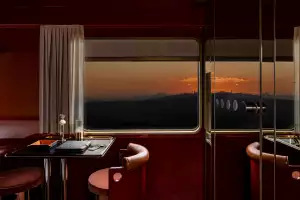
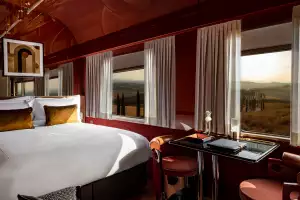
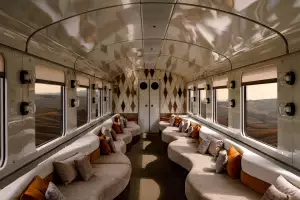
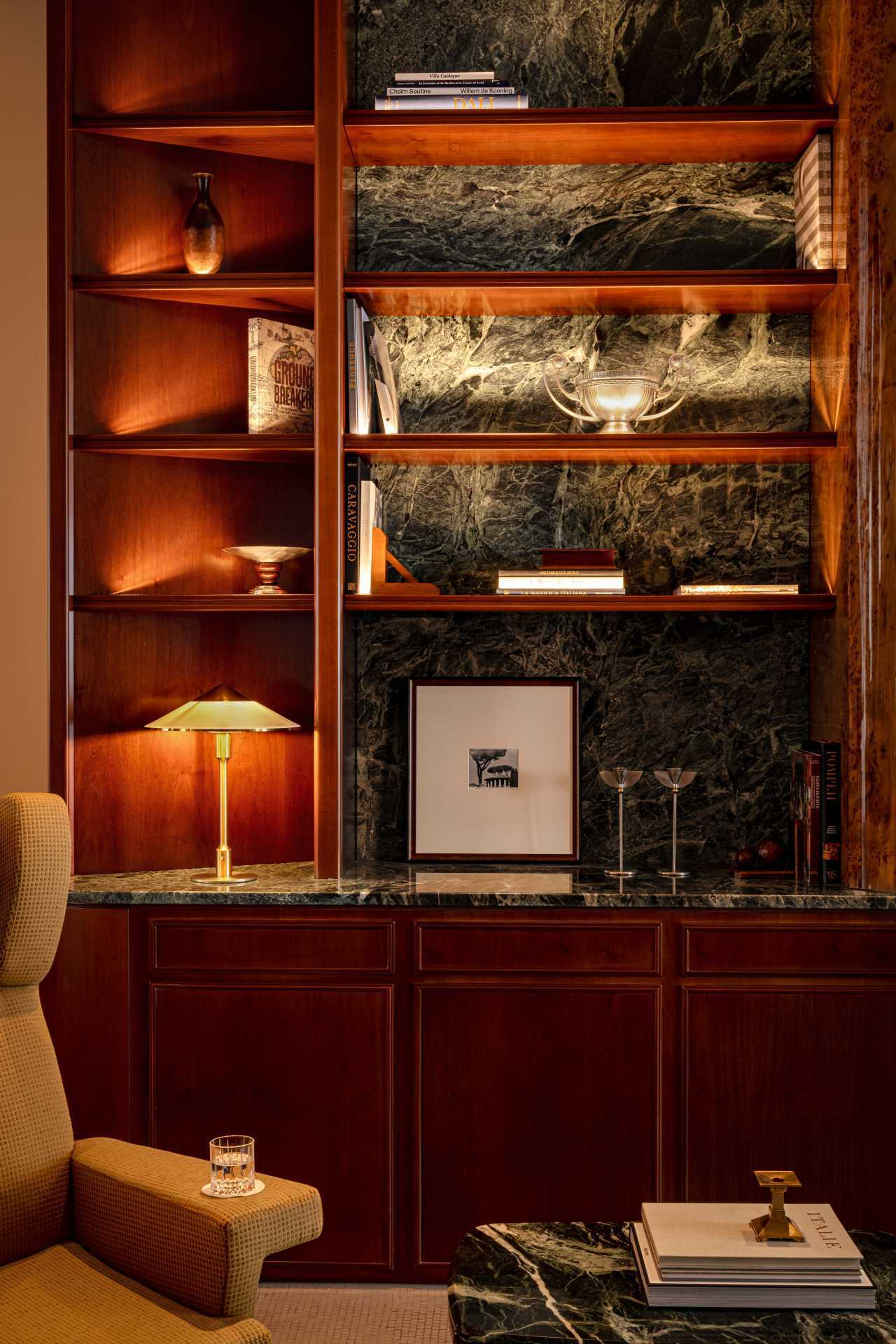
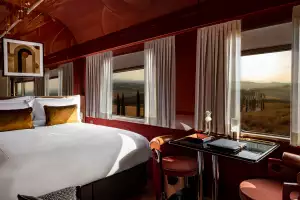
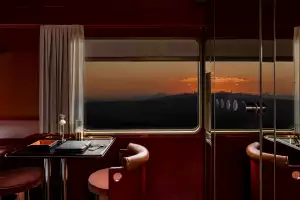
Goodness me, she’d stop you dead in your tracks. Dressed in a glossy midnight blue exterior featuring a burgundy trim and brass accents, La Dolce Vita’s 12 restored carriages (comprising 12 deluxe cabins, 18 suite cabins and one La Dolce Vita Suite), originally Z1 Italian models, underwent extensive restoration work carried out in Brindisi and Palermo to create this rolling palace. Designed by the Milan-based practice DimoreStudio – which drew inspiration from Italian design masters of the 1960s and 1970s including Gio Ponti, Gae Aulenti, Osvaldo Borsani, Carlo Scarpa, and Ignazio Gardella – each space on board seems to carry with it a purposeful retelling of 20th-century glamour through contemporary eyes. The colour palette and choice of materials have been carefully selected to conjure images of train carriage interiors from days gone by. It’s an elegant combination of walnut and lacquered wood, smoked glass and mirrors, suede-like Alcantara fabric, leather, marble and polished brass. In other words, it’s bold, architectural, sophisticated, and, quite frankly, gorgeous to look at.
This is not only one of the largest undertakings of its kind, but the crown jewel in Italian railway engineering
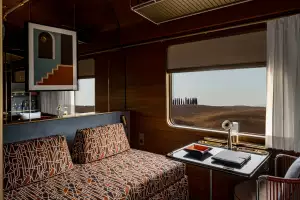
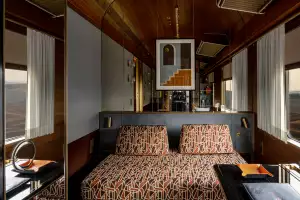
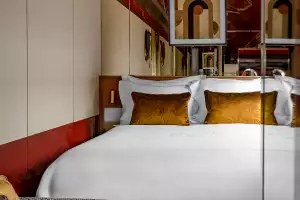
As we are greeted by our personal conductor at the steps to our carriage (think of them as your primary point of contact on board), I’m once again confronted with that unplaceable sense of nostalgia as we are shown to our suite cabin. For those who have not experienced luxury rail travel before, there is one recurring trend when it comes to their uncertainty: space. Encompassing 11 square metres, our suite cabin features a double bed complete with a pillowy soft mattress, sofa, armchairs and table, and a surprisingly large en-suite bathroom (by train standards, at least) that includes a marble-topped sink basin and a rainfall shower with excellent water pressure.
As for the question of storage, certainly a concern of mine as a first-time Orient Express traveller, the cabins are rather ingenious in their solutions. The sofa features a large pullout drawer more than sufficient for a few days’ worth of clothing, the chairs double as additional cubby holes perfect for hiding away shoes, two shallow wardrobes will fit a couple of suits and a coat, while the bed has ottoman storage ideal for stowing your unpacked carry-on bags. A walk-in wardrobe this ain’t, yet my wife and I found ample room for our golf gear (our clubs were stored in a separate carriage), evening attire and various other bits and pieces. If you’re imagining space for a Globe-Trotter trunk’s worth of clothing then perhaps manage your expectations, but otherwise you can make yourself right at home.
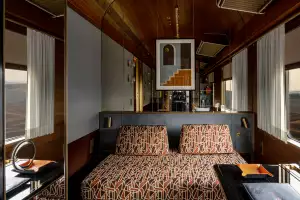
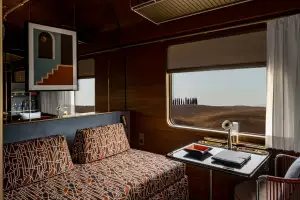
By the time we have freshened up and taken it all in, there’s a soft knock on the door and we are presented with a cordial invitation for dinner later that evening: aperitivos are served in the Wagon Bar before we’re to be seated in the Restaurant Carriage for a procession of fine dining dishes from the brilliant mind of three-Michelin-starred chef Heinz Beck. It’s the signature act in a theatrical experience played out in real time.
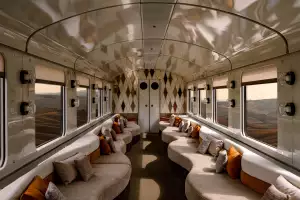
Negronis promptly fixed, we join our fellow passengers on the communal sofas and make polite conversation. It’s worth saying at this juncture that the social facet of your time aboard La Dolce Vita may not be for everyone. If you are a private individual or decisively not a people person at all (I sympathise…), I’d imagine that there are elements of this convivial environment you may find difficult at first. However, I would implore you to push on. There’s a rather joyous sense of community that develops over the ensuing journey and, though La Dolce Vita’s glamour is evident in the photography accompanying this piece, I can assure you that it is the people that bring these intricately designed spaces to life.
The Wagon Bar is unashamedly my favourite spot on board. The harlequin print wall, incorporating a playful palette of cream, blue, and orange tones, the sinuous form of the custom sofas, the fully stocked bar station (complete with vintage Faema E61 Legend coffee machine) goading you into one more for the road, and the baby grand piano – it’s a room that positively fizzes with raucous possibility. But more on that later.
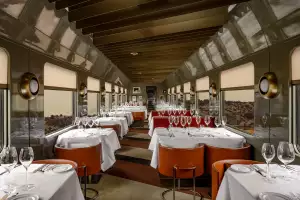
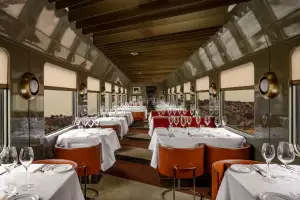
Heinz Beck’s involvement in La Dolce Vita is a statement of culinary intent and, oh boy, does it deliver. The chef’s flagship Rome restaurant, La Pergola, is renowned for its imaginative portrayal of Italian cuisine – deeply connected to seasonality and local ingredients, while elevating traditional peasant-style dishes to never-before-seen heights. Beck’s longtime collaborator Walter Canzio executes the menus perfectly in a remarkably compact galley kitchen, creating dishes that sing of the regions whizzing by our windowside seat. Menus change based on the market’s freshest produce, but expect a dizzying array of shellfish, pasta, Tuscan beef, and perhaps a little truffle if you time your visit accordingly. A simple dish of lobster, cooked to a perfect iridescent sheen, and served simply with variations of pumpkin rendered the entire carriage speechless for one brief moment.
The restaurant, quite pointedly different from the exuberance of the bar, is Mid-Century Modern in its style – allowing great food and conversation to take the lead over elaborate decoration. Service is effortless, the equal of numerous Michelin-starred institutions I have visited over the years, and yet disarmingly warm, a function of typical Italian hospitality that comfortably bests similar establishments in neighbouring European countries.
Mr Tripper
Mr Tripper
The wine flight, complimentary to all passengers, is a thing of great beauty. By design, it would appear that the sommelier has chosen each bottle based on the local wine region you’ll be situated within the following day; to get you in the mood, if you will. Our arrival into Tuscany was signalled by a 2023 vermentino from the acclaimed Grattamacco estate in Bolgheri, followed by a knock-your-socks-off 2022 Biondi-Santi Rosso di Montalcino. Not for the first time since arriving on board, I found myself leaning across to my wife conspiratorially and saying, “I could get used to this.”
I shan’t spoil the rest of the plot too much, but the subsequent few days blur into a seamless montage of snapshots that tumble into one another almost too swiftly to register their brilliance: playing the electric final third of Marco Simone as the sun hung low in the Roman sky, the golden glow reflecting off the water neighbouring the 18th green; waking up aboard the train, raising the blinds and seeing the Puglian coastline whizz past our cabin window; an extraordinary performance of ‘Volare (Nel Blu Dipinto Di Blu)’ with the tuxedo-adorned singer donning his finest Dean Martin impression as guests rose to their feet to dance; and The Club at Castiglion del Bosco offering passengers unheralded excellence whether the course, the facilities or the hospitality, each of which is every bit the measure of Europe’s finest private clubs.
I found myself leaning across to my wife conspiratorially and saying, “I could get used to this.”
Every phase of the journey is handled by a team of showrunners who operate the logistical side with such dexterity that you needn’t concern yourself with trivial matters like transfers, baggage, or dietary requirements. The image of the proverbial ‘swan above water’ comes to mind.
In the spirit of illustrating the levels of service I’m referring to, let me tell you a story from our second evening on La Dolce Vita. Picture the scene: we’re in the Bar Carriage in the waning hours, a few guests lounge in the communal seats discussing what to order as a nightcap before bed.
“What’s your go-to drink?” one of my companions enquires. I suggest that if my back’s against the wall, you can’t beat a good martini. “Ah, I thought your favourite cocktail was called a Back's Against the Wall – that’s a great name!” In that particular way that can only accompany moderate inebriation, what follows is a spirited discussion about cocktail names before someone suggests The Thomas Crown Affair would make for an appropriate tipple. The bartender, who had made his way over to our seated position hurried away only to return moments later carrying a tray of freshly stirred drinks. “This, gentlemen, is a Thomas Crown Affair,” he declared with a knowing smile. An on-the-spot riff on the classic Bamboo cocktail, incorporating sherry, pinot grigio, and a splash of calvados, it was a fitting end to a glamorous evening. No doubt Steve McQueen would have heartily approved.

Mr Tripper
There’s a lovely passage in Tim Parks’s Italian Ways: On and Off the Rails from Milan to Palermo where he talks about the charm of a great station: “The train station is the ideal scenario for greetings and farewells. The car is too banal. What does it mean to set off in a car? Nothing. The airport is too exhausting and impersonal, the plane itself remote, unseen, the barriers and security disturbing. Here the powerful beast of the locomotive thrusts its nose under the great arch of the station.”
As we reluctantly disembark from La Dolce Vita Orient Express one final time, I can’t help but share in his wonderment. The golden age of travel may have long departed, but here a chink of light shines down on the tracks. This is luxury at its most cinematographic, a grand sprawling narrative whose white-hot passion for Italy spills out at the seams.
Federico Fellini’s famous 1960 film La Dolce Vita shoulders a more complex, at times ironic, understanding of the pursuit of pleasure, but on board the Orient Express’s latest train, life is very sweet indeed.
Prices for La Dolce Vita "Italian Swing" itinerary start at €12,360 per passenger (not including green fees) with the next departure scheduled for March 2026. For more information, see orient-express.com
Orient Express La Minerva
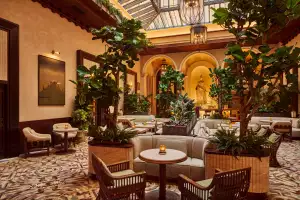
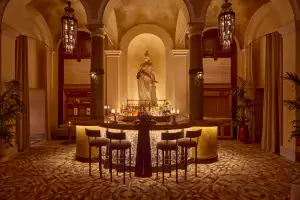
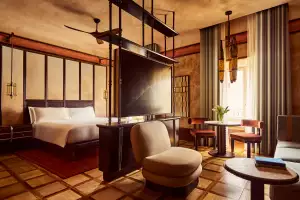
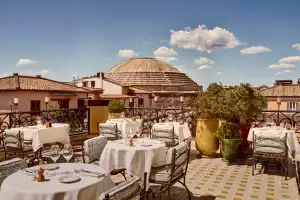
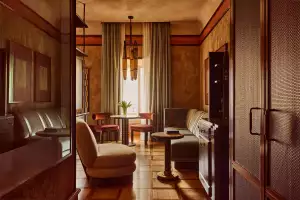
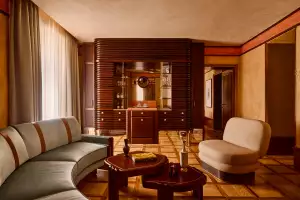
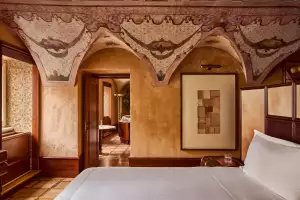
As post-credit scenes go, you would be hard pressed to match the instant allure of Orient Express La Minerva. The first ever hotel in the brand’s portfolio demanded the same attention to detail and lavish hospitality as its railway offerings, and on this count it has delivered.
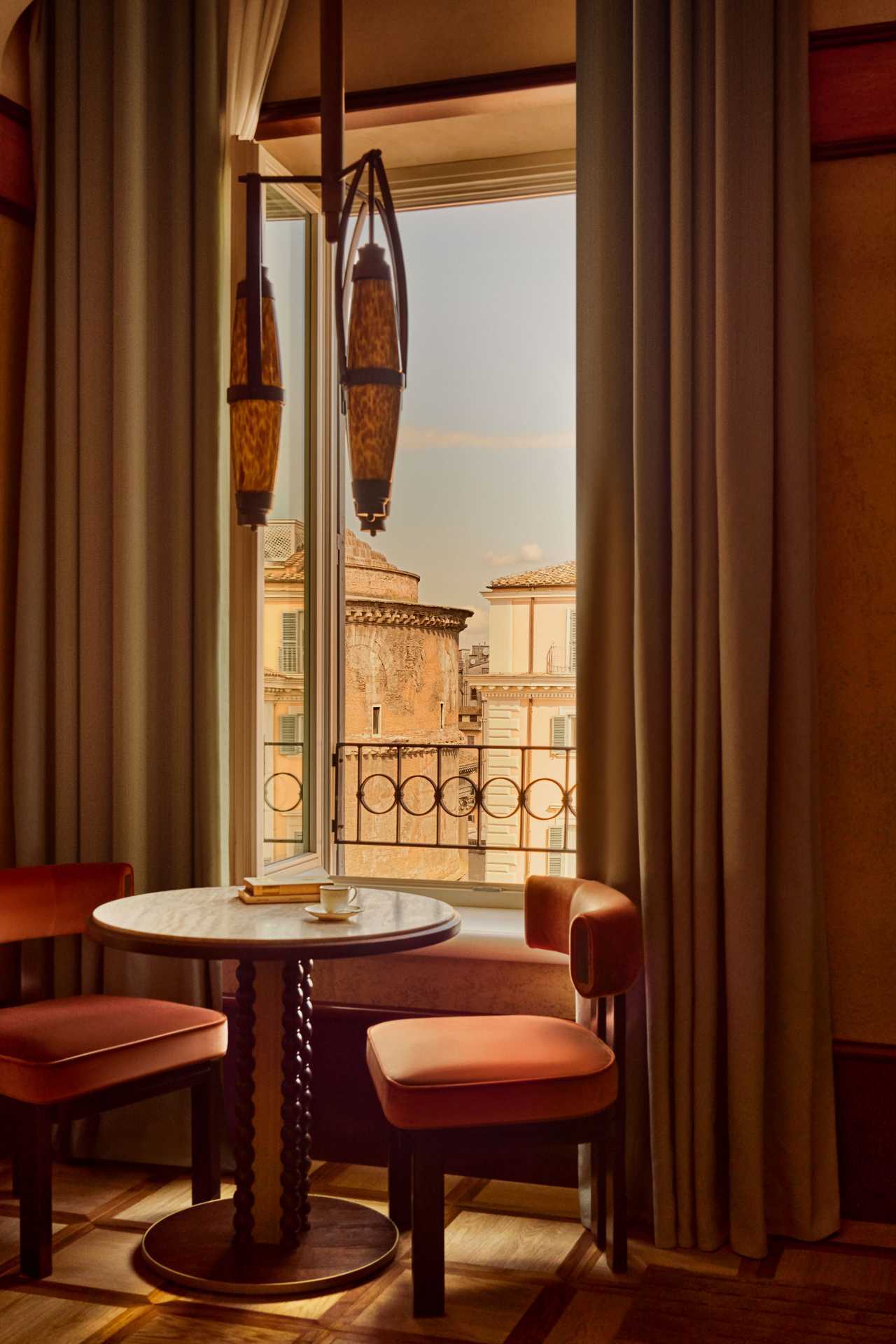
Designer Hugo Toro, the very same who created the stylish opening gambit for La Dolce Vita’s lounge, has poured his ingenuity into the former site of a 17th-century palazzo on Piazza della Minerva, within touching distance of the Pantheon. This is Toro’s first hotel commission and he has treated the undertaking with the same level of forensic attention that has garnered him a lofty reputation in the private residential sector.
Born on the French-German border to a Mexican mother and French father, Toro’s mixed heritage seems to have gifted him a unique ability to tell stories through the mediums of art and design. For La Minerva, he was tasked with blending the building’s heritage with a distinct edge of Art Deco elegance – blurring the lines between its Roman home and the Orient Express’s typical design language.
Stepping foot through its stepped entrance is every bit as immersive as boarding the train itself. Feeling decisively glum about leaving La Dolce Vita behind us, we gawped open-mouthed at the beauty we discovered walking through La Minerva’s hallway and into the central lobby-bar. There are original Murano glass chandeliers and a marble statue of Minerva by 19th-century Italian sculptor Rinaldo Rinaldi – artefacts from the hotel’s former life – rugs and wood flooring echo the Pantheon's geometric ceiling patterns, while a custom-designed facade, drawn by Toro himself, lines the bar. It’s a beautiful integration of multiple eras of design and culture handled with kid gloves.
Almost everything you set your eyes upon has been created bespoke for the new hotel design. The furniture was crafted by Italian artisans, including bedside tables shaped like travel trunks and hand-painted headboards in rose-hued tones recalling the shifting light of the Eternal City. There’s hand-painted bedroom ceilings, custom-designed fabrics, and an expertly curated selection of artwork dotted around the hotel’s walls that mirrors the eclectic tastes of its interior designer.
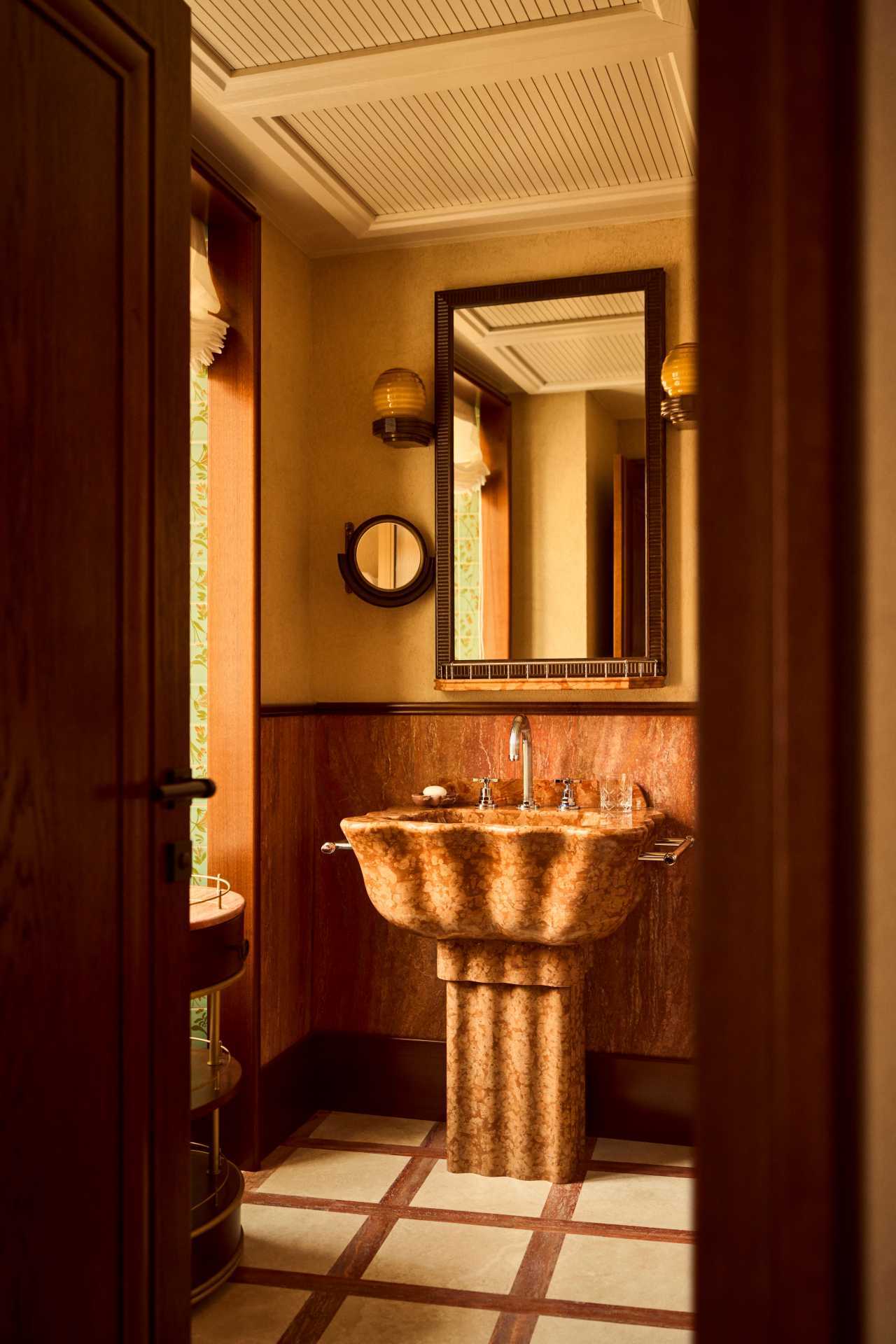
Alexandre Tabaste
Alexandre Tabaste
Our deluxe room continued this dream sequence as we were shepherded into a space that echoed the intimacy of the luxury sleeper train we had just departed from – but with the welcome addition of more space. There’s something distinctly Roman about the rich palette of textures, materials and colours that Toro has used, and I found myself in awe of its cosetting warmth.
One final bite of Italy awaited us on the hotel’s rooftop restaurant, Gigi Rigolatto Roma, which takes full advantage of its location next to the Pantheon and offers staggering views of the iconic rotunda, beautifully illuminated as it is of an evening, without the trivial concerns of the tourist crowds.
Without a hint of hyperbole, La Minerva is one of the most beautifully designed hotels I have ever visited on my travels. To me, it fuses the Art Deco grandeur of Claridge’s with a heartfelt Roman sensibility. Blessed with a frankly obscene location and sympathetically restored by a razor-sharp designer, it is an enchanting opening salvo for the new-look Orient Express portfolio. The iconic brand is on its own journey at the moment, but on the basis of my personal experience, it is most certainly on the right track.
For more information on La Minerva, see orient-express.com