“To know one thousand things, know one well” is a quote I often remember, although I don’t know who said it. OK, I actually do know. I didn’t want to say anything, because it was a samurai, which makes me feel pretentious about dropping it like this. Sometimes I play dumb to be more likeable – it’s a powerful technique.
When I want to tell my friends something smart I thought of, I’ll lie to them and say I heard it on a podcast. Instead of rolling their eyes they say, “Wow, that’s really clever,” giving me a compliment by proxy. I think this works because no one hates you more than your friends.
Anyway, I think what this quote means is that becoming good at something is a great way to experience the world. Growing up, I actively searched for this “something” which I could dedicate my time to.
I ended up having 16 different jobs until I finally did my first open-mic and thought: ‘OK, I like this more than selling car engine oil, baking pizzas, serving food, painting houses, making coffee, managing logistics or renting mountaineering equipment.’ It's honestly quite exhausting to think in such long, informative sentences, but I’m glad I did, because now I have something to quote.
DISCOVERING STAND-UP
The curse of being born in a small town in Eastern Europe is that, growing up, you’re exposed to, like, four things. If you’re not interested in playing piano, basketball or doing old-school theatre, there’s not much else for you to choose from. It makes me anxious to think you could be talented at something you never get to try. I remember failing an exam at school and joking with my friends saying, “What if I’m really good at riding elephants - but no one tests us for that?” In retrospect, what a creative way to think yourself out of studying maths.
But what I’m saying is that up until I was 23 years old, I didn’t know stand-up comedy even existed. Discovering it was like learning about a new chemical element with the difference being that I don't really care for elements or chemistry.
I did care for stand-up, so I pursued it. I was working as a manual labourer at the time and had a one-time job assembling the stage for some artists who turned out to be stand-up comedians. They made it look easy, and here we are. I keep thinking what my life would look like if the stage we built ended up being for a show of elephant riders.
Lila Cobryn
MOVING TO LONDON
I think that everyone who's pursuing a goal ends up having to make a choice one day: comfort or growth. Mine came with this thought: ‘Doing comedy in Lithuania is going well and you’re comfortable here, but if you don’t move to an English-speaking market you will never find out how good at stand-up you can become.’
Another convoluted long thought I’m glad I remembered. (I’ve read somewhere that some people think in images. That must be horrible if you like quoting yourself.) Anyway, I moved to London about four years ago and it’s the best decision I’ve ever made – and one I regret every day.
The first few years in the new scene were really challenging, which in itself turned out to be a blessing. I realised I identified with my career to a point where my happiness was completely correlating with my success.
If you asked me: “How are you?” my brain would rephrase the question into: “How is stand-up going?” At one point I was miserable for long enough to become aware of what was happening and fought myself really hard to change this thinking pattern. I’m happy to say that as of right now I am as stressed and unhappy as a regular person living in London, which is a big improvement for me.
GOING FULL-TIME
I like money. You can use it to buy stuff, but I also like it, because it puts a numerical value on your skill. Getting paid for something you spent years learning is the ultimate external validation.
When you start out, no one believes in you except you. Going full-time felt like someone else finally looked at me and said: ‘This has worth.’ I think it actually changes the way you perceive yourself and gives you confidence that makes your art better as you carry yourself differently, both onstage and offstage.
Don’t get me wrong: it’s great to do something for the sake of it and that should always be a psychological priority, but at one point, start giving me money please.
BECOMING A DECENT STAND-UP
I feel like no matter what kind of craft you’re trying to master, the true joy of doing it is unlocked only after you learn the basics and can break the rules you just learnt.
The first six years of doing stand-up for me were just going on stage and saying things that got laughs. If it’s funny, anything goes, there was no consistency to my style, no distinct voice (never puns though, you have to have some limits).
Only in the last few years did I finally become skilled enough to ask myself: ‘What do I actually wanna talk about?’ and then turn that answer into something funny.
For the first time in my career, I will come up with a funny joke and then won’t say it on stage, because it is not ‘me’. I still have no idea who this ‘me’ is, but I am much better at knowing who it isn’t.
I remember starting out in comedy and thinking the above doesn’t apply to me – that I can skip learning and go straight to expressing myself. I feel guilt thinking about the audiences that had to endure that. People walking around five years later, cringing to the memory of me dissecting communism at a poorly attended open-mic.
The reality is that if you wanna do a backflip on an elephant’s back, you have to learn how to ride it first.
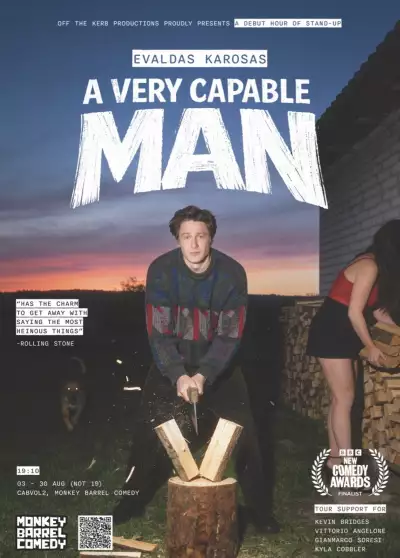
Evaldas Karosas will debut at the Edinburgh Fringe this summer with his show 'A Very Capable Man'. Tickets available now.