Let’s start with the tent. We’ll get to the other stuff – the jousting, the romance, the prince, the poet, Queen, Bowie, weighed, measured, change your stars – but to appreciate what makes A Knight’s Tale work, we should first consider the tent.
So lady-in-waiting Christiana has arrived unexpectedly at camp to discover what colour tunic Sir Ulrich von Liechtenstein will be wearing to the evening’s ball. This is important information: Christiana’s boss, the beautiful noblewoman Jocelyn, wishes to ensure her outfit matches Sir Ulrich’s. It’s date night!
Except of course Sir Ulrich is actually a peasant named William. He has no tunic, nor the slightest conception of what such a garment should look like. So he throws the question over to his friend Roland, posing as his squire. “Squire, answer her! What, er, colour is my tunic tonight?”
An expectant Christiana awaits the answer.
“Green,” says Roland thoughtfully. “Trimmed in a kind of pale green… With wooden toggles.”
Which happens to be the exact colouring of the tent behind Christiana.
A Knight’s Tale belongs to that rare collection of films that can reasonably be described as unimprovable
It’s a brilliant throwaway gag that also works as a character beat for Roland: a man with zero knowledge of aristocratic attire but enough wit and resourcefulness to dream a tunic up on the spot (and then sew it together). There’s no close-up of the tent, no cutaway of someone frantically gesticulating. If you notice, great – if not, no matter, onto Will learning how to dance. Like the wider film, the scene wears its intelligence lightly, offering joys both broad and nuanced. It’s smart, funny, generous. It goes above and beyond.
Even its fans often describe A Knight’s Tale as a silly film; a wonderful film but silly nonetheless. And look, I get their point. Consider the ball itself, where the villainous Count Adhemar attempts to humiliate William by demanding he demonstrate a dance before a roomful of politely curious nobility, only for Jocelyn to save her date’s blushes by taking the lead as the pair improvise a set of moves that ultimately culminate in a full-on party soundtracked to David Bowie’s Golden Years. Le Morte d'Arthur, this ain’t.
Everyone adores the dance scene, and rightly so, but the film knows it’s a highlight and even the worst films commit to their big moments. What makes A Knight’s Tale special is the care and, yes, the intellect put into the little moments, the tent being a prime example. Of course it helps that Roland is played by Mark Addy and Christiana, a relatively minor character, is played by Bérénice Bejo several years before she found fame in The Artist. With that depth of talent, no wonder every scene sings.
A Knight’s Tale belongs to that rare collection of films that can reasonably be described as unimprovable. That’s not to claim it’s the greatest film of all time or it’s entirely flawless. But none of those flaws, and I can’t count many, detract from the final product. Put simply, it is the perfect incarnation of itself.
I loved it the first time I watched it aged 11. I love it now at 34. There’s always the risk with childhood favourites that you grow up and discover their charms are muted as an adult. And then there are the ones that reveal themselves to be even better than you realised. They can be appreciated on their artistic merits while still making you feel like a kid on every viewing – giddy, joyous, free.
You know the premise: in medieval Europe, young peasant William Thatcher impersonates a knight in order to enter jousting tournaments. He falls in love with a freespirited noblewoman, develops a bitter rivalry with a wicked Count, enlists Geoffrey Chaucer as a hypeman and befriends Edward the Black Prince, a handy ally should the subterfuge ever be exposed.
The ensemble is ridiculously stacked: basically every member had great things ahead of them
If you haven’t seen the film, and somehow made it through all the tent stuff, I recommend you stop reading now, watch it right away and return in two hours with a massive smile on your face. Be warned, numerous spoilers lie ahead – albeit in many ways A Knight’s Tale is impervious to spoilers, every beat as familiar and impactful as a classic drum solo.
True fans can relive the whole thing in quotes, starting with “The spark of his life is smothered in shite” straight through to “That's your name, Will. Sir William Thatcher. Your father heard that.” So many brilliant quotes! “You have been weighed, you have been measured…” and “change your stars” have entered the cultural lexicon. A personal favourite is the clash between an enraged Wat and Chaucer after a wager looks set to go south.
Wat, furious: “I’m going to lose everything!”
Chaucer, bemused: “That’s why it’s called gambling!”
I use that line all the time.
Heath Ledger was barely 20 during filming, comfortably the youngest of a young cast
There’s also this quickfire exchange between Will and Chaucer in the immediate aftermath of a joust, the latter having chosen to deliberately lose a tournament to prove his love to Jocelyn and thus inadvertently cost his friends all their money.
Will, painfully sincere: Did she see me?
Chaucer, increasingly checked out: Yes, she saw you.
Will: Did she see me take the hit?
Chaucer: Yes, she saw you take the hit.
Will: Well, was she concerned?
Chaucer: It was dreadful, her eyes welled up, it was awful.
Naturally, a now-besotted Jocelyn allows Will to win the tournament and naturally he does, despite his victory breaking every rule of jousting the film has set. (All other tournaments are knockouts; this one must be a round robin with roughly ten thousand participants considering the length of the ‘Will losing’ montage.) Narratively it’s nonsensical; emotionally it makes all the sense in the world.
Speaking of emotion… Strong men weep at Will’s reunion with his blind father, John Thatcher. “And has he followed his feet? Has he found his way home at last?” It’s another big moment that lands like a sledgehammer – and its impact is heightened by the preceding scene, a beautiful little encounter between Will and a young girl in rainy Cheapside. “Ulrich von Liechtenstein,” she exclaims on seeing him. “You’re my favourite knight!”
I adore this scene yet I’m a little surprised it wasn’t cut. It serves little narrative function: the girl tells Will of his father’s blindness but there are surely more efficient ways to impart this information than a two-minute dialogue with a child. (Who is very well-acted by Alice Connor.) But that’s A Knight’s Tale for you – always finding joy in the small things.
The Cheapside encounter showcases Ledger at his most gorgeously charismatic – who can suppress a smile when he hops off his horse to join his young fan on the bench? As mentioned, the ensemble is ridiculously stacked: basically every member had great things ahead of them. Also, apologies for sounding reductive but it's a point worth noting – the aesthetics are off the charts. A Knight’s Tale must boast one of the most attractive collections of people to ever share the screen.
Bejo, Shannyn Sossamon and Laura Fraser are all stunningly beautiful women. As for the boys, there's something for everyone, a sort of Choose Your Own Hunk. Ledger is the blonde surfer stud. Want an aristocratic Englishman with perfect bone structure? Here's Rufus Sewell as Adhemar. Rugged alpha masculinity? Step forward James Purefoy's Black Prince. Does everyone being so stupidly pretty add to the quality of the film? It certainly adds to the sense of escapism, so I suppose the answer is yes. Is someone who looks like Ledger remotely plausible as a medieval peasant? Of course not; that's the point.
Oh Heath. We mustn’t be revisionist: Ledger gives an immensely likeable performance as Will but Paul Bettany’s Chaucer steals the show. Still, Ledger radiates star quality to the extent it's impossible to imagine anyone else as Will. He's makes a fantastic leading man – I say ‘man’ but he was barely 20 during filming, comfortably the youngest of a young cast. (Bar Sossamon, who was only a few months older.) Everybody clearly adored him. His passing is perhaps the only shadow cast by a film otherwise bathed in sunlight.
In an age where even popcorn films refuse to end, the ‘wham, bam, thank you ma’am’ denouement is something to cherish
A few years ago, I interviewed James Purefoy, a thoroughly lovely man. He told me a strange and moving story – how he heard about Ledger’s death on the same Prague studio lot where A Knight’s Tale was filmed.
Another story from the set: It was an extremely hot summer and the armour was real; the knights were hosed down with water between takes. The mischievous Ledger decided to fry an egg on Purefoy’s backplate. As Purefoy recounts: “I lay face down, he popped a teaspoon of oil on the small of my back, cracked the egg et voilà – it was ready to eat in ten minutes…”
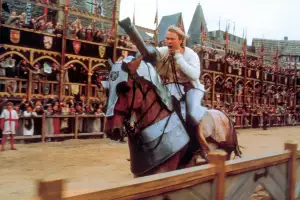
Ledger gets his moment in the final showdown with Adhemar, bellowing “WILLIAM!” as he rams the lance home. However, my absolute favourite shot of him… Actually, can we just appreciate that climactic joust for a second? It starts with a great little character beat as Adhemar’s squire attempts to emulate Chaucer’s rabble-rousing introductions: “Count Aaaaadhemar!” (Yes, even a character as minor as the villain’s squire gets his own mini arc.)
The stakes gleefully escalate: Adhemar’s cheating! Will’s hurt! He's two down! He can’t hold his lance! He's removing his armour! Oh my god, he’s strapping his lance to his arm!!! There isn't time – wait, here's Chaucer! “Sir William Thatcher. Your father heard that.” Let’s go! Do or die! WIIIIILLLLIAAAMMMM!!!!!
(Also, bonus points for ending on the ultimate high: Will planting a smacker on Jocelyn in front of a cheering crowd. Cue AC/DC. No needless epilogue or falling action here. In an age where even popcorn films refuse to end, the ‘wham, bam, thank you ma’am’ denouement is something to cherish.)
Anyway, my favourite Ledger moment comes a few seconds before his cathartic battle cry. It’s a shot of Will riding towards Adhemar and destiny – actually, gliding would be a more accurate verb. The sunlight makes his hair glow golden; his expression is determined yet strangely serene. A man utterly at peace with himself. It’s like the world is moving around him. Like he’s flying.
A Knight’s Tale is a film of premise rather than plot. The goals gradually shift: from making money to getting the girl to defeating the villain. By the final joust, Will has a fortune, Jocelyn, a real knighthood and, in the shape of the spear protruding from his shoulder, ample evidence to get Adhemar disqualified and disgraced. Yet he willingly risks everything, removing his armour to go full death or glory – an objectively ludicrous decision that nobody questions, including the viewer. It isn’t a plot hole because it’s so true to the character and the emotional tenor of the film, now reaching its crescendo. Of course he will ride. Of course.
We started with a green tent; let’s end on the Black Prince. The scene where he rescues Will from the stocks is yet another highlight, witty and moving at the same time. It’s one of the great deus ex machinas, Edward assuring the crowd that Will is in fact descended from royalty, then telling doubters to lump it with a steely: “This is my word... and as such isbeyond contestation.” (My mum’s favourite quote, as it happens.)
The scene also contains the lines that serve as the film’s thesis, spoken softly by Edward to an incarcerated Will. “Your friends love you. If I knew nothing else about you, it would be enough. But you also tilt, when you should withdraw. And that is knightly too.” A whole life ethos is contained in those four sentences. Be good to others. Be true to yourself. Be brave.
While widely beloved today, initial reviews were mixed and box office lukewarm – globally, A Knight’s Tale was the 37th highest-grossing film of 2001, below the likes of America's Sweethearts, Spy Game and Lara Croft: Tomb Raider. For those who bemoan the current IP era, it’s worth noting that Pearl Harbor was the only film in the 2001 global top 10 that wasn’t either part of a franchise or spawned one. (And there’s an argument Michael Bay is a franchise unto himself.)
Just goes to show, eh? Nothing weighs and measures better than time itself – and today the only thing A Knight’s Tale leaves us wanting is more. Thank goodness we never got it! There’s no underwhelming sequel. Nor is there any dodgy CGI or dated cultural references. Fittingly for a film that combines David Bowie with Geoffrey Chaucer, A Knight’s Tale is timeless. Like its star, it remains forever young. And there’s nothing I’d change about it. Not a single thing.
A Knight’s Tale returns to cinemas this summer.