Her life reads like a melodrama. An abandoned and abused child who became the world’s most famous film star. A woman adored by everyone but herself. Her lovers included icons of American literature, sport, entertainment and politics – and none of these men are more iconic than Marilyn Monroe.
She considered herself a lousy actress yet she starred in several classic films, including what is commonly considered the greatest comedy ever made, Some Like It Hot. Dead at 36 from a suspected overdose, the circumstances of her passing are still debated to this day.
If her life was remarkable, her afterlife has proved even more so. She inspired Andy Warhol to create one of the century’s most famous artworks and Elton John to compose one of its most enduring songs. Norman Mailer wrote a sensationalist biography, Joyce Carol Oates a celebrated novel. She is homaged through music videos, photoshoots, and red carpets, by everyone from Madonna to Beyoncé to Sydney Sweeney. Kim Kardashian wore a dress of hers to the Met Gala; it promptly doubled in value, despite damage to its back.
“Her image permeates our culture,” says Andrew Wilson, author of a new biography I Wanna Be Loved By You. “She’s always there. She’s constantly with us.” Wilson’s book – subtitled ‘Marilyn Monroe: A Life in 100 Takes’ – doesn’t aim to explain Marilyn. (It’s always Marilyn, never Monroe.) Rather he uses contemporary accounts to present the countless, often contradictory versions of her that existed in public and private life.
It is a book worthy of its subject – fun, fascinating, and heartbreaking often on the same page. Marilyn once wrote a poem that included the lines, “since I know from life / one cannot love another, / ever, really.” A century after her birth, she remains a beloved icon, the star of all stars.
People have tried to think that Marilyn was this creation, this persona. She was much more interesting and much more complex than that
SM: What made you write the book?
AW: I didn’t want to write a book that tried to explain Marilyn. You can get criticised as a man for writing about women, trying to explain away the issues or identity. I wanted to do the opposite in a way. I wanted to make Marilyn more complex and more difficult to understand.
A journalist called W J Weatherby interviewed Marilyn in the early 1960s. And he references that quote by Virginia Woolf: “A biography is considered complete if it merely accounts for six or seven selves, whereas a person may have many thousand.” Weatherby goes on to say, “But people have been trying to kill off Marilyn with all her 999 selves and reduce her to this dumb blonde.”
So it’s my aim to increase her complexity. And that’s why the book is structured in a hundred takes. We see many different facets of her. The whole point was a kaleidoscopic approach to biography. With each turn of the kaleidoscope, you see her through a different prism or you see a different aspect to Marilyn’s life.
SM: Many of the contemporary quotes you include often contradict one another. Someone says she’s a dumb blonde. Someone else says she’s really intelligent. She’s a complete innocent, she’s quite manipulative. The most famous person in the world is such an enigma…
AW: I think she was an enigma to herself as well. Probably like all of us are, but maybe even more with Marilyn, because she was very self-conscious of creating a character. The character of this ditsy, dumb blonde, which people have described as one of the greatest comic characters of the 20th century along the lines of Charlie Chaplin’s Little Tramp.
People have tried to think or believe that Marilyn was this creation, this persona. Obviously we know that she was much more interesting and much more complex than that. I think it’s quite dangerous to try to reduce Marilyn down to the most basic levels of interpretation. And that’s why the book is written as it is.
All Star Picture Library / Alamy
SM: She has such an interesting relationship with ‘Marilyn Monroe’ – multiple times she talks like she is a separate entity. She never seems to think of herself as Norma Jeane.
AW: I think she could draw on the power of Marilyn. There’s that great quote where she’s walking down Park Avenue and she says to her friend, “Do you want to see me be her?” She doesn’t change an outfit, she doesn’t need to do anything, but she draws on some kind of special power that she has and projects this force of Marilyn. Heads start to turn, people say, “Oh God, there’s Marilyn Monroe.”
She had this very rare star power, which only exists in a very, very few people where they can come alive, more alive, on camera or on screen. She had that in greater depths than many of her contemporaries. I think that’s one of the reasons why we still are fascinated by her today. How many other actors and actresses from the golden age of Hollywood do we talk about with this same level of obsession?
SM: In 2000, the AFI ranked her the sixth greatest female movie star of the 20th century. Obviously there are various metrics but I’d say she’s clearly the biggest, certainly the most enduring…
AW: Her image permeates our culture and we have a sense that Marilyn’s there all the time in the background of our culture. Particularly this year, being the centenary of her birth. She’s always there. She’s constantly with us. I say in the book, she kind of haunts our culture.
One of the reasons is this star power that she has. Another is that she had an extraordinary life story. Going from this really difficult childhood with a schizophrenic mother, a father she never knew. She was born illegitimate, brought up in foster homes and orphanages, sexually abused as a child, married at 16. And this transformation from Norma Jeane into this big movie star goddess is simply extraordinary.
It was her greatest fear that she was going to end up in an institution like her mother.
SM: Her childhood is Dickensian. You do a great job of tracing how issues from her childhood – or even before her birth in the case of her mother’s mental illness – affected her as an adult.
AW: It was her greatest fear that she was going to end up in an institution like her mother. Not just her mother, but her mother’s parents both ended up in mental health institutions. Gladys’s mother, Della, who seemed to try to smother Marilyn when she was a little baby. And Della’s father, Otis, seemed to have suffered from neurosyphilis – syphilis on the brain, which can be passed down genetically from male to female and from mother to child. So there’s a lot she was battling in addition to what came after her birth – the fact that she was sexually abused.
She talked about this in the 1950s when it was such a taboo subject. I think that’s another reason why we’re still fascinated by her story. She talked about what we consider to be very modern issues like sexual abuse, like mental health issues, like addiction. And she was doing this in the 1950s and 1960s. At the time, she talked about her sexual abuse, the majority of people didn’t believe her. All these men just wrote her off as trying to get attention or a publicity stunt, or it’s just a wild fantasy.
But it seems to me from all the evidence that she really did suffer from sexual abuse at the age of eight, and not just once but probably a couple of times, which we know can have devastating effects on an adult and their ability to form relationships, and the splintering of the psyche and disassociation and all those kind of things that come with that early trauma. I think she did remarkably well considering the hand that she’d been dealt. She achieved so much.
She was abandoned as a child during the day because her foster parents said, “Oh, just go and play.” And little Norma Jeane would take herself off to a movie house and sit there for eight hours a day watching people like Greta Garbo and Jean Harlow and Clark Gable on these enormous movie screens. When people asked, “Oh, what was the secret of your success?”, she said, “I dreamed the hardest,” which I think is such a lovely quote. She was determined.
SM: One of the descriptions that recurs across her life is childlike. You note that people who suffer sexual abuse as a child are often quite childlike in their adult life. It’s obviously a seminal moment in her life, not that it should define her in any way…
AW: Not at all. Marilyn’s been pathologised over and over again, she’s been reduced down to a couple of symptoms. It goes back to my bigger point about trying to include these issues and these facets, which are very traumatic, but not let them completely limit or define her.
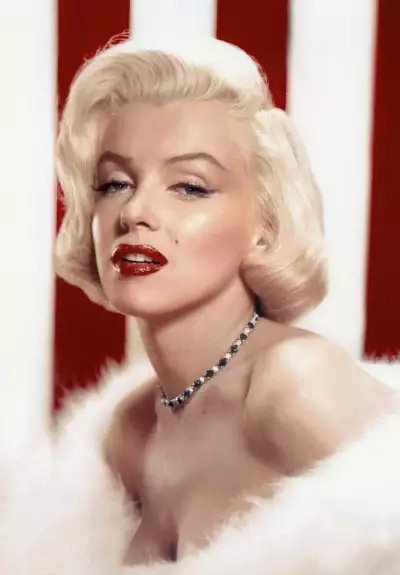
Marilyn Monroe in 1953 as she appeared on December 1953 issue of Photoplay magazine.
SM: Many of her lovers are older men – she even refers to Arthur Miller as “Pops”. You needn’t be Freud to draw a link to her own absent father…
AW: Not knowing her father was such a hurtful thing for her. Her mother had that photograph, which I include in the book, and he does look like Clark Gable. He’s got this movie-star quality to him. Her mum said he died before she was born but then Marilyn got to know the truth and she started to search for him. It became something of a lifelong obsession.
There’s that really tragic scene – she tracked him down just outside Palm Springs in California where he runs a dairy farm. He’s living with another family. He’s married and has children, and he didn’t want anything to do with her. He just said, “Talk to my lawyer.” And it comes full circle, obviously when Charles Gifford, her father, then is ill in the early 1960s and contacts Marilyn and says, “Can we get in touch?” And she gets her revenge, saying, “Go through my attorney.”
SM: Even before she becomes a superstar, she clearly has this unbelievably magnetic personality. There’s that photographer, when she’s a teenager, who nearly kills himself over her.
AW: Before puberty, she was known as String Bean Norma Jeane, because she was quite flat. Obviously, she was a girl. When she started to develop curves, all her female friends distanced themselves from her because she started to get this extraordinary attention from the boys, being driven slightly crazy, jumping around, throwing themselves on the floor.
There’s that quote from her friend Shelley Winters, the actress, who said Marilyn would’ve been happier if she’d been dumber. And people said that she had a soul that was so sensitive, it didn’t really fit into this highly sexualised body. Her acting tutor Natasha Lytess said Marilyn’s soul just doesn’t fit her body.
Obviously we are talking the 1950s where women had a certain kind of very straitened, very stereotypical role. If you’re going to be a movie star, like Marilyn wanted to be a movie star, she always wanted to be sexy. She was obviously pigeonholed, which went with the territory. People would only read her in that way, and that was one of the biggest problems of her life, I think.
Getting involved with Joe DiMaggio and Frank Sinatra and that mob he had hanging around him was quite a dangerous game
SM: She married Joe DiMaggio and Arthur Miller, had affairs with Frank Sinatra and John F Kennedy. Four icons of sport, literature, music and politics – she’s like a nexus for 20th-century American culture…
AW: She becomes this linking point between all those different aspects of American life. And not just American life – they were global superstars, all of them. With Joe DiMaggio, Marilyn kind of used him. She had what we now call agency. People have tried to portray Marilyn as a victim, and she was in some aspects of her life, but certainly not in others.
I think she really did use Joe DiMaggio to negotiate her way through this tricky publicity chaos that was going on in the early 1950s when it came to her image. There was the leaking of the publication of this nude calendar that she’d done in 1949, which threatened to bring her down.
SM: Again, a very modern phenomenon. And she owns it. When a journalist asks if she really had nothing on, she says, “I had the radio on.” It’s a brilliant quote.
AW: Yes, exactly. We have to give her credit for the fact that she could determine her own destiny and make these big decisions for her own ends. Going back to Joe DiMaggio, who’s supposed to be incredibly well endowed – “a penis with a man hanging from it” was one of his friends’ descriptions of him. But obviously that wasn’t quite enough for Marilyn.
He was always watching the television, asking her to make spaghetti meatballs for him and didn’t really want her to have a career. So that’s why the relationship came to an end. In addition to the domestic violence, he started to beat her up as well.
SM: There’s that unbelievable scene where DiMaggio and Frank Sinatra try to catch her with a lover in a sting operation. Proper ‘stranger than fiction’ stuff.
AW: It’s crazy, isn’t it? I’ve got that unpublished interview with Hal Schaefer, who was Marilyn’s lover at the time. He put himself on the line for Marilyn because he really loved her, and I think she did really love him as well. But obviously getting involved with Joe DiMaggio and Frank Sinatra and that mob he had hanging around him was quite a dangerous game.
SM: What’s your favourite performance of hers? She made several classics…
AW: I love her in Some Like It Hot. It is one of those films that always lifts the mood. And she kind of shimmers in that film – one of the many roles where she lights up the screen. I love her in Niagara. She plays this femme fatale who tries to hatch a plot with her lover to kill her husband, and it all goes terribly wrong. That’s the one where she was described as having the longest walk in movie history.
She was known as the girl with the horizontal walk. In 1950s America, sex on screen was really, really controlled and limited. This was considered one of the most erotic moments in screen history, the fact that she shimmered and walked in this kind of liquid way.
SM: Would you say she’s underrated as an actress, even today?
AW: Yes. She didn’t get an Oscar, she never got nominated. But she has an incredibly wide range. So she has the superficial dumb blonde, funny roles, which she excels at, like Gentlemen Prefer Blondes. Then she does more serious roles. There’s a film called Don’t Bother To Knock, where she plays a psychotic babysitter. She’s very, very good in that. And in her final released film, The Misfits, I think she’s extraordinarily powerful.
She trained at the Actors Studio and wanted to do more serious roles. People laughed at her when she said she wanted to play Grushenka in Fyodor Dostoevsky’s The Brothers Karamazov. But she had a really, really very wide range. One of the issues she was battling against was the perceptions of the studio. Studio heads said she’s fine at doing silly roles, but no dramatic roles. It started to limit her performances until she broke free and formed her own production company in 1955.
SM: There’s that moment where she gets very nervous about performing a scene to the acting group…
AW: I think she would’ve been too nervous to be a great stage actress because she did suffer from those nerves, which you can’t really have as a stage performer. But she had that magical quality that some of those lauded stage performers could never capture. This indefinable star quality. All she had to do was open her eyes and look at the camera.
People who were around when she took her first screen test said she has the ability to sell emotion on screen. And there’s very few people who can do that effectively. And radiate sex as well – another of the comments. She would light up the screen.
Billy Wilder found it exasperating to work with her. It took her 47 takes to say, “It’s me, Sugar” in Some Like It Hot. It drove him mad. But after Marilyn died, there were a number of projects that people wanted him to direct. And he said it was only Marilyn that could have made those projects work. All other actresses are Earthbound. She had this kind of divine quality that he recognised.
Marilyn had this ability to connect to so many different people even after her death. They want to find out more about her
SM: Which might explain why she’s had such a remarkable afterlife. She inspires the likes of Andy Warhol and Elton John to immortalise her in different mediums. Neither of those men ever met her. She never seems to leave.
AW: One of the reasons is she died at 36. There’s that idea that if people die young, they’re with us forever because they’re captured at a moment in time. The early death, the sense of mystery surrounding Marilyn’s death, is one of the things that keeps her legend alive. Also the fact that her image has been reproduced so many, many times over and over again. So Andy Warhol was very, very clever in capturing that kind of multifaceted Marilyn. The many different faces of Marilyn in the series of silkscreens that he did.
SM: Weirdly, she reminds me of Muhammad Ali. They both contain such multitudes. These incredible lives, their charisma and beauty. They are unimprovable versions of themselves.
AW: I think Elvis fits into that mix as well. And these 20th-century figures – the word ‘icon’ could be invented for them. I know it’s a word that’s overused but if you show an image to anyone around the world of Marilyn, there’s a very high chance that she’d be recognised in whichever culture you’re in, whichever country, and almost whichever age group.
SM: I was actually wondering about this. I reckon 90 people out of a hundred would recognise Marilyn today. Is that true of any contemporary star?
AW: I don’t think so, because the stars of today appeal to their fan base, even though it can be a big fan base like Taylor Swift. Marilyn had this ability to connect to so many different people even after her death. People want to read more about her. They want to find out more about her.
There have been 650 books written about Marilyn. I thought it’s time for a new book about her, told in a new way to appeal to a new generation of people who may not know that much about her. So it’s written for people who think they know everything about Marilyn, and also for people who know nothing about her and can discover her afresh.
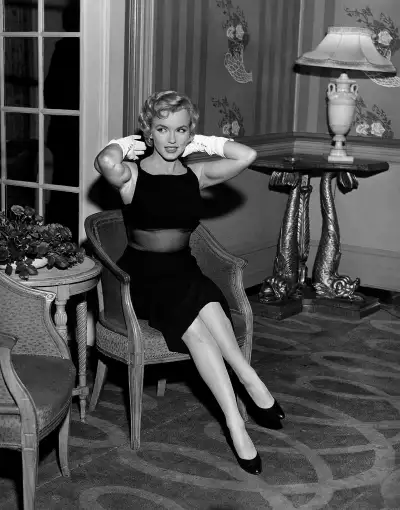
Marilyn Monroe at a press conference held at the Savoy Hotel in London in July 1956.
All Star Picture Library / Alamy
SM: Several of her contemporaries predicted a young death for her. Is that a self-fulfilling prophecy? If she doesn’t overdose that night, what happens to her? I guess it’s impossible to answer.
AW: It is, isn’t it? Which kind of adds to the uncanny appeal in a slightly unsettling way. What could have happened to Marilyn in the future if she’d lived?
But I didn’t want to go into the book thinking that she was already going to die. And in a way, she’s not dead because she’s so alive in our culture.
We’re constantly consuming her and watching her and being haunted by her and thinking about her and being moved by her. So in a way, she still survives. There’s that quote from John Huston. He directed her twice and he was asked, “Why does she still fascinate and still endure?” And he answered, “Because she’s alive.”
SM: Kim Kardashian wearing her dress at the Met Gala – and inevitably damaging it – as a piece of cultural commentary, it’s almost too on the nose.
AW: It’s extraordinary, isn’t it? She went on that extreme diet for three weeks. She wore it up the red carpet with a wrap so nobody could see the potential damage to the back of it. That dress was already the most expensive dress at auction – I think it went for nearly $5m. It’s now estimated to be worth $10m after Kim Kardashian wore it. What does that say about us?
Sydney Sweeney wore a white halter-neck dress, which references the subway dress that Marilyn wore for The Seven Year Itch when the air shaft blows hot air up underneath her, and her skirt goes up – one of the most iconic moments in movie history. People always reference her looks, her persona, her dress, her history. She’s continually being reinvented even though she died in 1962.
She was naturally very, very funny. People always thought these lines had been scripted for her
SM: What’s your favourite quote about Marilyn? One that best captures her?
AW: It’s a really poignant one by Arthur Miller, which really kind of captures this sense of duality between her outside image and her interior life. “She was a poet on a street corner trying to recite to a crowd pulling at her clothes.” Inside she was very sensitive, always trying to aspire to a greater sense of education and intellect, but people saw her as this dumb blonde.
SM: He also said to her, “You’re the saddest girl I’ve ever met.” And that’s before they’ve even got married.
AW: Which is one of the lines he then includes in the script of The Misfits, which adds to this sense of, ‘Who am I? Am I just to have an image? What’s he done to me? He’s taken my life and used my bits of my life and bits of my words.’
SM: It’s crazy. She’s playing a character based on herself in a film inspired by her failed marriage written by her ex-husband. Their marriage seemed bizarre from the outside – the intellectual playwright and the sexy blonde movie star – but the book makes it totally understandable.
AW: They wanted things from each other. So he’d been in a sexless marriage, he’d had two children, but his marriage had broken apart. He was looking to Marilyn to give him a sense of sensuality and sexuality, which he felt was missing from his life. Who’s better to give you that than the biggest sex symbol in the world?
And she wanted a sense of history, culture, literature, intellect from him. They had gaps in their personalities that they looked to each other to try to fill.
SM: What’s your favourite quote of hers? She said some brilliant lines.
AW: She was naturally very, very funny, wasn’t she? People always thought these lines had been scripted for her. That one where she was asked, “What do you wear in bed?” and she said, “Chanel No. 5 – which was shocking for the time but tells you something about Marilyn’s self-confidence, her sense of sensuality, and her humour. She knew how to court journalists by giving them these brilliant quotes.
SM: Reading the book, it’s hard not to fall slightly in love with her. Did you fall slightly in love with her while writing it?
AW: I think I did. I didn’t want to rescue her, but I wanted to empathise and wanted to try to understand. I think a little bit of love is quite healthy when you’re writing about somebody like Marilyn, because I felt protective over her. That doesn’t mean I’d shy away from her faults or problems.
There’s that interview with Angela Allen, who worked on The Misfits. She’s really vicious about Marilyn. That is included as a chapter. There are lots of people who have quotes which give you a sense that Marilyn wasn’t just a sweet, innocent person. She was a survivor. She could be tough, she could be bitchy, she could be unsettling, she could ruin friendships. All those things are included as well.
SM: ‘I Wanna Be Loved By You’ is a song from Some Like It Hot. It’s a very sweet statement when addressed to an individual and quite narcissistic if addressing the world. Fair to say she used it on both?
AW: I think so. I called it that because I tried to persuade the reader to be sitting in that room at the hotel where Marilyn is singing. Sipping ice-cold champagne and the glitterball is going around, and we’re watching her perform. When we’re watching Marilyn on screen, we each have our own relationship with her. We think she’s talking directly to us as the viewer.
That again is one of her greatest strengths and abilities and talents. She’s talking individually, it seems, to every single one of us. That’s one reflection of that quote. And the other one is Marilyn’s desire to be famous and be loved because she had no love in her early life. So she always wanted to have this sense of love that she never experienced early on.
I think she would’ve survived if she had lived a bit longer and had the medication that she needed
SM: Is there any figure whom you would compare her to? Historical or contemporary?
AW: She is quite unique because she came in a particular moment in history where our visions and hopes and expectations around sexuality were changing. Post-war America on the cusp of the sexual revolution, which eased society into a different relationship with sex. In the 1950s, America was incredibly repressive.
I wrote a book about the young Sylvia Plath, and some of those issues Plath was battling against as well. She was an incredibly clever, sensitive woman born in 1932, so a bit later, but also a woman who dreamt about Marilyn, who dyed her hair platinum blonde like Marilyn. She identified with her and wrote these heartfelt, autobiographically sourced poems about what it means to be a woman, what it means to be an individual in America in modern times.
You can definitely look at both those lives and see some kind of parallels. Plath died at the age of 30, leaving two children behind, and that seemed to be a suicide. But she left behind this great heritage and legacy of poetry, which changed the 20th century. So even though they were very, very different women, they were born at a time where it was really difficult to be a woman in modern society because of other people’s expectations of you.
SM: Lastly, if you could travel back in time and give Marilyn one piece of advice, what would it be?
AW: It’s really difficult, isn’t it? I think she would’ve survived if she had lived a bit longer and had the medication that she needed. She was born at a time where our treatment of mental health was so different. She had therapy but it wasn’t particularly effective.
Perhaps she would’ve been helped if she had been on some kind of medication which would’ve treated some of her symptoms. She knew that people loved her, she knew the public loved her, so she doesn’t need any affirmation that she was loved, but the idea that if you just can try and hang on for a bit longer…
I know it sounds trite, but things may have been different.
I Wanna Be Loved By You: Marilyn Monroe, A Life in 100 Takes by Andrew Wilson is available now (£25, simonandschuster.co.uk).