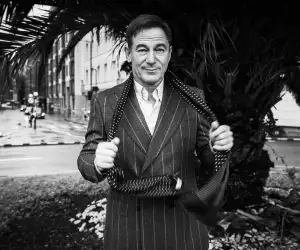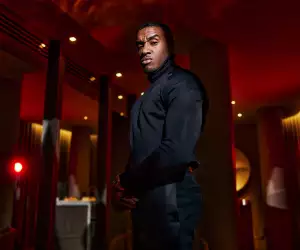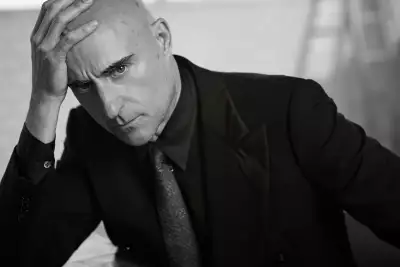
“I still think there is a part out there that is going to be better than anything I’ve ever done,” says Mark Strong with quiet conviction. “That’s what keeps me going.”
It would need to be some part. For the past 40 years, Strong has established himself as one of the most versatile actors in the industry, a restless workaholic whose proficiency spans theatre and film, big screen and small.
He started out doing Shakespeare, got his big break on TV, and cracked Hollywood as a heavy – equally credible outsmarting the hero as beating the hell out of them.
You can see why Strong often gets cast as the hard man – the gangster, the spy, the megalomaniac. He’s well north of six foot, sporting a shaved head, baritone voice, and a brooding intensity that makes one very aware of the nearest doorway.
PG Wodehouse described the thuggish Roderick Spode as possessing “the sort of eye that can open an oyster at 60 paces”. From the same distance, Strong’s eye could shock a soldier crab from its shell and into the Peace Corps.
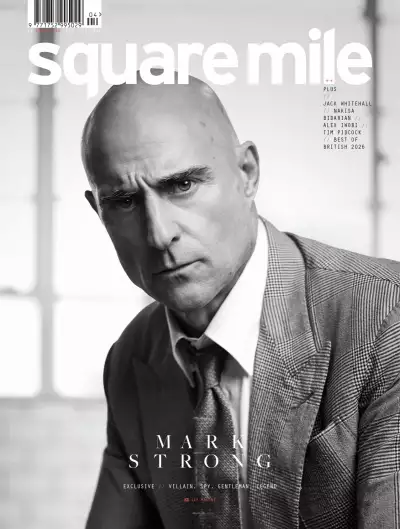
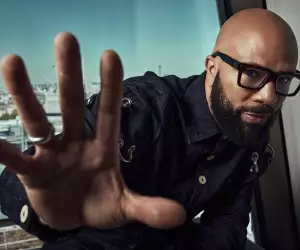
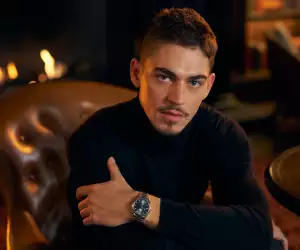
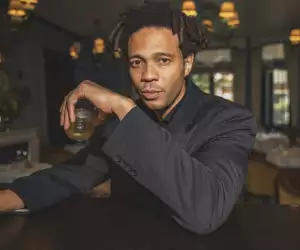
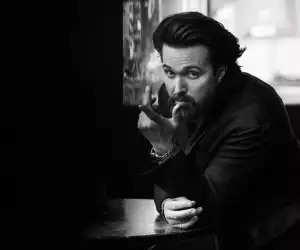
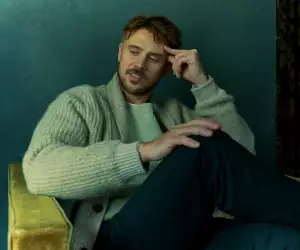
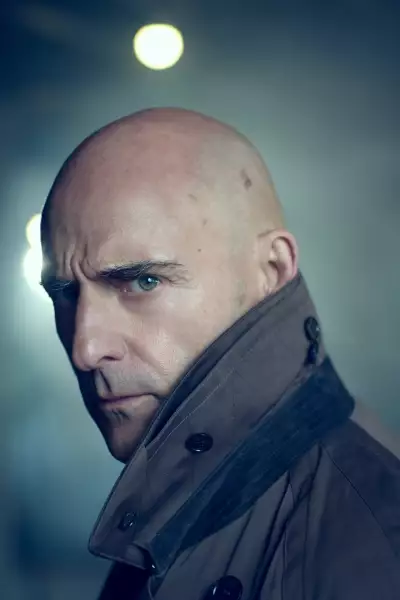
SHOP THE LOOK: [Above] Dunhill Prince of Wales check wool silk seersucker double-breasted Cavendish suit jacket and matching pleat trousers MTM £POA, and button down linen tattersall check shirt, £525; vintage Bottega Veneta tie, stylist’s own. [Below, video] Studio Nicholson black ‘Revere’ trench coat with leather collar, £795, and Giorgio Armani black lambswool polo neck, £650.
Inevitably, he is one of the kindest, gentlest souls you could hope to meet. Remarkable how such a foreboding presence on screen can be so soft-spoken and self-effacing off it. (Actors, eh?)
During the photoshoot, he treats every member of the team with the utmost courtesy. It is a team effort, an ensemble piece, if you will. That evening, our photographer Lee receives an unexpected phone call. It’s Strong, thanking him for the shoot.
He learned some simple lessons as a young actor. “Don’t get carried away. Don’t get above yourself. Don’t believe the hype. Remember why you became an actor in the first place. For me, it was always about mastering this job and becoming good at acting, becoming good at the job of acting, rather than becoming famous.”
He’s always resisted the notion that visibility equates importance. “I learned quickly that’s the least interesting bit.”
Strong shares this wisdom in a rather good café in Seven Sisters, directly across the road from our photo studio. (Beans & Cream, if you’re ever in the area.)
North London is very much his patch. He was born in Islington, and now lives across town with his wife, the producer Liza Marshall, and their two sons. As we peruse the menu, conversation primarily concerns Arsenal’s chances of closing out the league – Strong has held a season ticket for two decades.
He may soon claim silverware of his own, having received a Tony nomination for Oedipus. The play broke box office records at Broadway’s Studio 54, grossing well over a million dollars.
Critics raved: “Mark Strong as the upstanding, self-righteous Oedipus opposite Lesley Manville as a breezy and dynamic Jocasta, first set us on the edge of our seats and then set the stage on fire,” wrote the Guardian. The New York Times described the production as “electrifying” and “a spine tingler”, praising Strong as “sturdy, assured, telegenic”.
“He’s creative, dynamic, thorough, generous, funny and a complete joy to work with,” shares his co-star, the great Lesley Manville. She describes “the caring and delicate way he navigated the complex scenes we had to achieve. I always felt safe and able to do my very best with him.
“He also had to listen to my speech every night and never once did he waver his attention or try to pull focus. His generosity was astounding – and that enabled me to do my very best work.”
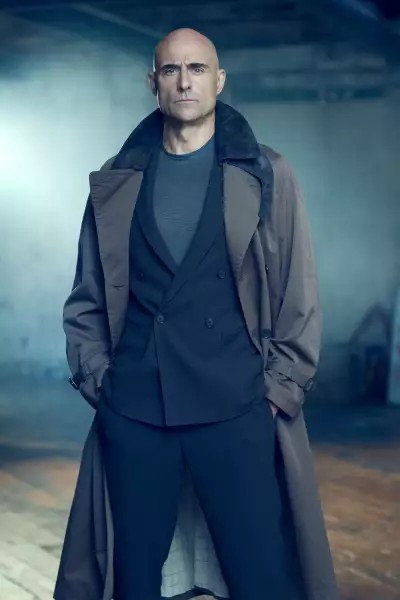
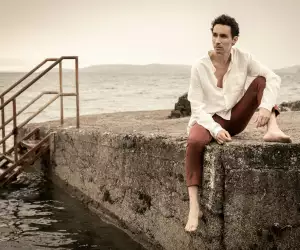
SHOP THE LOOK: Dunhill cocoa cotton/silk trenchcoat with leather collar, £3,600; Giorgio Armani chocolate rib blend wool notch lapel double-breasted soft blazer and relaxed strides, £1,900, Thom Sweeney cocoa slubby linen tee shirt, £265.
Oedipus is his second consecutive Tony nomination, following his previous collaboration with Icke on A View from the Bridge a decade earlier. The stage is where he learned his craft – long stints at regional theatres, touring the world doing Shakespeare. He spent 15 years treading the boards until his film career blew up and there simply wasn’t the time anymore. On asking if he feels like a theatre actor who essentially fell into screen work, I receive a firm nod. “Exactly that.”
Despite his extensive filmography, Strong rarely finds himself up for individual trinkets. Such is the lot of a character actor, the only thing he’s ever wanted to be. I believe his assertion that, “it really isn’t about the awards. You don’t choose projects for the awards – or I certainly don’t, and never have. I’ve never had that luxury. Perhaps some people do.”
He later admits, “I still think I’m going to win an Oscar. Having said that awards aren’t important…” A wry smile but I see no contradiction here: brandishing a shiny gold trophy before a cheering audience isn’t what guides his career, but it still sounds like a pretty fun night.
“A good career has moments – hot moments, cold moments,” says Strong. “It’s like a wave, like a sound wave.”
Depending on the coming days, he may yet be deafened by the sound of applause. Few would deserve it more.
After 20 minutes’ conversation, I find myself deeply envious of Mark Strong: not for his successful career or doting family, though I’m sure both are great, but because he really smashed his lunch order. Poached eggs with garlic yoghurt and what I think is extra ham and mushrooms – woof. My eggs with spicy sausage are very nice but feel a little spare in comparison.
“Do you want some of this?” he offers.
No, no, I say, don’t be silly.
“Sure? You can have a couple of forks.”
Momentary temptation – it really does look delicious – is quickly resisted when I imagine my editor’s reaction on hearing I ate half my interviewee’s lunch.
His was an eventful childhood. He was born in Islington in 1963 to an Austrian mother and an Italian father. The latter left soon afterwards; Strong has no memory of him. He was christened Marco Giuseppe Salussolia, but his mother anglicised his name by deed poll to help him fit in. They bounced around North London flats while she worked multiple jobs to put food on a succession of tables.
Strong is remarkably phlegmatic about his absent father – how can he miss something he never had? He’s never felt the need to track him down. At one point, I make the link with Oedipus – another man who never met his dad (well, not knowingly). Strong gently but firmly refutes the idea. “That didn’t even occur to me, to be honest with you. I didn’t really even think about that. There was so much else going on in the play.”
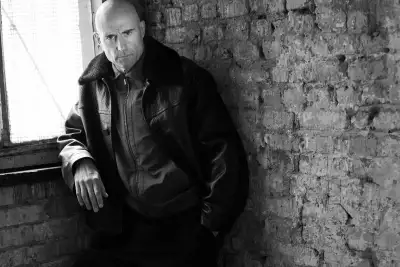
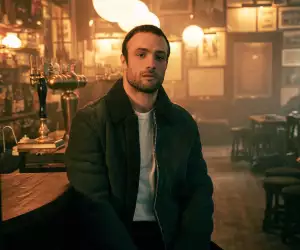
SHOP THE LOOK: Studio Nicholson black Del leather jacket with shearling collar, £1,395, and plain front Ester trouser: stylist’s own; Canali knitted track-jacket with collar, £1,790.
However, he directly attributes his work ethic to his upbringing. “For me, it’s always been about working. Just keep working. I haven’t really ever considered a part or a job in terms of the reward, either financial or awards. It’s just about keeping working. It’s that working-class ethic – I find it very hard to turn down a job.”
For Strong, it is a matter of choice; for his mother, it was necessity. However, 1970s England wasn’t exactly a hotbed of economic opportunity, and eventually she decided to move to Germany. “She earned way more money being in Germany.”
The 11-year-old Mark stayed in England. An unruly boy, he had been packed off to an orphanage for fatherless children for a period. His mother offered him the option to relocate to Germany but he chose to attend Wymondham College, the largest state boarding school in the country.
It all sounds slightly Dickensian but Strong actually quite liked the daily structure, the discipline it instilled. Don’t envisage God, gruel and the lash: at Wymondham he even joined a punk band.
The punk band instilled a love of performance. “That’s the first time I got in front of an audience.” Yet he never did plays at school, and upon graduation he followed his mother to Germany to study law in Munich. He gave it an unhappy year before realising he’d made a mistake.
“I probably wanted to act being a lawyer. I liked the imagery of a trench coat, a briefcase, and a BMW, saving people. But the reality was the studying was incredibly difficult and I didn’t enjoy it. I had a realisation that if you’re going to commit to something, you might as well try to find something that you’re going to enjoy.”
And so he found acting, returning to London to study English and drama at Royal Holloway, then heading west to Bristol Old Vic Theatre School. As a career move, swapping law for acting is a little like selling your gold reserve and sticking the proceeds on black, but Strong had the advantage of ignorance.
“Everybody said, ‘It’s really hard. The chances of succeeding are very slim and it’s going to be a very difficult life.’ I had no concept of what they were talking about. I just knew it was something I wanted to do. I just stuck to it and, touch wood, I’ve been lucky.”
He refers to luck several times over our conversation, noting at one point, “It always sounds a bit disingenuous when I say, ‘Oh, I’m just lucky.’ But it’s a huge part of the business. You can’t really craft a career. You’re reliant on the subjective opinion of people giving you work.”
At the time, he didn’t know this. “I didn’t really contemplate failure. Not that I knew I was going to be a successful actor or anything, but there was nothing else. There was nothing else I was interested in. Now I talk to young people and I’m very conscious of saying to them, ‘It does rely enormously on luck. It’s not a meritocracy.’ There are some great actors not working and some terrible actors who are working.” I resist the temptation to ask the obvious – not that Strong would have answered.
I didn’t really contemplate failure. Not that I knew I was going to be a successful actor or anything, but there was nothing else.
He started working straight out of drama school, doing nine plays in nine months at the Swan Theatre in Worcester. “You’d rehearse the play in the day and then perform in the evening.” There followed a brief dry spell – the only one of his career – which forced him to get a temporary job in telemarketing, specifically selling advertising space in a business magazine. (Hey!)
“I was pretty good at it,” says Strong. “Largely because I speak German. So I had Switzerland, Austria, Germany to do – and I was the only one in the office covering those territories.” Were he a less talented actor, he might currently be heading the square mile sales team. (Or perhaps quadratmeile, following the inevitable European expansion.) Instead he landed a job doing Shakespeare at the National Theatre with Ian McKellen and Brian Cox. Your loss, Strong.
The company did two productions: Richard III and King Lear. (McKellen played the former king, Cox the latter – although every actor had roles in both.) After the National, a world tour that went everywhere from Paris to Cairo, Tokyo to a recently unified Berlin. Heady days, and plenty of them – the whole adventure lasted 18 months.
A few years back, Strong reunited with McKellen for the 2023 film The Critic. Did the pair reminisce about old times? “We did,” he confirms. “I had a photograph of the two of us in 1990, which I shared with him. He’s a friend.”
More theatre and minor TV projects followed before he landed the role that would change his life: playing the brash Terry ‘Tosker’ Cox in the BBC drama Our Friends in the North.
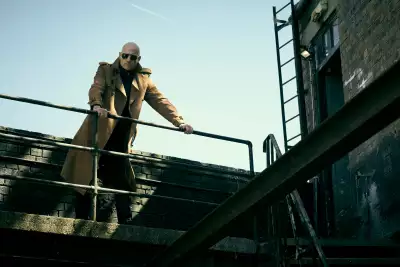
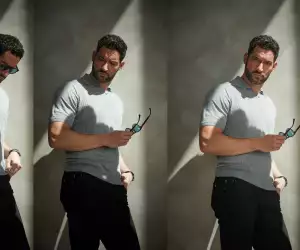
SHOP THE LOOK: Canali ‘Nuvola’ caramel lamb-skin suede trench, £4,500; Thom Sweeney midnight Japanese nylon track-top jacket, £2,495 with midnight wool drawstring trousers, £695; Calvin Klein CK26100S sunglasses, £160.
One of the nice things about Strong’s career – when people profess themselves fans of his work, he’s never sure what work they’re talking about. “It really varies,” he says. “I’ve been doing it for so long.”
He mentions Stardust, Temple and also Grimsby, the 2016 spy comedy from Sacha Baron Cohen that received a mixed reception from the critics and widespread adoration from teenagers. “The boys, the 15 year olds, they love Grimsby,” notes Strong. “So many people love that film.”
Much easier is citing the work that had the biggest impact on his career. Our Friends in the North depicted the lives of four friends across the latter half of the 20th century. Nine episodes screened on BBC Two that changed the lives of everyone involved. Three decades later, Strong’s performance as aspiring musician-turned-businessman Tosker remains a definitive one.
“We had no idea that it was going to be as successful as it was,” he says. The series garnered rave reviews and multiple awards, making stars of its central quartet: Strong, Christopher Eccleston, Gina McKee, and Daniel Craig. Five years after it aired, the BFI ranked it among the greatest British TV programmes of the 20th century; the Guardian later anointed it the third-best TV drama of all time.
He owes Our Friends a lot. It established him as a serious screen presence: the year of its release, 1996, he also played Mr Knightley in the ITV adaptation of Emma and the treacherous Colonel Brand in Sharpe’s Mission. He also forged a lifelong friendship with his co-star Daniel Craig, the godfather of Strong’s firstborn son.
Strong and Craig have both enjoyed phenomenally successful careers while following different trajectories: the character actor vs the leading man. Was this a deliberate choice on both their parts?
“He always knew he wanted to be in movies,” says Strong of the future James Bond. “He was very committed to a sort of particular part. He knew exactly what he wanted to do. Personally, I just wanted to work. It didn’t really bother me whether I was doing TV, film, or plays.”
A few years later, Strong landed an audition for Gustav Graves, the Bond villain of Die Another Day. He decided to celebrate by hitting the town with his mate. It proved a disastrous decision…
A momentary pause when a chap passing the café spots him through the window. He pops inside for a hello and a photo. Strong obliges, fields a question on the whereabouts of his Kingsman co-star Taron Edgerton, and then resumes the story exactly where he was cut off.
“Dan and I had been out for a night out,” he recalls. “I’d learned the lines and I was really confident – overconfident – about the audition the next day.”
The drinks flowed – perhaps a little too freely. Strong arrived at the audition and couldn’t remember his lines. “I blew it.” Had he returned the favour ahead of Craig’s audition for Casino Royale, modern cinema might be a very different place.
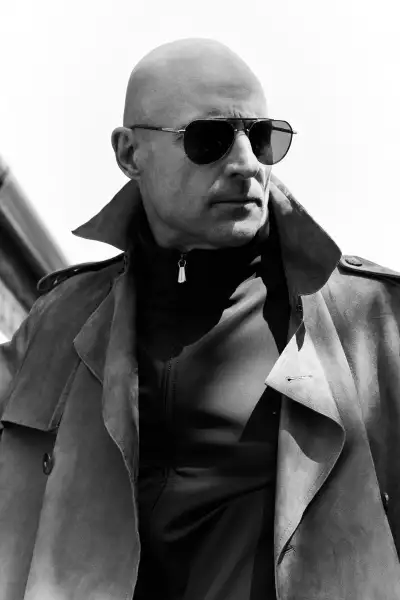
It’s not like his CV lacks for wrong’uns. Over the years he’s become something of a specialist in blockbuster bad guys, playing the antagonist in films such as Sherlock Holmes, Robin Hood, Kick-Ass, and Shazam!. His ascension to VIP Villainy was confirmed when a suave Strong appeared alongside Tom Hiddleston and Sir Ben Kingsley as part of a Jaguar campaign with the tagline, ‘It’s good to be bad.’ “Have you ever noticed how in Hollywood movies, all the villains are played by Brits?” purrs Sir Ben from inside a shadowy mansion.
Strong certainly agrees with the thesis. “I remember Ryan Reynolds once said to me, ‘As a hero, you just get to crack a smile, throw a punch, kiss the girl.’ It’s so obvious that the villains can be even more fun.” Pondering the long heritage of British actors playing Hollywood heels, he notes, “We have a tradition of bad guys as our cultural heritage. We’ve got Richard III and Macbeth; they’ve got John Wayne and the homecoming king and the quarterback. Their whole culture is based on being the hero.”
He has yet to grace a Bond film – c’mon, Amazon – but he landed his own version playing the tech genius Merlin in two Kingsman films. The sequel features Strong performing a memorable rendition of ‘Take Me Home, Country Roads’ while standing on a landmine. “I love that scene,” says Strong. A friend once told him that every movie has five moments, the ones the audience leave the cinema discussing. “If you have one of those five moments in a movie, no matter how big or small your part is, you’re in the movie.”
He’s had his fair share of moments in a whole lot of movies. Is there any throughline to his career? “There really isn’t. Other than maybe trying to do the opposite of what I’ve done before. So if I go and do a big studio picture, then I like to go back and do a little play.” As he notes, “The variety is incredibly important. Always has been.”
It might seem perverse to spotlight one of his lesser celebrated works, the 2002 pharmaceutical thriller Fields of Gold that even Strong describes as “a bit hokey”. Perhaps, but it introduced Strong to his wife, Liza Marshall – recently immortalised as the producer who brought Hamnet from page to screen. Can we therefore crown Fields of Gold as the most important work of his illustrious career? The question draws an obliging smile. “Well, if she reads this, I would have to say, of course it is…”
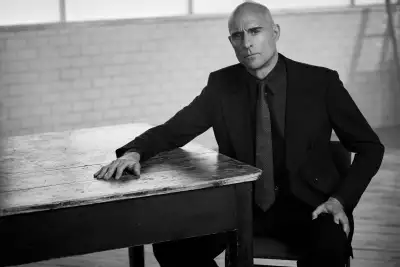
SHOP THE LOOK: Giorgio Armani midnight cupro peak lapel double-breasted suit, £3,850 and chocolate silk shirt, £980; vintage Armani tie: stylist’s own.
A few weeks after our interview, I catch up with Strong over Zoom. He’s in New York, doing multiple engagements for the Tonys. He’s currently being transported to one, speaking to me from the back of a moving car, the city shifting behind his shoulder.
“It’s an incredible feeling,” he says of his nomination. “It’s always great to be recognised. When you do something like this, you don’t do it for awards, you do it because you want the production to be amazing. But the award is kind of a rubber stamp, an acknowledgement if you like.”
Has he composed a speech, just in case? “I don’t have a speech prepped. In a weird way, I think that’s bad luck. Also, stuff off the cuff is much more interesting. I’ve been to a lot of award ceremonies and the endless thanking of people can be really tedious.”
Two days earlier, his beloved Arsenal claimed their first league title in 22 years. Strong was recording an interview with Screen Actors Guild – his phone kept buzzing in his pocket. After sneaking a surreptitious glance, “suddenly the interview became the most amazing place to be because I felt elated.” (If you think that’s unfortunate timing, he followed the pivotal West Ham match from the BAFTAs.)
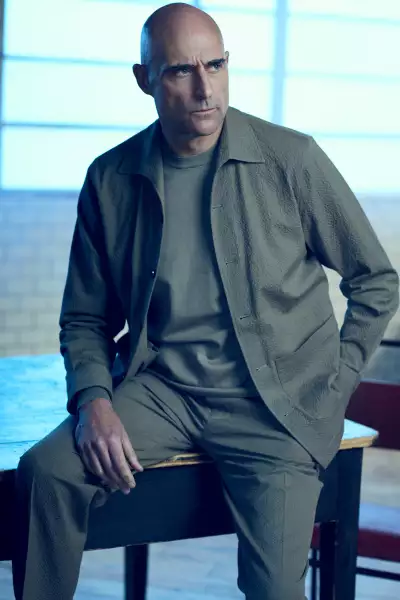
SHOP THE LOOK: Edward Sexton olive seersucker chore jacket and pleat trouser co-ordinated set, £1,350 with Sunspel light cotton olive knit, £175.
While Strong tried to manage his emotions on the wrong side of the pond, Liza and the boys drove to the Emirates to party with the thousands of elated fans. Neither of his sons were born when Arsenal last won the league. “This is for them,” says Strong. “This is for all the kids who’ve supported over the last 22 years.”
There’s also the small matter of the Champions League final next Saturday. Champions League or Tony Award? The reply is instant. “Champions League, every time. Every time. I love the Tonys but there’s always another opportunity – and I’m not going to wait 20 years for that!”
Several articles compared the celebrations outside the Emirates to the climactic scene from Fever Pitch, the 1997 adaptation of Nick Hornby’s memoir. It gave Strong one of his first major film roles, playing the best friend of Colin Firth’s Arsenal-obsessed protagonist.
Perhaps Firth was acting a little more than his co-star… “I used to send him faxes in those days,” grins Strong, “letting him know what had happened at the game. But I think now he’s absolutely a Gooner.”
Fever Pitch was the first of several jobs with Firth – others include Tinker Tailor Soldier Spy, the Kingsman films, 1917, and the upcoming Tom Ford film Cry to Heaven. (Set in the world of eighteenth-century Italian opera; “It’s going to be gorgeous,” says Strong.) Repeat collaborations are a Strong hallmark: in terms of directors alone, he’s worked multiple times with Guy Ritchie, Matthew Vaughn and Ridley Scott.
Don’t expect to see Strong behind the camera. He prefers to take the work as it comes. “What I love is getting a script dropped through the letterbox, not knowing what it is, having a read and finding a part that I feel I can do something with. That’s why I’ve never written anything and have no desire to be a director. I don’t want to be a creator. I’m much more of an interpreter.”
Well, he’s interpreted exceptionally for more than four decades. Expect nothing less in the decades ahead from a brilliant actor and true gentleman. As the man says: “I’m not in a place now where I’m coasting. I don’t want to coast for the next 20 years.
“I’m still very keen to find something really good and blow people away.”