“Talk to me, Harry Winston. Tell me all about it.” Nine words, infinite cultural resonance. You don’t have to have seen Gentlemen Prefer Blondes (nor Moulin Rouge for that matter) to recognise the line. It comes dripping with meaning, glamour, and the glint of a very large stone.
In 1953, when the Marilyn Monroe film premiered, this was the only name the well-to-do had on their lips when it came to the best diamonds money could buy.
Mr Winston’s instinct for sourcing and setting exceptional stones had earned him a reputation as the ‘King of Diamonds’, and that legacy now underpins three new chapters of the House’s high jewellery story.
These new collections celebrate three parts of his persona – first, his reputation as the ‘King of Diamonds’; second, his remarkable eye for stones in ‘Rare Jeweler of the World’; and finally, his well-charted relationship with Hollywood as ‘Jeweler to the Stars’.
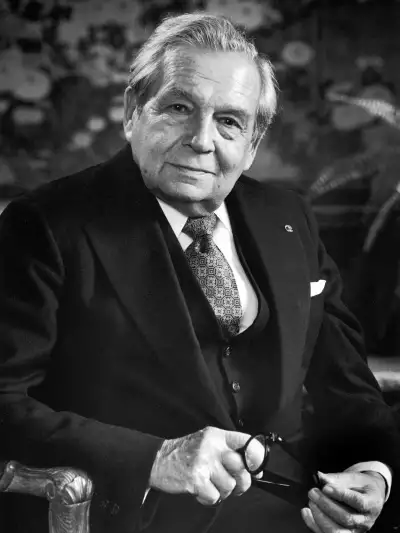
Harry Winston, widely known as the King of Diamonds, founded his eponymous company in 1932.
Alfred Eisenstaedt/Time & Life Pictures/Getty Images courtesy of Harry Winston
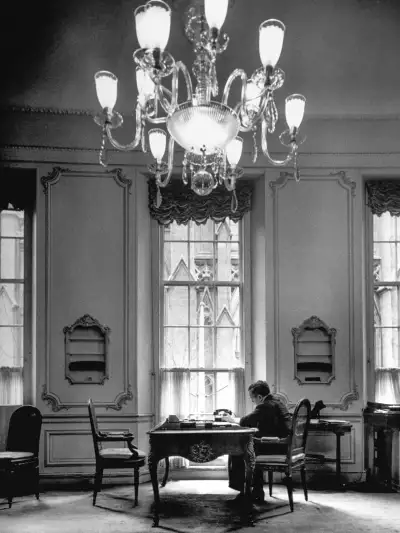
Harry Winston sitting in a townhouse opposite St Patrick's Cathedral, where he was a guest as a young man.
Eliot Elisofon/Time & Life Pictures/Getty Images courtesy of Harry Winston
Each draws on a distinct facet of his life, translating biography into jewellery suites and one-of-a-kind creations ablaze with rare, precious stones.
“Harry Winston stands at the pinnacle of high jewellery, celebrated worldwide for its exceptional diamonds and classic timeless designs,” explains Lisa Levinson, head of UK, Natural Diamond Council – the not-for-profit organisation dedicated to promoting and protecting the integrity of the natural diamond industry worldwide.
“Diamond lovers around the world admire Harry Winston’s unwavering focus on placing the beauty of the individual diamond above all else. This relentless focus on exceptional stones set in timeless designs results in jewellery that exudes high-powered glamour.
“As Harry Winston famously said, ‘No two diamonds are alike. Each diamond has a different nature. Each diamond must be handled as you handle a person’. It is a philosophy that is widely embraced in the diamond industry.”
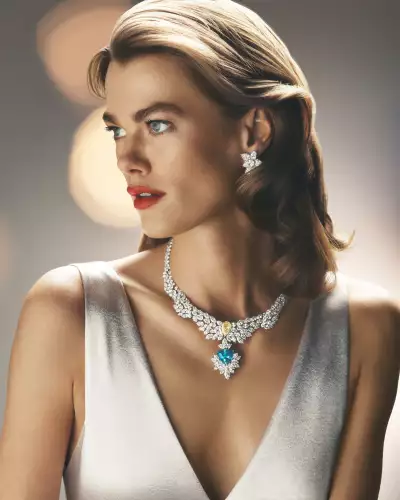
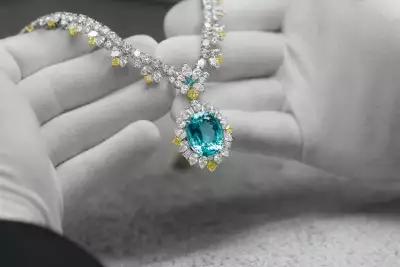
In this necklace, a 16.10-carat Paraiba tourmaline is set into an elaborate cluster of diamonds – 65 carats of marquise, pear-shaped and round brilliants – complemented by a 5.01-carat pear-shaped yellow diamond.
Winston himself had a precocious eye for precious stones. He was the son of Jewish immigrants from Ukraine – and his father owned a jewellery shop.
Legend has it that at just 12 years old, he noticed a small green stone in a tray of costume jewellery that had been dismissed as glass. He bought it for 25 cents. It wasn’t glass. It was a two-carat emerald that he sold for $800 – around $27,000 in today’s money.
It was another act of ingenuity that secured Winston’s place in the very gate-kept world of diamond dealing.
Rather than continue to pound on the closed doors of the establishment, he went into the estate jewellery market – buying vintage pieces and then redesigning them to suit modern tastes.
Because society families were usually embarrassed to be liquidating heirloom jewels, they sold quietly and at lower prices. The collection that cemented his reputation was that of Arabella Huntington’s estate.
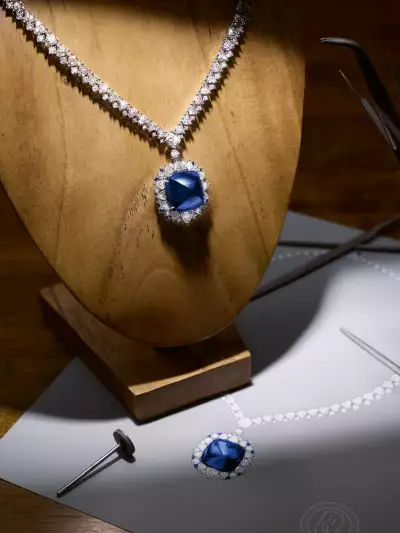
A remarkable 65.61-carat Cabochon sapphire is framed by custom-cut diamonds that mirror the same pyramid shape of the main stone
This widow of railroad magnate Henry E Huntington had amassed one of the world’s most prestigious jewellery collections filled with everything from a 150-carat emerald and diamond brooch, which was rumoured to have originated from Empress Eugénie of France, to statement pieces from Cartier and Tiffany.
In 1926, two years after her death, her son sold it all to Winston – and the House of Harry was born.
Winston celebrated with a diamond-buying spree. Between 1932 and 1947, he acquired three of the most significant gemstones in history.
The 726ct rough Jonker [below], at the time the largest diamond in the world; followed by the 34.4ct Stotesbury emerald; and then hot on its heels, the 90.38ct Briolette Diamond, thought to be one of the oldest stones in the world, dating back to 12th-century India.
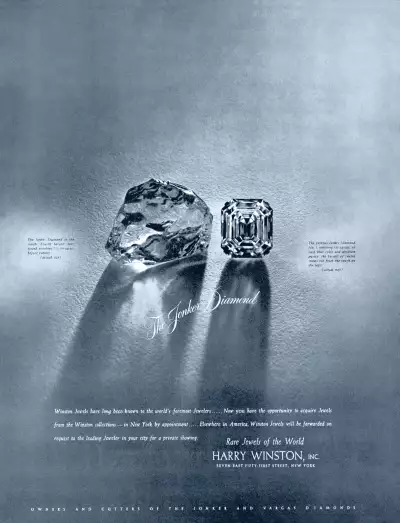
Harry Winston Jonker diamond advert from 1951
It is this facet of his reputation that the new ‘King of Diamonds’ chapter sets out to commemorate in precious stone and metal form.
The first thing you’ll notice, of course, is plenty of diamonds. They appear in suites with octagonal-cut sapphires the size of a baby’s fist; they are complemented by rubies and enormous South Sea pearls; they sit alongside one-of-a-kind Paraiba tourmalines, jostle for space on a bracelet with emeralds and sapphires, or in yellow as well as white clustered into earrings, a necklace and even a high-jewellery timepiece.
Each stone is given the space to shine, embodying Winston’s philosophy that diamonds were like stars one could touch.
It was this knowledge of how to set stones that is celebrated in the next chapter, ‘Rare Jeweler of the World’.
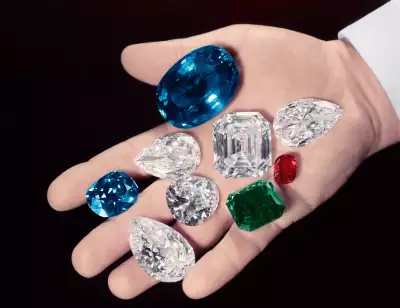
Mr Harry Winston's hand holding some of his most famous diamonds and gemstones.
What elevated Winston from his contemporaries was his innate instinct for judging how best to showcase each individual stone. These skills he honed in his early years in the business, reinterpreting estate-sale jewellery and this chapter explores the myriad ways stones can be set without losing the individual brilliance of each gem.
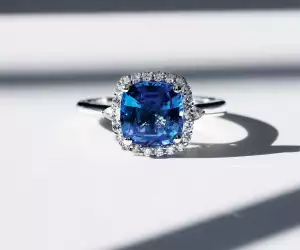
A lone sapphire is circled by diamonds in varying shapes, with a few extra sapphires at its edge to create a starburst of a brooch; a similar melee surrounds another cushion-cut sapphire as a ring.
Brilliant white stones fan out around emeralds as green as the city in Wicked; intentionally set on various levels to add volume and intrigue. The complementing earrings emphasise the fan-shaped motif, while the statement ring emphasises the modernity of the design.
There is a sea of deep blue sapphires cosseted by a surf of diamonds, while rubies slice through the middle of a bracelet surrounded by these glittering stones. The pièce de résistance is the Yellow Diamond Suite comprising a necklace, bracelet, earrings, ring, and matching tiara, with a diamond-driven design that celebrates the elegance of a pear-shaped cut.
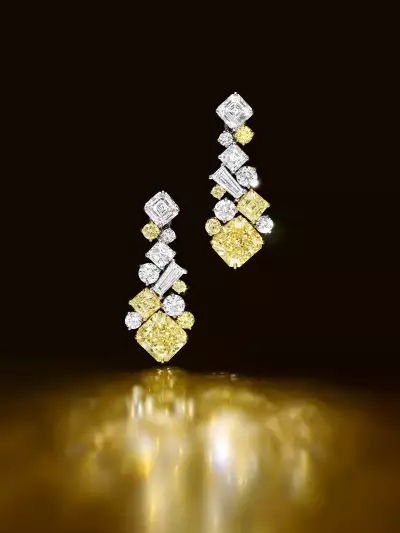
Harry Winston ‘Starlight Yellow’ diamond suite earrings. A matching necklace comes with a 7.94 carat radiant-cut yellow diamond centrepiece.
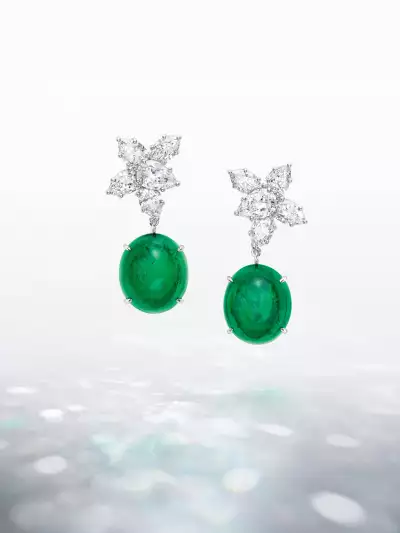
Talk to Me, Harry Winston Collection pair of Cluster diamond earrings elegantly frame two Colombian emerald cabochons, weighing 17.79 and 17.25 carats.
“Harry Winston created a dazzling world so desirable that, more than a century later, people still aspire to be part of it. His reverence for extraordinary diamonds continues to resonate with people globally,” says Levinson.
“The jeweller’s iconography remains culturally relevant – Hollywood stars and pop culture talents still enchant us, and so does the allure of rare and beautiful diamonds. Harry Winston’s vision of American glamour and luxury has transcended time and appeals to ever-growing audiences.”
One of those audiences was and still is Hollywood. Winston scored a marketing coup when he became the first jeweller to lend for the red carpet.
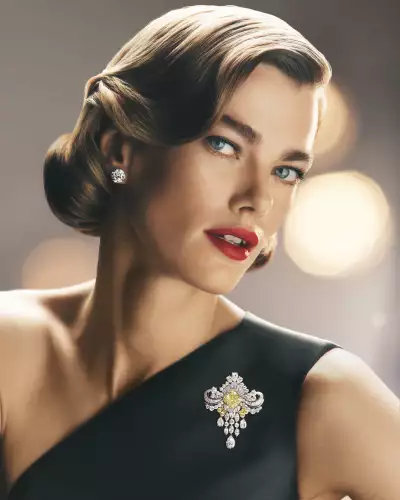
Model wears a brooch from the 'Jeweler to the Stars' chapter, with a 9.81-carat cushion-cut fancy intense yellow diamond centre stone is surrounded by an elaborate arrangement of 12.74 carats of diamonds.
His first foray was at the 16th Academy Awards in 1944, when Jennifer Jones, bedecked in Harry Winston, took home the Best Actress Oscar for her role in The Song of Bernadette about a miller’s daughter in rural Lourdes, who, in 1858, experienced visions of the Virgin Mary.
The stones flashing under the photographer’s bulbs started a relationship between jeweller and starlet that would endure and from which the new ‘Jeweler to the Stars’ chapter enjoys its pure, unadulterated glamour.
This is jewellery designed to be photographed in. There are stones in a variety of cuts, ingenious settings that make the diamonds, rubies, and sapphires appear layered in multiplying strands, a beautiful play between stone sizes so every camera angle catches their light.
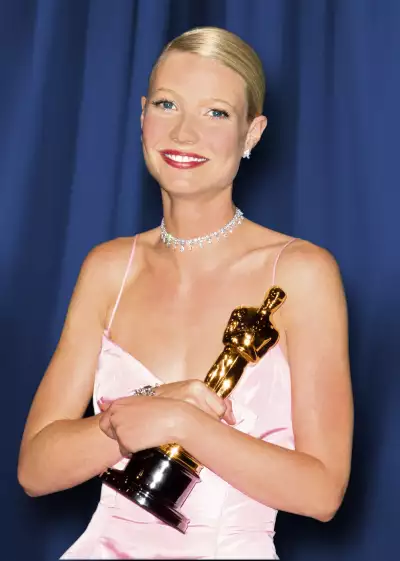
Gwyneth Paltrow wearing Harry Winston at the Academy Awards in 1999.
“People! Drama! Romance! Precious Stones! Speculation! Excitement! What more could you want?” Harry Winston once exclaimed when talking about why he loved the diamond industry, and the yellow-diamond brooch that is the pinnacle of this collection illustrates this perfectly.
An extraordinary 9.8-carat cushion-cut fancy intense yellow diamond is at its centre, and it is surrounded by an elaborate arrangement of 12.74 carats of yellow and white diamonds.
Mixed-cut stone strands dangle from the centre piece, as ribbons of baguette-cut diamonds gracefully loop around. It is Harry Winston in a single piece – a true celebration of the beauty of diamonds.
See more at harrywinston.com