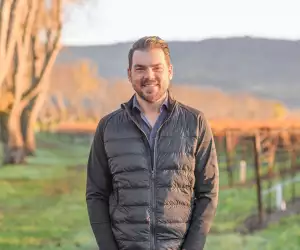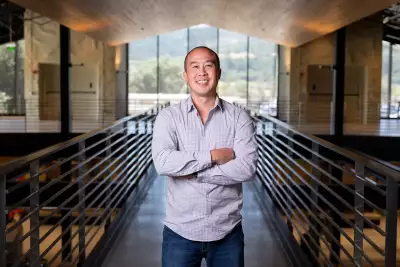
The first wine Kurtis Ogasawara made was a Grenache at University of California, Davis. He thinks he might still have a bottle somewhere, with a blue sticker and a lot number. He tasted one about a decade ago. His verdict? He’s got better.
It’s fair to say, that’s probably an understatement given his career trajectory since.
Ogasawara went to UC Davis to wrestle and study mechanical engineering. An introductory winemaking class persuaded him to change course, but it took a room full of Champagne, tasted while working his very first vintage at Mumm Napa, to show him just how much there was to discover.
He joined Robert Mondavi Winery as an oenologist in 2015, learning the contours of To Kalon under Geneviève Janssens. The two still taste together.
Now director of winemaking, Ogasawara has marked the 60th Anniversary of Robert Mondavi Winery with a 2023 Cabernet Sauvignon from his first vintage in charge. It draws in roughly equal measure on To Kalon and Wappo Hill, where Robert Mondavi made his home.
We caught up with Kurtis Ogasawara in the wake of our latest Square Mile Wine & Watches event…
SM: How did you first get into wine?
KO: Wine wasn’t a huge part of my life growing up. My parents had bottles in the house, but they were tucked away in a closet. They drank wine occasionally, but it wasn’t part of everyday life. It wasn’t really until college that I discovered wine.
I went to UC Davis and originally enrolled as a mechanical engineering major, but quickly realised it wasn’t what I wanted to do. You’re a young kid going to college and you have no idea what you really want. I was an athlete, wrestling for my college, so I considered kinesiology, but that wasn’t for me either.
Then I took an introductory winemaking course. It was essentially Winemaking 101, covering how to grow grapevines, wines from around the world, different varieties and regions. I found it fascinating. As I dug deeper, I discovered how many disciplines were involved. There’s the agricultural side, which is incredibly important because you’re dealing with Mother Nature. Then there’s the science, and finally the art of blending. All these different disciplines come together.
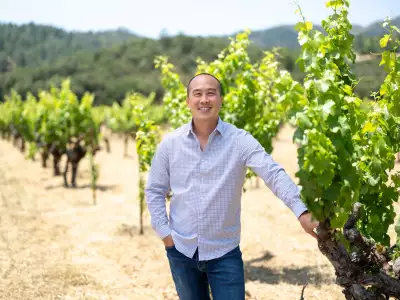
But it didn’t really take hold of me until my first vintage. I worked at Mumm Napa, a sparkling wine house here in Napa Valley. It was a great experience, but what really opened my eyes was a particular tasting.
The Institute of Masters of Wine holds an annual Champagne tasting in San Francisco, and they brought our entire team along. There were different tables dedicated to Blanc de Blancs, rosé, vintage and non-vintage Champagnes, with probably 30 or 40 bottles on each table.
As a young guy, you know about Champagne and perhaps you’ve tasted a little, but seeing the sheer diversity and the distinctive profiles was extraordinary. It wasn’t a single wine that changed everything for me. It was discovering just how many possibilities there were, what you could do with wine and how different wines could taste, look and feel. That was the experience that really sparked my passion.
SM: What was the first wine you made?
KO: The first wine I ever made was at college, while I was studying for my viticulture degree. It was a Grenache. I think I might still have one bottle left. I can picture it now, with its blue sticker and lot number.
For one of our classes, we worked in small teams to create a wine. We conducted various trials and learned about techniques such as pumpovers. At the time, it didn’t all connect because you’re trying to understand the science behind everything. I tasted a bottle about ten years ago. I’ve definitely improved as a winemaker since then!
I tasted a bottle about ten years ago. I’ve definitely improved as a winemaker since then!
SM: Winemaking is often described as a balance of science and art. Which comes more naturally to you?
KO: I think there’s a great balance, although certain winemakers naturally gravitate more towards one side than the other. For me, it started with science because I began my career in the laboratory. I have a fairly analytical mind, and that was how I initially understood winemaking.
When you’re working in the lab, you’re running numbers all day. You might taste a little, but you’re primarily looking at the chemistry and understanding what the winemakers are searching for. What are the indicators that prompt certain decisions? What might concern them?
As my career developed, I began connecting that scientific understanding with tasting, with what was happening in the vineyard and in the cellar. I started with science and gradually built everything else around it, understanding how those elements translated to what you perceive on your palate.
Once I understood those fundamentals, the artistic side became increasingly important. I knew how to make wine from a technical perspective, but the art of blending opens up so many possibilities. You could give four winemakers exactly the same four base wines and they’d produce four completely different results.
Experience plays a huge part, too. I’ve been fortunate enough to spend 12 vintages at Robert Mondavi Winery. Over that time, you develop a deeper understanding of the vineyards, how different components might work together and how those decisions will influence the wine in the bottle.
SM: How has your winemaking style evolved at Robert Mondavi?
KO: When I started at Robert Mondavi Winery, I was the oenologist. It was essentially the entry-level position on the winemaking team, and I was fortunate enough to learn from Geneviève Janssens, who became my mentor.
Geneviève was the director of winemaking at Robert Mondavi for around 20 years before me, and she had previously spent approximately eight years at Opus One. She has an extraordinary background, with more than 30 years of experience working with To Kalon Vineyard. Her knowledge of the different blocks, clones, historical vintages and how all those factors influence winemaking decisions is incredible.
She also had a direct relationship with Robert Mondavi himself, so I heard plenty of stories about him. My training was heavily influenced by the way Geneviève approached winemaking and the philosophy that Robert had instilled in her.
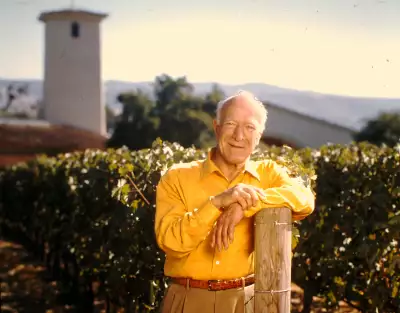
Robert Mondavi
She once told me about presenting one of her finished blends to Robert. He’d come down to the cellar to taste with her, and she’d poured him the To Kalon Vineyard Cabernet Sauvignon Reserve. He tasted it and said, “Well, that’s good, but what are you going to do better next year?”
That was his mindset. You always had to keep pushing, looking forward and thinking about what you could improve. You were never finished.
I learned a tremendous amount from Geneviève about the winery’s stylistic identity and the way its wines had traditionally been made. During my first couple of vintages, I was conscious of not wanting to get anything wrong.
SM: The pressure was on…
KO: Exactly! In my second vintage, 2016, I was the assistant winemaker. Another winemaker was away on maternity leave, which gave me the opportunity to make the Chardonnay and Pinot Noir. I was still a young guy, in only my second year with the team, and I wanted to make absolutely sure I was following the correct protocols. I didn’t feel I had a huge amount of freedom at that stage.
Looking back, though, it was incredibly important to understand how those wines had been made for decades and to ensure we were achieving the quality and stylistic goals expected of us.
As my career progressed, I began asking different questions. Could we improve something? Were there incremental changes we could make as a team that might have a meaningful impact on wine quality?
I’m not here to change everything, because what we’ve been doing for 60 years has been remarkable.
Even now, I’m not trying to put my fingerprint on every bottle. I’m not here to change everything, because what we’ve been doing for 60 years has been remarkable. It’s about finding the nuances that can make those wines even better in the glass. That might involve improving efficiency in the cellar, creating a better working environment for the team or making our operations more sustainable.
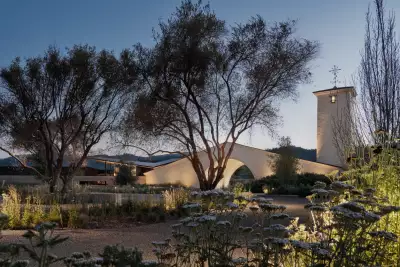
The biggest change, of course, has been the winery itself. We’ve just completed a huge renovation, which has introduced many new variables and opportunities over the past few years. I believe those improvements will elevate the wines even further.
So my personal style has changed a little, but it’s important to remain grounded in what the winery has been doing successfully for so long. The goal is to make incremental improvements, challenge ourselves every year and continue pushing the quality of the wines forward.
SM: Tell me about your latest release, the Robert Mondavi Winery 60th Anniversary Cabernet Sauvignon 2023.
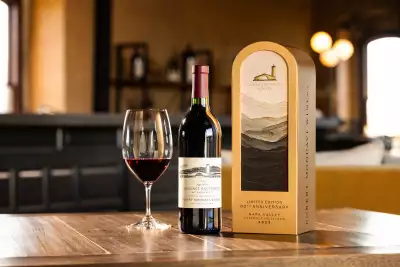
S Granlund
KO: I’m really excited about it, particularly because 2023 was also my first vintage as director of winemaking. We wanted to celebrate the winery’s history with something special, but the wine also commemorates its reopening. It was the first time we’d closed and reopened in 60 years, so this was a significant moment.
We wanted to create something that represented both our history and where we want to go in the future. When people around the world think of Napa Valley, they think of Robert Mondavi and Cabernet Sauvignon.
We wanted to create a wine that demonstrated why we’ve been so successful, and for me that came down to our two estate vineyards.
The first is To Kalon Vineyard in Oakville, where the winery is located. That’s where Robert chose to establish his namesake winery, and it’s obviously a hugely important and internationally renowned site.
The second is our historic Wappo Hill Vineyard in the Stags Leap District. It’s a 300-acre property where Robert Mondavi built his home. He lived there, and his sons, Tim and Michael, still live on the property. That made it another crucial part of the winery’s history.
We brought those two vineyards together in a blend comprising roughly equal proportions from each, using 100% Cabernet Sauvignon. I don’t think we’ve produced a blend quite like this in our 60-year history, which makes it particularly special.
I’m delighted with how it came together. It’s a beautiful wine that’s already showing extremely well, but it also has the concentration and density required to cellar for decades.
I’m equally excited about the packaging. The new label is beautiful, with elements reminiscent of our original 1966 label alongside references to the new architecture we’ve introduced during the renovation.
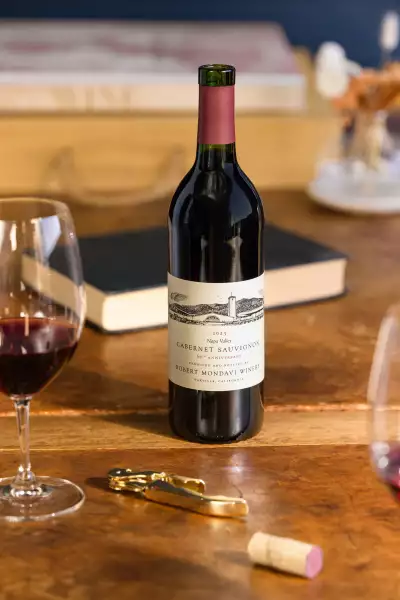
Robert Mondavi Winery 60th Anniversary Cabernet Sauvignon 2023
S Granlund
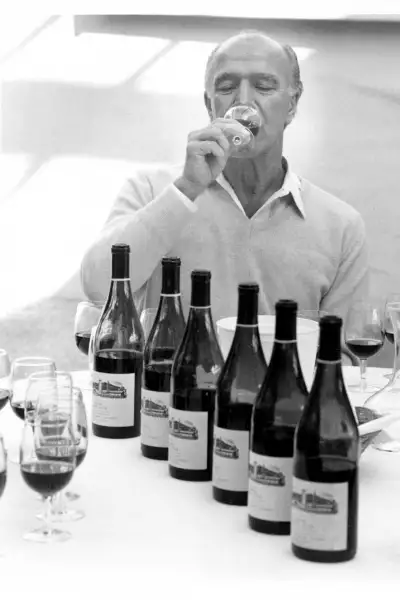
Robert Mondavi tasting his own wines.
SM: How has the wine industry changed during your career?
KO: I think people still love wine, but there are simply so many more options available today. That’s happening across the world, and I think it’s contributing to the general decline we’re seeing in wine consumption.
But I’m optimistic. I feel we’re going to move upwards from here.
The next generation of drinkers has an enormous range of choices. There are so many interesting things they can try, so we need to give them reasons to gravitate towards wine. We need to share our stories and create compelling experiences.
That’s partly why we’ve renovated the winery. We wanted to improve the entire experience of visiting us. It’s not just about having great wine in the bottle. It’s about experiencing Napa Valley as a whole.
There’s something special about sitting with a glass of wine and looking out towards the very vineyard where those grapes were grown and harvested. That connection is incredibly powerful.
We’re trying to improve the bigger picture – the entire experience surrounding wine – to attract more people to the category.
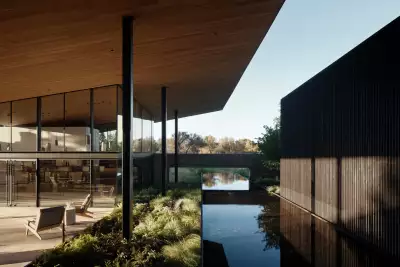
The newly renovated Robert Mondavi Winery
Adam Rouse
SM: Who’s your winemaking hero?
KO: Geneviève, without question. We’ve grown very close over the years. She hired me, and she’s such an important figure in the wine industry, particularly here in Napa Valley. She’s been an incredible mentor.
We still taste wines together and occasionally walk through the vineyards. She keeps me on my toes, which is so important. Having her perspective and experience helps ensure we’re staying true to the winery’s identity while continuing to move forward.
SM: What’s your most memorable experience from your time in the industry?
KO: Ten years ago, we celebrated the winery’s 50th anniversary with a big dinner. We invited former winemakers and Robert Mondavi alumni to join us.
Some of the finest winemakers in the world have passed through the halls and cellars of Robert Mondavi Winery, so it was a real who’s who of the industry. I was still a young guy, in my second year on the team.
We’d enjoyed an extraordinary dinner with a wonderful selection of wines and food. It was held in the Vineyard Room on the south side of the winery.
Towards the end of the evening, the servers started bringing trays around containing small pours of red wine. Nobody knew what it was.
Everyone began swirling, sniffing and tasting. There was a real buzz around the room as people tried to work out what they’d been served.
Then a gentleman stood up.
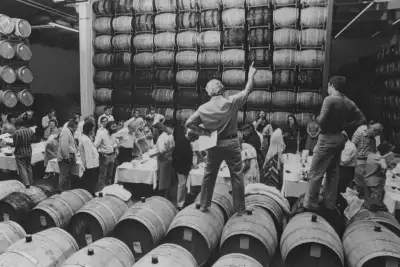
A photo from the archives of Robert Mondavi delivering a speech to workers
He said, “My name is Warren Winiarski. I was the first winemaker here at Robert Mondavi Winery. This is the first vintage we made – the 1966 Cabernet Sauvignon.”
He started talking about what he remembered from making that wine. Parts of the building hadn’t even been finished when they started crushing fruit. He remembered contractors running around, the smell of sawdust and all the activity of a winery that was still being built.
It was one of the most surreal experiences of my career. Here I was, enjoying an incredible career at this historic winery, tasting the very first Cabernet Sauvignon it had produced, while listening to the man who made it describe what had happened.
Of course, Warren went on to establish Stag’s Leap Wine Cellars and became a hugely important figure in Napa Valley’s history.
It was a remarkable moment, and something I’ll never forget.
SM: What’s the most important lesson you’ve learned?
KO: I think it’s simply to never stop learning. There’s always something new to discover. You’re never finished.
If you think you’ve learned everything there is to know, perhaps this isn’t the right career for you. You’re certainly not going to be as successful as you could be.
Winemaking is particularly interesting because we’re always at the mercy of Mother Nature. Every vintage is different. You might add a few new tools to your toolbox each year, but Mother Nature will inevitably give you something different to work with the following season.
That keeps you on your toes. It keeps you wanting to learn, grow and evolve.
That’s why the vintage on a bottle is so important. It represents a particular growing season and the collective efforts of so many people, bringing together all their passion, knowledge and experience.
All of that ultimately comes together in a single bottle that someone can purchase and enjoy. So the biggest lesson is to never stop pushing yourself to improve.
Adam Rouse
SM: What do you drink at home?
KO: I drink a fair amount of wine at home, but after a long day of tasting, to be completely honest, there’s nothing better than a cold beer! Something really fresh and bright. It’s a palate cleanser.
But I have quite a few different wines in my cellar. There’s plenty of Mondavi, obviously, but I’ve also got Spanish wines, Chardonnay and Pinot Noir from Oregon, and some interesting bottles from California’s Central Coast.
I’m always looking to explore. It comes back to that philosophy of never stopping learning. There’s so much wine out there that I still want to discover.
See more at robertmondaviwinery.com