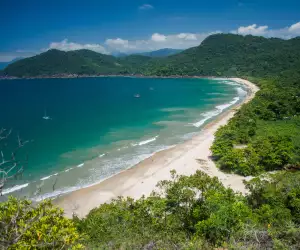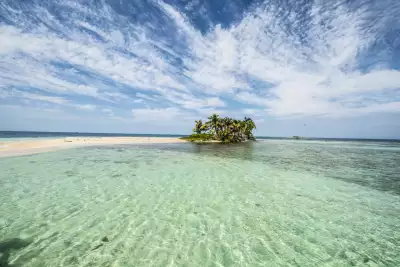
It’s a quarter to sunset, and I’m standing, margarita in hand, knee-deep in the warm, turquoise waters of the Caribbean Sea. I am on the western shore of Caye Caulker, a tiny but idyllic island made of coral, just off the coast of Belize. A dozen stingrays are taking it in turns to glide playfully over my feet, each attempting to tickle me into feeding them.
I resist (for reasons I’ll explain later) and instead turn my attention to a brown pelican perched on a wooden pole rising out of the lagoon a few feet away. He, in turn, has his laserlike stare fixed on a nearby parrotfish in an attempt to hypnotise it out of the water and into his huge, sagging pouch. It’s what you might call a three-way Belizean stand-off. A picture postcard moment of man, nature and tequila-based cocktail in perfect harmony. And it comes at the end of a tour around a country I have fallen hopelessly and irrevocably in love with.
I’m not the first to have succumbed to the charms of this pint-sized paradise, a nation of less than 500,000 people nestled between its gargantuan neighbour of Mexico to the north, and Guatemala to the south and west. The geography alone should clue you in to the fact that Belize is mega-rich in biodiversity: more than half of it is covered with lush forest and jungle, most of that comprising national parks and wildlife sanctuaries. Rumour has it that Madonna’s 1987 single ‘La Isla Bonita’ is named after the Belizean island of Ambergris Caye, home to the town of San Pedro she dreamt about in her “Spanish lullaby”.
The country, which boasts the largest barrier reef in the Northern Hemisphere, has long been a favourite destination of discerning Americans – Leonardo DiCaprio and Francis Ford Coppola both own property here – but is rarely stamped in the passport of even the most well-travelled Brit. Which is strange because, prior to 1981, it was part of British Honduras. Some of the banknotes still in circulation carry pictures of our late Queen, and English is officially the first language spoken by locals (the only country in Central America to do so), along with a lively English-based creole.
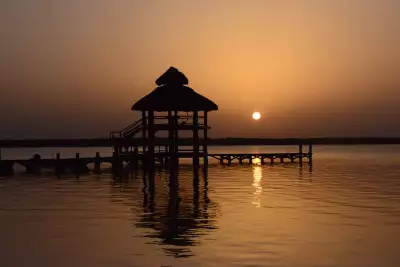
Corozal Orchid Bay
I had joined G Adventures’ ‘Explore Belize’ group tour, a nine-day adventure which starts off in the rustic village of Burrell Boom, just outside the country’s former capital, Belize City. G Adventures has partnered with the National Geographic Society for a series of expeditions called National Geographic Journeys, and this is one of the highlights. The partnership dictates a commitment to responsible travel that includes strict policies for staff and partners to mitigate negative impact on animal welfare (hence me being asked by my guide not to feed the stingrays; it encourages dependency), as well as guidelines for interactions with indigenous people.
It doesn’t mean that guests are restricted or enjoy their holiday any less, however. I made a solo, ‘off-piste’ detour by taxi to Belize Zoo in order to meet the country’s comical-looking national animal, the Baird’s Tapir, which looks like it’s been brought to life from the wonky drawings of a three-year-old. Following the rules is no hardship (“Don’t ride wild elephants” is verging on the obvious) but does help you to feel a little less like a tourist, and more like a genuine traveller.
The first full day of the tour brings a speedboat ride up New River to Lamanai, one of the oldest Mayan archaeological sites in Central America, dating back to 1500 BC. It’s an exhilarating rush through crocodile-infested waters teeming with exotic wildlife that flies past me so fast I feel like I’ve been teleported into a David Attenborough documentary played at high speed (well, 26 knots). Hilberto Novello, the Mestizo (a mix of indigenous and Spanish) skipper, is 55 but has 20/20 vision, his steely eyes constantly darting left and right, combing the area as he steers. Suddenly, he brings the boat sharply to a halt and points to an Anhinga (‘Devil Bird’) in the branches of a Santo Domingo tree overhanging the lily-fringed riverbank.
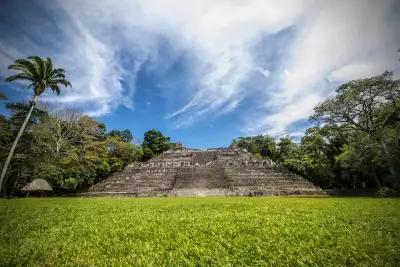
Caracol is Belize’s great jungle temple complex – a vast Maya city of pyramids and plazas
Below it, a sleek diamond-backed watersnake hunts for a lunch of Mayan catfish; catching one, she swallows it head first to avoid being stung by its sharp pectoral fins. Using the Swarovski Optik NL Pure binoculars I’d brought especially for the trip (the best for wildlife spotting, apparently) – and aided by Hilberto who emulates the call of native birds to encourage them to appear – I admire herons of every variety, snowy egrets, and even a sungrebe. The latter is considered a ‘life bird’ tick on the list of the many avid birders who flock to Belize for the ornithological bragging rights it offers.
Next morning is a trip to the nearby Community Baboon Sanctuary which was partially co-founded by a National Geographic grant. This 20-square-mile nature reserve is dedicated to the conservation of the 5,000 Yucatán black howler monkeys (locally called baboons) whose existence was previously threatened by the loss of habitat caused by Belize’s historical main industry, logging. The mahogany tree even features on the country’s flag, which depicts two woodcutters alongside the national motto in Latin; translated, it reads “Under the Shade (of the tree) I Flourish”.
These monkeys are called howlers for a reason, and the sanctuary’s likeable, laid-back guide, Robert Sydney Panting, uses mimicry again to attract them out of the dense tree canopy above. He also tracks them by looking and even smelling for their droppings on the ground. “Howlers defecate as soon as they wake,” he tells us, “and it can be a mighty unpleasant alarm call to anyone standing below, given that the trees they sleep in are up to 80 feet high.”
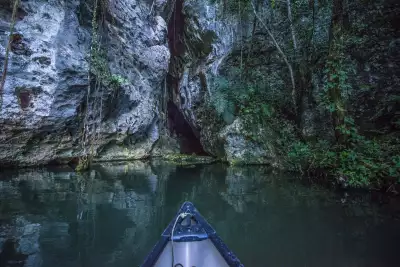
Barton Creek Cave
Robert’s growl is no match for these aerial-bombing baboons when we finally hear them, though; their 90-decibel roar is second only to a lion in the ‘mammal loudness’ rankings – although the monkeys probably beat the lions hands-down in the ‘long-distance defecation’ stakes.
Next stop is a visit – via a backcountry drive through rolling hills and serene-looking villages with names like Teakettle, Buttercup and Scotland Halfmoon – to a women’s cooperative in San Antonio whose work in the community is also partly funded by G Adventures. The women, some of whom are victims of domestic violence, make and sell pottery and embroidery – traditions deeply embedded in Mayan culture – as well as local delicacies in their open-air shop and restaurant.
Here, I tuck into chicken tamales cooked with the women’s own home-made hot sauce. It’s good but not as fiery as the Marie Sharpe’s brand, a bottle of which seems glued to the table of every restaurant in Belize and is the perfect spicer-upper to the country’s traditional comfort dish of cow foot soup and jacks (doughy bread pillows). Word to the wise: it’s also an excellent hangover cure should you imbibe too much of the excellent local Belikin beer.
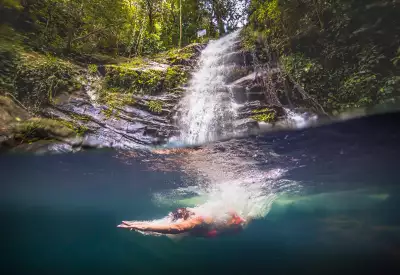
Taking the plunge beneath the 150-ft Big Rock Falls.
We spend the night and following day at San Ignacio, an earthy town with a distinctly mellow, backpacker vibe. Retired Rastafarians ride around the colourful open food market on rusty old clunkers, playing reggaeton music from speakers mounted on the high handlebars. As well as offering plenty of vibrant bars and good restaurants, it’s also the launching pad for travels around the Cayo District.
This eco-tourism hub is home to the ruins of Xunantunich, a ninth-century complex of temples and palaces – including the 39-metre-high El Castillo pyramid – that is Belize’s most visited attraction. I join an optional excursion to Belize Botanic Gardens for an easygoing ramble through 45 acres of verdant forest in the foothills of the Maya Mountains. There are over 100 species of orchid growing here, including the national plant, the Black Orchid, whose flowers are a deep shade of purple.
Climbing over ancient tree roots, we reach a hide halfway up a native Fire Tree from which we spot the three kinds of vulture native to Belize (Turkey, Black and King Vulture). They circle, majestic but menacingly, above the canopy of the rainforest below while a golden-fronted woodpecker goes about its demolition work on a neighbouring tree trunk. Back on the ground, I try eating termites for the first time when our guide, Rommell, encourages me to lick my finger and dip it into a nest in a dead tree; verdict: surprisingly minty.
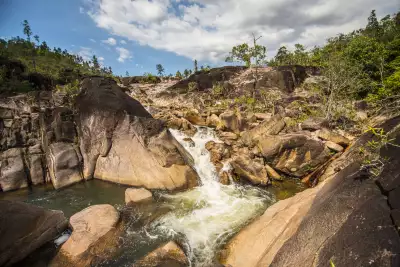
Rio on pools
The nature trail continues with a visit to Green Hills Butterfly Ranch, home to around 1,500 of these winged insects, comprising 30 species from the 700 or so that are native to Belize. This 100-acre rainforest estate contains hothouses that, as we walk through them, butterflies land on our clothes, attracted by bright colours. In addition to the 300 exotic species of bird that live here, such as hummingbirds and long-billed hermits, there are creatures I had never even heard of, such as agoutis (a guinea pig-like rodent), margays (similar to jaguars, which also roam the forest) and gibnuts, locally known as ‘royal rats’.
Our tour ends at Caye Caulker, via a one-hour ferry trip from Belize City. The local motto is “Go Slow” and it would be easy just to pull up a sun lounger on one of the golden beaches of this breezy, laid-back isle and do nothing but simply gaze up at the pelicans and magnificent frigatebirds soaring overhead. I’d signed up, though, for a bike ride around the sandy, car-free streets (all motor vehicles are banned except scooters and golf cart-style buggies) with students from Ocean Academy.
It’s the only high school on the island and its ‘Bike with Purpose’ project is another initiative supported by G Adventures, which donated the Schwinn beach cruiser-style bikes they use. We ride first to the school, accompanied by friendly stray dogs (the locals call them ‘pot-lickers’) who run alongside us, happily carefree, and then to a mangrove lagoon where we feed the eight-foot-long tarpon fish who give ‘acrobatic’ displays in the water.
The final day brings a snorkelling tour with Ragga Sailing Adventures (run by Charlie from Wimbledon) where we see moray eels, lobster, nurse sharks, barracuda and turtles when we dive down into the crystal-clear waters around the reef. As we weigh anchor just off San Pedro (Madonna’s La Isla Bonita), I lie on the deck, soaking up yet another Caribbean sunset, and reflect on the wisdom of the Material Girl’s vacation choices. According to recent reports, she’s lately fallen in love with Margate (well, she is getting on a bit now) but for me, I’ll always thank my Lucky Star I chose to holiday on the wilder side in Belize.
This nine-day ‘National Geographic Journeys: Explore Belize’ tour from Belize City to Caye Caulker from G Adventures costs from £1,599pp including all accommodation and activities (excludes international flights). For more information, see gadventures.com