There are complications – and then there are grand complications. The perpetual calendar sits firmly in the latter camp: a mechanical rebuke to the idea that a wristwatch should simply tell the time.
Properly executed, it tracks the day, date, month and leap-year cycle, adjusting automatically for 30- and 31-day months and the quadrennial quirks of February, all without human intervention until 2100 (or considerably longer in some of the examples below).
To compress that level of calendrical intelligence into a few square centimetres of metal is one of watchmaking’s great flexes. Hundreds of components work in silent choreography beneath the dial, advancing in perfect sequence at midnight while you sleep (or don’t).
Small wonder, then, that the perpetual calendar has long been regarded as a litmus test of haute horology – a stage on which maisons demonstrate both technical mastery and aesthetic restraint.
Here, Alan Seymour selects the standouts: watches that bend time to their will, and make it look effortless in the process.
Patek Philippe
5236P In-line Perpetual Calendar
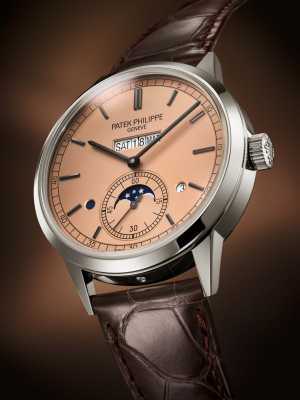
In 1925, Patek Philippe introduced the world’s first perpetual calendar wristwatch in the form of the No. P-72. As the OG of the wristwatch perpetual calendar game, Patek’s offerings are among the most sought-after on the market. And its ref. 5236P ‘In-Line’ is certainly no exception.
Drawing inspiration from a number of vintage pocket watches Patek produced for the American market, and for the first time on wrist, the 5236 displays its calendar information in a logical, single straight-line 12 o’clock window.
Automatically wound with a platinum micro-rotor, the movement’s 118 additional-part calendar mechanism is protected by no less than three patents. Day/night, moonphase, ‘small seconds’ and leap-year cycle indication are also displayed.
Breguet
Classique Quantième Perpétuel 7327
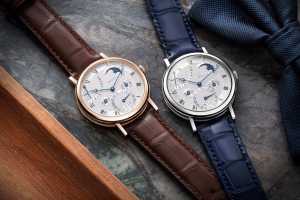
Breguet was the first watchmaker to design and produce a perpetual calendar movement specifically intended for a wristwatch.
Despite being the first overall, Patek Philippe’s No P-72 used a movement initially developed for a ladies’ pendant watch. Breguet’s current ‘PC’ offering is the Quantième Perpétuel 7327, a cultivated 39mm self-winding contemporary expression of traditional fine watchmaking, available in either white or rose gold options. Both equally handsome.
Note well, the moon-tipped hands, guillouché engraved dial and multiple off-centred dials – all elements introduced to horology by Breguet’s eponymous founder, Abraham-Louis Breguet.
A Lange & Söhne
Datograph Perpetual Tourbillon HoneyGold “Lumen”
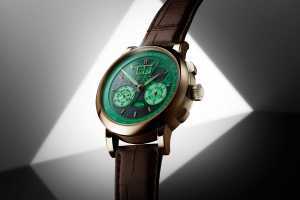
As its name suggests, the Datograph Perpetual Tourbillon HoneyGold “Lumen” combines a host of Lange’s most beloved brand attributes in one package.
Namely, the namesake Datograph ‘big date’ and flyback-chronograph complications; proprietary Honey Gold alloy; and a transparent dial combined with extensive amounts of lume across the sub-dials, tachymeter ring, date wheels, and hands.
A moonphase, rear-mounted tourbillon and, of course, perpetual calendar have also been invited to the party. Cramming all this into an exhibition-back 41.5 x 14.6mm case, the watch is limited to 50 pieces only.
Breitling
Navitimer B19 Chronograph 43 Perpetual Calendar

With the B19, Breitling has integrated a perpetual calendar into its classic Navitimer pilot’s chronograph model.
Employing a distinct 12/3/6/9 o’clock quadrant sub-dial layout, with moonphase and an encircling bezel-operated slide rule scale (something of a signature for the Navitimer collection) the watch displays a considerable amount of information in an approachable manner.
Boasting a 43mm stainless-steel case, platinum bezel, and a very striking ice blue dial, it’s driven using Breitling’s self-wound, COSC-certified Calibre B19 movement with a respectable 96-hours of power reserve.
Audemars Piguet
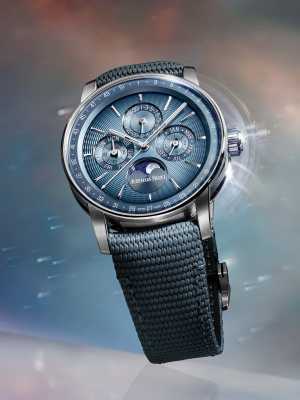
Code 11.59 by Audemars Piguet Selfwinding Perpetual Calendar
The perpetual calendar is designed to accurately display the correct day, date, month and year – automatically adjusting for both the differing lengths of months and leap years – until, at next count, the year 2100. Gulp.
To engineer all this into a mechanical wristwatch is staggering – and only few can manage this feat.
Celebrating its 150th anniversary last year, Audemars Piguet rebooted its perpetual calendar line-up with a new self-wound perpetual calendar movement: the Calibre 7138.
Impressively, the new calibre is entirely crown set. A moonphase is found at the 6 o’clock position and, judiciously, the day/date/month sub-dials are now orientated to reflect the European calendar date format.
Making its debut in both the Royal Oak and Code 11.59 collections, the 11.59 variant employs a 41mm white-gold case with a ‘smoked blue’ dial.
IWC
Portugieser Eternal Calendar
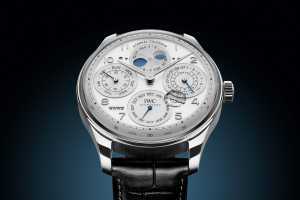
Generally speaking, setting a perpetual calendar is an onerous task, involving myriad tool-operated ‘hidden’ pushers. But in 1985, IWC created the first solely crown-set perpetual calendar.
Building on this lineage, IWC released the Eternal Calendar, whose movement fully compensates for the Gregorian calendar’s irregularities and is accurate until at least the year 3999; the world stage is currently undecided on whether or not year 4000 will skip the leap year.
To sticklers for accuracy, rest assured the moonphase, however, is guaranteed to remain accurate for an astonishing 45 million years. Just don’t forget to keep it wound.
Bovet
Récital 21

Proudly displaying the complex inner workings of a perpetual calendar, for the latest iteration of its Récital 21 model, Bovet has used ‘open’ sapphire crystal dials with either a green, blue or brown tint.
It boasts a hand-wound manufacture movement with five days of power reserve, as well as a retrograde ‘pointer’ style date hand/scale. Notably, the Récital 21’s case – titanium, measuring 44.4mm in diameter – is angled to better sit on the wrist in what Bovet calls its ‘writing desk’ style.
To enhance the visual impact, the watchmakers developed a mechanism that slows down the date hand during its retrograde jump, an effect that can best be appreciated when the last day of the month changes to the first.
Chopard
L.U.C Lunar One
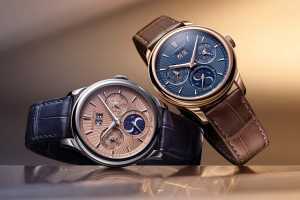
Chopard’s take on the perpetual calendar, the L.U.C Lunar One, utilises a classic 3/6/9 sub-dial layout to display readings for its calendar and moonphase complications (with moonphase sharing a dial with a running seconds function), topped off by a ‘big date’ at 12 o’clock.
Displaying the moon’s current orientation when viewed from either the Northern and Southern hemispheres, the moonphase also bears depictions of the North’s Big Dipper and South’s Crux star constellations.
The astronomical display is accurate to one day in 122 years. Renowned for its finishing, Chopard has used Côtes de Genève engraving on the movement’s bridges and hand-engraved ‘sunburst’ guilloché on the dial.
Baume & Mercier
Riviera Calendrier Perpétuel
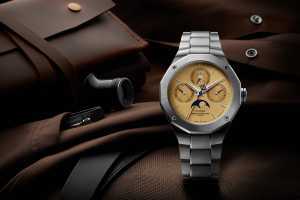
A product of the integrated bracelet, ‘sports watch’ school of design, Baume & Mercier’s Riviera collection first saw use of a perpetual calendar in 2003, on the occasion of the line-up’s 50th anniversary.
More recently we’ve seen the release of a sophomore Riviera Perpetual Calendar, in the shape of the ref. M0A10786. Highlights include: a 40mm dodecahedral case, a moonphase, a brushed anthracite dial with snailed sub-dials, a Côtes de Genève decorated automatic movement, a sapphire crystal caseback, a quick-change bracelet/strap system, and 50m of water resistance.