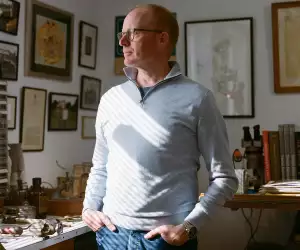
When you think of Leica, you of course think of cameras. But its watch division is beginning to carve out an identity of its own. Helping shape that next chapter is Henrik Ekdahl, managing director of watches and accessories (technically, of Ernst Leitz Werkstätten), who returned to Leica in 2024 after 17 years at IWC Schaffhausen – and an earlier stint with Leica in the 1990s.
Meeting him at the brand’s headquarters in Wetzlar, Germany, it’s obvious that Ekdahl understands the opportunity for growing Leica’s watch division lies in leaning into its photographic world without simply turning cameras into watches.
To find out more about his plans, I spoke to him about how the collection is evolving and how he plans to turn a camera brand into a serious watchmaking proposition.

Per Schorn
Square Mile: You left Leica in the 1990s. What brought you back in 2024?
Henrik Ekdahl: I left after two years because, honestly, Leica was not like this [gestures to the surroundings]. Leica was in a rebuilt furniture factory in a small village about 10km from here, and coming from Stockholm and living here was not easy. I moved to Giessen, which is a university city about 20km away. But after two years, I felt I needed to move to a bigger city – so I moved to Munich and worked for Cartier.
I always kept in touch with Leica because I was into photography and I loved the brand. I remember having a discussion with a headhunter once, maybe five or six years ago, and she asked me what kind of brand I would like to work for – and I said Leica. I always kept in touch with some of the people I had already worked with here when I was younger. The head of Leica Germany, for example, was already a buddy of mine back in those days.
While working for IWC for 17 years, sometimes we needed to source gifts. IWC sponsored the America’s Cup and we needed binoculars, so I said, “I have a contact at Leica. I’ll get you very nice, small binoculars.” We also bought cameras as VIP gifts and put Santoni leather on them because IWC was working with Santoni.
I very much enjoyed working for IWC, but after almost 17 years, it was enough. I also did not really want to go to another watch brand competing with IWC. It was like when I worked for BMW; I did not want to join Audi. I have had the privilege of always working with brands I really believe in, which fit with my DNA. Going from IWC to Omega, or something like that, would have felt wrong. Going to Leica was different because we are not really competing with any watch brand. Then I received an email or a call, we met, and that is how it went.

The Leica ZM 1 Urban Green shown on both strap options, pairing the collection’s clean, instrument-like design with fumé noir dial fading from a deep green to black.
SM: Some current employees have worked at Leica for 45 years. What do you think that says about the company as a place to work?
HE: I think it is a sign that people love the brand. Every person is a photographer here or a hobby photographer, so it’s a good sign that people stay a long time. At the same time, you need fresh blood, thoughts and ideas from time to time, so you need a mixture. I think it’s a pretty good blend – and it’s a very international team. Not just here, but overall, Leica is super international. We have people from all over the world. I think it is a good sign that you have people around who have worked for a long, long time, but at the same time you have new spirits joining.
SM: What was your first watch – and do you still have it?
HE: It was a Seiko automatic. I got it when I was seven years old and yes, I still have it. I wanted a watch, and we went down to a jeweller. I remember there was a James Bond advertisement for Seiko with a digital watch. It was 499 Deutsche Marks. The one I got was analogue and cost about 140 Deutsche Marks, so about one-third of the price, but it was by far not as cool as the digital one I really wanted.

The ultra-modern architecture of Leitz-Park, the official global headquarters of Leica Camera AG, located in Wetzlar, Germany
SM: Since you joined Leica Watches, what are some of the design decisions you have fought hardest for?
HE: What you see now was already in the pipeline, with the exception of the ZM 12, where we chose colours and so on. It takes a long time to change things in this industry. When you start, you do not have a network of suppliers you can rely on completely, and you always have to check. Trust is good, control is better, so it takes time.
What we have now are design renderings for the next models, which are very nice and based on the past, but of course they have been changed because we need to come up with something new.
I think the closer we are to the world of photography and cameras – whether that’s materials, design or features – the easier it gets for us because that is our niche.
There are certain cameras that have a fantastic combination of colours and materials; that would be something I would like to add to Leica’s watch collection.

Leica ZM 11 featuring blue textured dial and vibrant orange textile strap.
SM: Could you see Leica exhibiting at a major fair such as Watches & Wonders?
HE: We, of course, think and dream about that. But at the same time, when you look at Watches & Wonders and know how big Leica is in the world of photography and cameras, you have to ask how big or small Leica Watches should be before it exhibits at Watches & Wonders? We are not talking about Rolex or IWC size, but I do not see us being there as one of the independent brands, either. And I do not want to be too small, because we are Leica.
So I do not see the perfect format for our presence there yet. Honestly, considering how much it costs, I would rather invest it in local activities with retailers who believe in us, or continue to do PR-led projects with photographers and partners.
One day we might be there, or maybe there are other fairs where we can start. We have been at WatchTime in New York. I stood there for two and a half days demonstrating watches and getting feedback. It was fun, and it was in a very cool location called Gotham Hall, only five minutes south of Times Square. So we have been at fairs, just not Watches & Wonders.

The Leica ZM 12 brings the brand’s photographic design language into sharper focus, pairing a textured dial with understated proportions.
SM: How would you like to see Leica Watches evolve over the next five years?
HE: We will build our own cases. We will add optical features from the world of photography. We will introduce models into the entry-price segment – ones which look great and have a fantastic design.
Our designer worked for 22 years at IWC and was in charge of the Portugieser and Pilot’s Watches, so that is pretty huge.
We will also expand our distribution, not just through Leica stores. It would be great to get recognition that Leica is not trying to be a pure watch brand but has interesting watches. That is how I would put it. We have our egos under control here. We are realistic, but we have fantastic design heritage. At the same time, I do not believe in using too much of the design language we use in cameras. Take inspiration, yes, but do not copy it.
Learn more at leica-camera.com