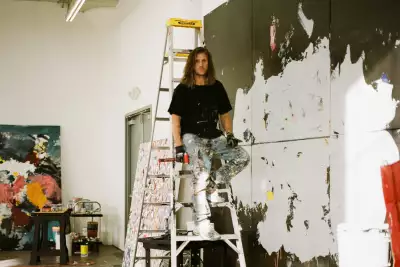
The Irish artist Robyn Ward treats ideas as combustible forms – neurological sparks that ignite gargantuan canvases layered with urgency and passion.
The global nomad cut his teeth in Belfast as an anonymous street artist whose early works interrogated the fractures of modern identity, consumer culture and political malaise, but his increasingly large-scale abstract paintings have moved into profound expressions of the void and the collective consciousness – his surfaces resembling conceptual battlegrounds where explosive colours collide, seduce and overwhelm.
And it could be argued that his close creative relationship with renowned curator and collaborator Shai Batel has had some part in this evolution, refracting that initial spark into the sustained action that has resulted in the Ward becoming a globally recognised art world staple.
Batel entered Ward’s orbit not as a manager or mere promoter but as a conceptual interlocutor who listened to the core questions behind his practice and pushed them outward to new audiences. Where Ward begins with an image or a visceral impulse, Batel frames those impulses within larger narratives – exhibition architecture, public engagement, critical context – without softening the rawness that made them so enticing in the first place.
As such, their partnership is a continual negotiation between immediacy and shape – Ward supplies the fizzing, electric material, Batel arranges the current so it lights rooms differently.
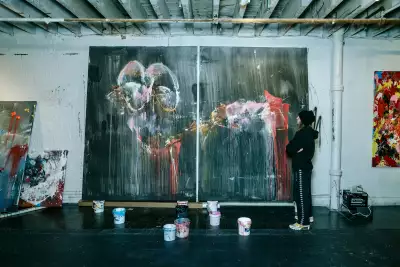
Together they have translated solitary studio gestures into acclaimed public events that continue to broaden Ward’s register. Batel’s curatorial eye identifies the themes already embedded in Ward’s work, such as memory, class and loss, and devises formats that let viewers enter those stories.
Exhibitions curated by Batel emphasise encounter and reflection – inviting audiences to grapple with the artifacts and narratives Ward lays bare in bespoke environments. Their collaboration iterates the fact that how you tell a story matters – Ward provides the fuel and Batel sculpts the way in which it is presented.
Essentially, the partnership turns solitary invention into a shared experience, shaping how Ward’s provocation is seen, read and felt by a wider public.
In this interview with Square Mile the artist unpacks the ongoing collaboration, tells us why he is most interested in tension between the seen and unseen, and explains why being challenged in a relationship has more value than affirmation and agreement.
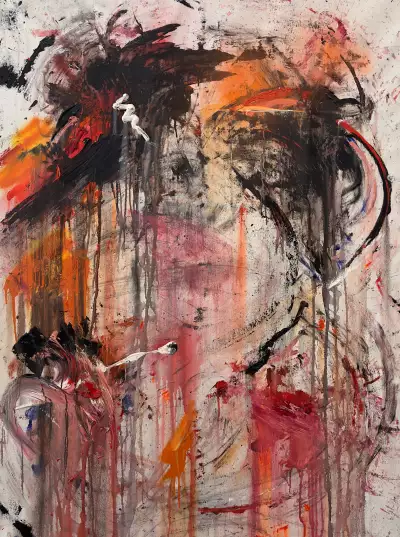
Distant Memories by Robyn Ward
Square Mile: In your practice, destruction seems just as vital as creation. How do you conceptually balance the act of marking the canvas with the act of defacing it – when does a painting transition from damaged to finished?
Robyn Ward: I don’t really think of it as destruction anymore. Earlier in my career I probably would have described it that way, but, over time, I’ve come to see the process more as excavation.
The paintings are built through accumulation. Layers of pigment, charcoal, dust, marks, revisions and failed decisions build up over long periods of time. The scraping back isn’t an act of aggression against the surface. It’s more about trying to uncover something that’s already sitting inside it.
Very often the most important parts of a painting are buried long before they become visible. It is a very physical process. I use whatever feels right at the time – hands, tools, objects, pressure, removal. The surface takes a beating, but that is usually where the painting starts to become honest. Sometimes the painting has to get ugly before it tells the truth.
SM: It sounds like a process of internal push and pull …
RW: I’m interested in the tension between what remains and what disappears. Memory works in a similar way. We don’t remember events perfectly. We edit them, compress them, lose parts of them and preserve others. The paintings go through something similar.
As for when a work moves from being damaged to being finished, I don’t think there’s a clean dividing line. Most of the paintings pass through periods where they look completely broken. If they don’t, I usually become suspicious.
A painting is finished when it stops resisting itself – when all the additions, removals and contradictions finally feel like they belong together.
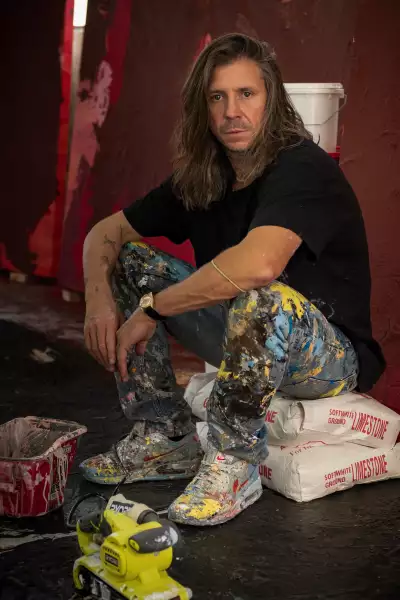
Chance Falkner
SM: You live a nomadic existence. How has that influenced your perception of identity and belonging? Do you view your canvases as a way to construct a fixed ‘home,’ or are they reflections of transient environments?
RW: I’ve spent much of my adult life moving between cities and countries. Looking back, I think that inevitably found its way into the paintings. Not literally, but psychologically. When you’re constantly arriving somewhere new, you become aware of what you carry with you and what you leave behind. You also realise that identity isn’t as fixed as people like to think. It keeps changing, whether you want it to or not.
I probably used to confuse movement with freedom. Now I think it was also a way of trying to understand where I belonged. I don’t think of the paintings as a home. They’re closer to records of searching. They let different places, memories and feelings sit together without forcing them into one clean story.
I don’t think of the paintings as a home. They’re closer to records of searching.
SM: How do you hope they will impact the viewer?
RW: I don’t want to tell people what to think about themselves. That would be the wrong way round. The details may come from my life, but uncertainty, loss, change and wanting to belong are not exclusive to me. The paintings become more interesting when they stop being about me and start holding something for someone else.
SM: In a world obsessed with individualism and the ‘selfie,’ your work leans into the abstracted or veiled – what does the act of obscuration achieve for you?
RW: I think we live in a culture that often mistakes visibility for understanding. The assumption is that the more something is revealed, the better we understand it. My experience has generally been the opposite.
A lot of the things that matter most are difficult to describe directly. Memory, grief, anxiety, hope, love – they rarely arrive as clear images. They come in fragments. Abstraction lets me work closer to that. The act of obscuring isn’t about hiding information. It’s about resisting certainty.
Once an image becomes too fixed or too illustrative, I usually lose interest in it. I don’t want to over-explain the work. I also don’t want people to completely project themselves onto the paintings. I want them to meet the work halfway.
Some of the best conversations I’ve had about the work have been with people who saw something completely different from what I thought was there.
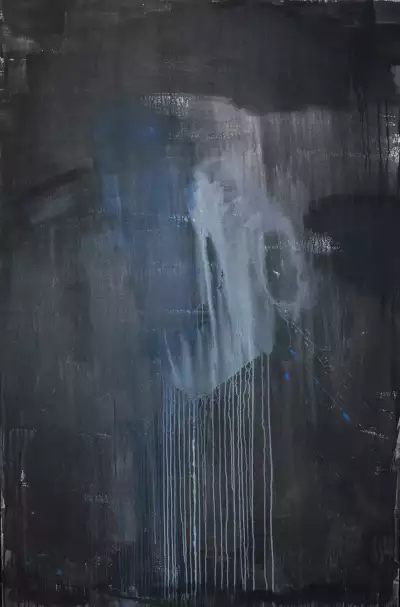
Bobby's Revenge by Robyn Ward
SM: As I understand it, for Walking in the Dark, Shai Baitel designed a highly unconventional exhibition space, including a pitch-black basement where viewers experienced your installations. Did Baitel’s literal manifestation of the darkness alter the way you viewed the psychological weight of your own canvases?
RW: One of the reasons the relationship works is that we don’t approach the work from the same place. I make decisions intuitively in the studio; Shai looks from a greater distance and identifies larger patterns.
The pitch-black exhibition wasn’t something I had thought of exploring myself, but once it played out, it felt completely natural. It wasn’t trying to illustrate the paintings. It was extending something that was already present in them.
Walking in the Dark moved from New York in 2023 to London during Frieze and eventually to the Modern Art Museum Shanghai, where the programme that year included artists such as Marina Abramović and David Hockney. What stayed with me was not the scale of that context, but seeing how the same body of work could shift as it moved through different spaces and audiences.
Throughout that process, Shai kept returning to themes that I wasn’t always consciously considering myself. Not because they weren’t there, but because I often work instinctively before I fully understand why I’m making certain decisions.
What I value most is not agreement, but challenge. With Shai, the useful part is that he can make me look again at something I thought I already understood.
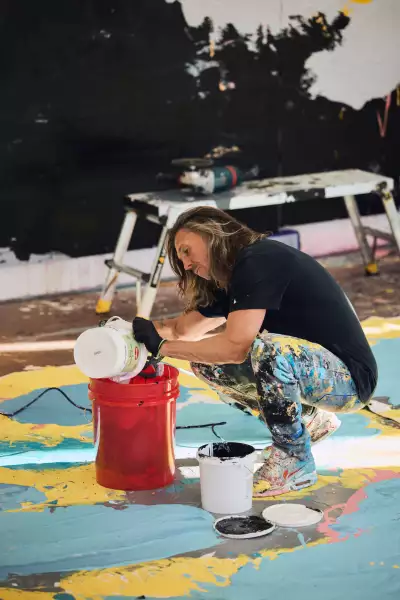
Justin Flewaway
SM: Baitel has noted that your nomadic lifestyle abstracts the deeper reasons for your roaming. Curators can be mirrors to an artist’s lifestyle. When Baitel began framing your geographic restlessness as a central thesis for your work, did it force a revaluation of your own motivations?
RW: I don’t think he changed my motivations, but he probably helped me recognise patterns that had become invisible through familiarity. Sometimes it takes somebody standing outside the work to point out connections that are obvious to everyone except the person making it.
The collaborative process we have is mostly conversation. It isn’t someone telling me what to make. The work originates in the studio; the conversations come afterwards, when we’re trying to understand what it’s doing and where it might lead. Over time, those conversations have become less about single exhibitions and more about longer trajectories.
Walking in the Dark became the first chapter of a larger trilogy. Shards of Dawn is the second. With Shards of Dawn, that conversation moves into a different material language – including repurposed mechanical fragments and materials that already carry their own history – but the questions underneath it are connected.
That body of work begins its institutional tour with Mana Contemporary before travelling to the Modern Art Museum Shanghai, with other institutions to be announced later this year. The exhibitions matter, but they’re chapters within a broader conversation. What I’ve learned is that making the work and understanding the work are often two different things. Sometimes they happen together. More often, for me at least, the understanding comes later.
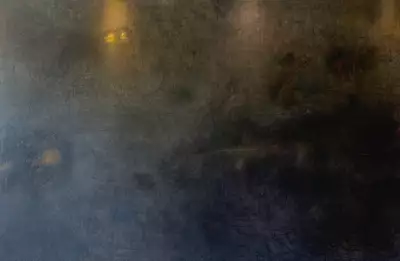
Somewhere Before Morning by Robyn Ward
SM: Working with a museum-level powerhouse like Baitel scales up an artist’s intimate inner world into a grand public spectacle. How do you and Shai protect the quiet, fragile nature of your childhood memories of Belfast and the aftermath of societal trauma when scaling them up into massive global exhibitions and monographs?
RW: I think the protection comes from not treating those memories as content. The memories matter, but they’re not the destination. They’re the starting point. I don’t want the work to become an illustration of my past.
Growing up in Belfast during a period of social and political tension definitely shaped me, but I’m not trying to document specific events. I’m more interested in how those experiences alter the way somebody understands pressure, uncertainty, belonging or resilience. The work also has to survive without the biography.
If somebody knows nothing about Belfast, or me, or the circumstances behind the paintings, it still has to hold them physically and emotionally. Otherwise the work becomes too dependent on explanation.
Scale doesn’t necessarily make something less intimate. A large exhibition or monograph may reach more people, but the work still has to operate on a human level. Whether the work is being shown in New York, London, Shanghai or elsewhere, the challenge remains the same: don’t simplify it too much. The moment something becomes too neat, it usually loses the thing that made it meaningful in the first place.
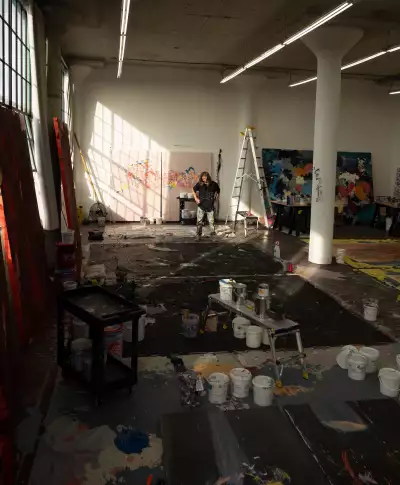
Chance Falkner
SM: In the past, you often contrasted nostalgic, childhood imagery with raw, contemporary violence and decay. Is nostalgia a safe haven we retreat to when the present becomes too hostile, or is it actually a dangerous illusion that prevents us from fixing the world we currently inhabit?
RW: That belonged to a particular body of work from an earlier period. I was using cartoon characters and nostalgic childhood imagery to poke at much more serious social, political and geopolitical issues – racism, bigotry, hatred, violence and the broader absurdity of the world around us.
On the surface the work could look playful, but underneath it was dealing with something much darker. It isn’t how I make work now, but it was important. It taught me something about how images can carry contradiction. Nostalgia is neither entirely comforting nor entirely dangerous. It’s editing. Memory is selective. We remove certain details and amplify others. I don’t think we should live inside nostalgia. The past is too complicated for that.
But I do think examining it can tell us something about the present. Often what we’re nostalgic for isn’t a specific place or event. It’s a feeling. A sense of possibility. A sense of connection. A sense of certainty.
The current work deals with that in a much more abstract way. It isn’t trying to recreate the past. It’s more about understanding how the past continues to sit inside the present, even when the original image has disappeared.
Every generation has believed it was living through uniquely difficult circumstances. What interests me more is how people respond to those circumstances.
SM: If a future civilisation unearthed your canvases a thousand years from now, how do you think they would view them? Would they see them as a documentation of a broken world, or the blueprint for rebuilding one?
RW: I don’t know if they’d learn very much from my opinions, but I hope they might learn something from the traces. Every painting is really an accumulation of decisions, mistakes, removals, revisions and discoveries.
In that sense, they’re probably closer to archaeological sites than images. They contain evidence of a process rather than a conclusion. I don’t see the work as documenting a broken world.
Every generation has believed it was living through uniquely difficult circumstances. What interests me more is how people respond to those circumstances. The line between critique and creation is probably much thinner than we like to imagine. To make something is also to question something. To remove something is often to reveal something else. The two processes are deeply connected.
I suppose I am optimistic, but not in a naive way. I don’t think optimism means believing everything will work out perfectly. I think it means believing there is value in continuing regardless. If somebody uncovered these works a thousand years from now, I’d hope they saw evidence of someone trying to make sense of a complicated moment, not someone surrendering to it.
Major museum exhibitions curated by Shai Baitel are confirmed for 2026 and 2027, including presentations at MANA Contemporary, New Jersey, MANA Miami and a solo exhibition in London.