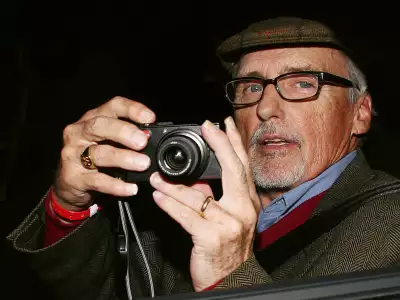
I take a quick stroll down the hill from Piccadilly Circus Tube station and soon reach the grand open spaces of the Iconic Images Gallery on Waterloo Place. It’s housed within an imposing Edwardian building, and the walls and hanging panels inside are adorned with famous photographs shot by the likes of the late, great Terry O’Neill, sports photography legend Neil Leifer, and the renowned music photographers Gered Mankowitz and Kevin Cummins.
With high ceilings and tall windows letting in huge swathes of light, the gallery space is ideal for showcasing photography.
I’m here to meet photographer Greg Brennan, who has spent the last 35 years in London shooting the most famous people alive – and even had a signed print requested by HM The Queen. I arrive early, but after perusing the pictures for about 20 minutes, I spy the diminutive figure of Brennan arriving at the front desk – like Johnny Cash, he’s dressed in all black.
We’re ushered to a table to discuss his first-ever book of his photography – The Big Shot: Photographs by Greg Brennan. It’s a visual journey through his stellar career of capturing candids of actors, musicians, supermodels, politicians and sports stars.
While all of the book’s pictures are Greg’s, the words have been penned by his talented teenage son, Dylan, who sits in on the interview and often interjects to provide recollections that add even more colour to his father’s stories.
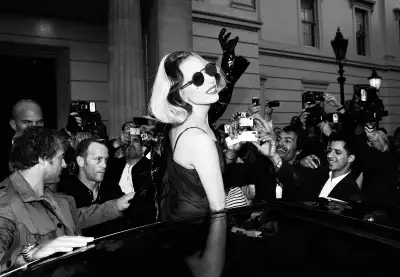
Lady Gaga, May 2011: “As she prepared to leave, she climbed onto the roof of her car and struck a playful pose for the screaming crowd.”
Greg Brennan
Natural raconteur
Brennan is a natural raconteur and tales of celebrity encounters tumble freely from his mouth – riding in a car with Jack Nicholson, going shopping in Harrods at 3am with Michael Jackson, bumping into Leonard Cohen unloading his instruments from a van outside the Royal Albert Hall and tracking down Bill Clinton in St James’s.
I start by quizzing him about his background in photography. He admits: “I wasn’t sure I was going to pursue a career in photography, but around 1991 I made my mind up that I wanted to have a go. I went out and invested in my first Canon camera – an EOS 5 film camera that I’ve still got.
“My dad wasn’t a photographer, but he was left some money by his father and travelled around the world after leaving university. I grew up looking at his photos in a box he used to have in the closet at home.” He laughs and adds, “They were awful – the worst pictures you’d ever seen. He never learnt how to use a camera!”
Despite his father not sharing his inherent, self-taught talent for taking pictures, this didn’t deter Brennan. One of his first tips came when music superstar Michael Jackson was in London to promote his 1992 Dangerous world tour.
“We’d been given a tip by a couple of chauffeurs that he was going to go shopping at Hamleys toy store. I got excited because it was a big deal. I ran home, grabbed my camera, went to Hamleys at three in the morning – and waited.”
It was the most amateur picture you ever saw, but I would go on to repair that years later.
Jackson duly arrived with an entourage of around 25 security men, and got out of a car, but just as Brennan was raising his camera one of Jackson’s bodyguards knocked his arm. After an agonising wait for a lab to process his films, it ultimately proved fruitless.
“I only managed to capture him from the cheek upwards; just part of his face. I was frustrated, but I stuck that photo in my album as a reminder. It was the most amateur picture you ever saw, but I would go on to repair that years later.”
In 1999, Brennan finally got a full-face shot of Jackson, but he did so by sticking his camera under a bodyguard’s armpit. “As he’s got hold of me, because I’m the only person there with a camera, Michael walked between us. I managed to stick my camera under the guard’s armpit, held it up and shouted ‘Michael!’, he turned, and I got half a dozen shots that were widely published.
“The following year, he came back and went to Harrods again. This time he recognised me. I was standing outside and all of a sudden the door creaked open and they said, ‘Come in. They want you to take some pictures inside.’ I ended up walking around Harrods at three in the morning shopping with Michael Jackson – it was a most surreal experience.”
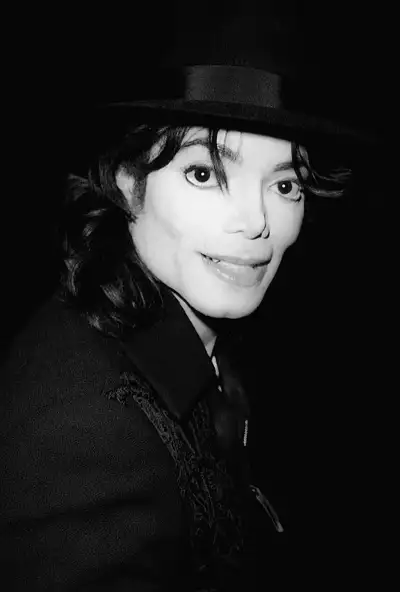
Michael Jackson, April 1999: “More than a star – he was an era unto himself.”
Greg Brennan
Influences and inspirations
Brennan’s eye was shaped by Terry O’Neill, as well as the American paparazzi Ron Galella and Victor Malafronte.
Of Galella, he recalls, “I know he wasn’t the most respected or liked at the time, but there was something about his work. For me, he was the godfather of celebrity photography, but he did it in a different way to everybody else – he did it on a street level. There’s a wonderful documentary (Blast ’Em) on him.”
Brennan was attracted to movie stars by his childhood in Southern California, where his bedroom overlooked a drive-in movie theatre that played classic films every Wednesday night. “I had a small radio next to my bed and tuned it in for the sound. I watched every classic, but all in black and white, so that triggered the interest in shooting black and white. For me, Hollywood is black and white because it was the era I grew up in – the flashbulbs, the excitement and everything around it was very interesting.”
He adds, “I took up photography and worked with a couple of other photographers who had a lot more experience than I did. They guided me and it was a self-learning process. My first published picture was of Cindy Crawford. I’d done numerous pictures before this, but this was the first one that sold and it got published in three newspapers.”
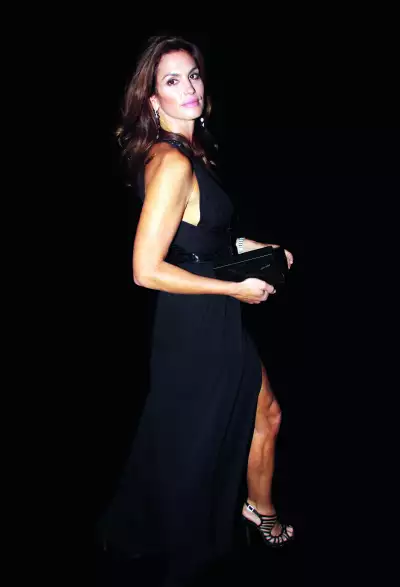
Cindy Crawford, Mayfair, October 2009: "Leaving a party at banker Roger Jenkins’s home."
Greg Brennan
Back in those days, Brennan was working six or seven days a week. He would stay up all night to develop his films and print the best shots; then cycle to drop the prints off in envelopes to Fleet Street newspaper picture desks early in the morning. He’d then go to bed at around 7am, sleep all day and then get back out again for the next night’s shooting. He recalls, “I was white as a ghost because I never saw daylight, but I quickly made a name for myself – and a lot of the editors realised I was getting good pictures.”
Brennan was getting commissioned by the News of the World, the Mirror, the Sunday People, Today and even Piers Morgan, who was, at that time, the editor of The Sun newspaper’s showbiz column, Bizarre.
“I started peppering them all with pictures, so, eventually, they had to take note. I just kept going back and I’d turn up at the [News International] Wapping plant. By then, I didn’t have to process my own film anymore. At Wapping, they had a 24-hour lab, so I would just turn up, drop ten rolls of film in and go home. I started having a bit more time in the day – it made life a lot easier and I had so much fun. I prefer those days to today.”
Outsmarting the press pack
In The Big Shot, Brennan is quoted as saying, “What really makes a photograph sing is its ability to tell a story, to catch something no one else has.” I ask him to expand on that; he replies: “It’s an art form. I think you do it with great observation and a certain amount of cunning.
“Even to this day, as press photographers, we have a lot of competition. Now there’s more of us than there ever was, but in the early 1990s, I would always try and outsmart the press pack, steal away, and get something exclusive.”
A classic example of outsmarting the paparazzi pack occurred when former US president Bill Clinton came to London in 2004 to promote his autobiography, and Brennan shot an image that papers later headlined ‘All the President’s Men’.
Unlike the other photographers, who were waiting outside the Waterstones bookshop, Brennan knew Clinton was staying at The Ritz hotel and had a hunch that he’d walk from the hotel to the bookstore. He reveals, “I saw two doormen taking out the revolving door of The Ritz. I’d only ever seen them do that a couple of times – for The Queen and for Princess Margaret when she was in a wheelchair.
Suddenly, Secret Service agents filled the streets and he came down the steps. I started taking pictures and one agent said to me, ‘We don’t mind that you’re here. As long as you stay on that side of the road.’ I ran ahead. Clinton stopped in at Fox’s cigar shop, came out, took his time getting to the bookstore – and I got this one shot.”
![Bill Clinton, July 2004: “I saw two doormen taking the revolving door of The Ritz out. […] The next morning, my instincts were vindicated. Four of my shots hit every front page, each accompanied by the headline, ‘All the President’s Men’.”](https://cdn.squaremile.com/dynamic_height_full_400/6a4e1d8a1b00b.webp "Bill Clinton, July 2004: “I saw two doormen taking the revolving door of The Ritz out. […] The next morning, my instincts were vindicated. Four of my shots hit every front page, each accompanied by the headline, ‘All the President’s Men’.”")
Bill Clinton, July 2004: “I saw two doormen taking the revolving door of The Ritz out. […] The next morning, my instincts were vindicated. Four of my shots hit every front page, each accompanied by the headline, ‘All the President’s Men’.”
Greg Brennan
The next day, Brennan’s photograph of Clinton and his entourage was on the front page of almost every newspaper, with some running it as a double-page spread inside. About six weeks later, Brennan got a call from the head of the UK diplomatic protection squad to say that Clinton wanted a copy of the picture.
Two months after sending out four 16x20-inch prints, Brennan was summoned by the same protection squad officer, and was handed a big, brown envelope. He recalls, “I was confused, but I ripped it open and pulled it out. There it was… ‘To Greg, Great Photo. Many thanks. Bill Clinton’ – and he’d signed it on the bottom.” To this day, it is Brennan’s most widely published picture.
Favourite subject
When asked to name the favourite subject he has trained his lens on, Brennan swiftly replies, “Without a shadow of a doubt, Jack Nicholson. I’ve met Jack about 40 times over the years. One year, he arrived really early at about 5am at the hotel. He went in, got changed and came back down a couple of hours later. He went out for breakfast and then to a hat shop at the top of St James’s. He went in the shop. While he was in there a painter was working on the front of the shop. He saw us there with our cameras and said, ‘Who’s that guy?’ We said, ‘Oh, that’s Jack Nicholson’. He said, ‘Oh, my God’ and couldn’t believe it.”
He continues, “Jack was in the shop for ten minutes and he came out. As he came out the guy said, ‘Can I have your autograph?’ Jack looked at him and said, ‘Sure… you got a pen?’ The guy didn’t have a pen but he went, ‘You can use this’ and handed Jack a four-inch paintbrush. So, Jack looks at him, laughs, drops the bags and says, ‘OK, you asked for it’ and took the paintbrush. I love this picture.”
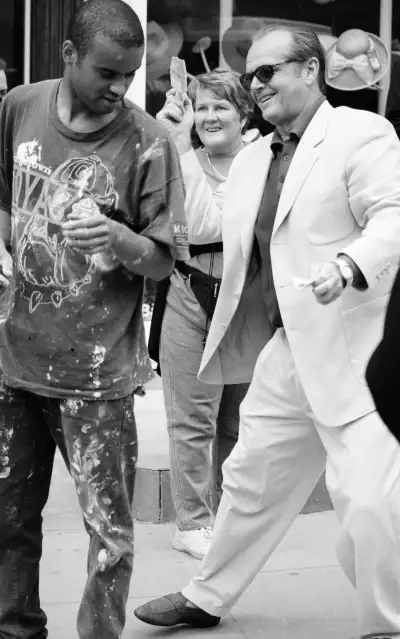
Jack Nicholson, January 2008: “Then, with a flourish, he signed his name in white paint across the builder’s back.”
Greg Brennan
Brennan laughs at his encounters with Jack Nicholson and says, “I think the whole reason I got into press photography was to capture that era of the Hollywood hellraiser. That’s what intrigued me the most, and I was lucky because I got into it just in time to capture some of them. The same with people like Elizabeth Taylor – these are real Hollywood stars.”
A competitive edge
When flicking through a preview copy of The Big Shot, which Brennan shares with me, it’s clear that he is a master at capturing celebs in a matter of seconds.
He reveals: “I’ve got an extremely competitive edge – I think it comes with experience. When I was starting out I didn’t have lots of money or the best equipment. It was a ‘win-or-don’t-eat’ situation for me.
“Film and cameras weren’t cheap, but I didn’t want to work for photo agencies because they would give you the camera and film, but take half of your money. I didn’t ever really syndicate my work through agencies because it just devalues the overall picture. I have a huge archive – and I’ve kept the copyright of every single picture I’ve ever taken.”
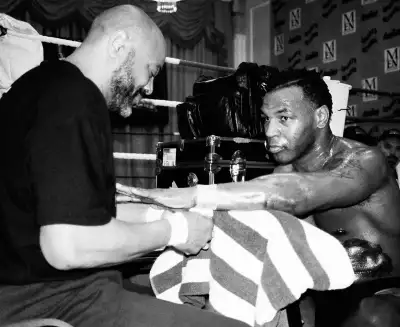
Mike Tyson, January 2000: Tyson being hand-wrapped at the Grosvenor House Hotel during training for his fight with Julius Francis.
Greg Brennan
Brennan also believes the longevity of his career is built on the foundations of always dealing with people with respect. He reveals he has, on occasion, not taken pictures – notably when Lady Gaga arrived, make-up free, at her London hotel at 4am and asked him not to take a shot and also when encountering Elizabeth Taylor, who arrived at The Dorchester Hotel in a van, but was seated in a wheelchair.
He explains, “You’ve got to get the balance right between privacy and respect. You’re not going to catch me hanging over someone’s garden wall invading their privacy. The majority of my subjects are happy to pose. This is the difference between being respectful and disrespectful. I’ve always tried to keep to the gentle approach because I find people are more receptive to that. Why would you want to annoy people? I’ve found that 99.9% of celebrities want to be photographed. They get it – it’s how they’re famous. If you play the game with them, they’re more than happy to play the game.”
The book project
Producing a book of his images was something Brennan has had in mind since his career started. “My parents wanted me to pursue a [real] career after university, but I said to My dad, ‘I need to buy a camera’.
He wasn’t best pleased, but he said that he’d support me no matter what, so I went for it. Back then my dad said, ‘What do you hope to achieve taking pictures?’ I said, ‘Hopefully, one day, a book’.”
The Big Shot is a visual treat, featuring around 140 photographs that will appeal to anyone who loves images of famous people and enjoys the stories behind pictures. It’s been about three years in the making – partly accelerated by a 2023 bike accident when Greg injured his ankle and had some spare time on his hands to sort through his archive of photographs alongside his son Dylan. Greg also hints at plans for future books: “We dropped about 300 pictures from the edit – those 300 are just as strong as what’s in here.”
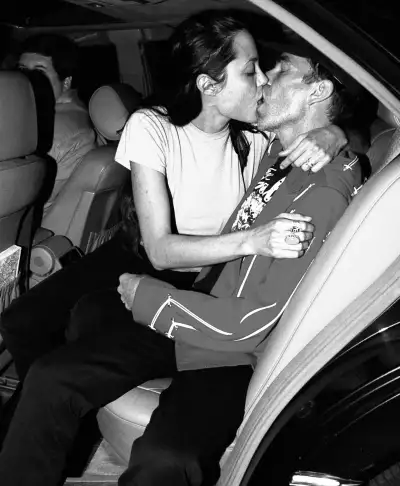
Angelina Jolie and Billy Bob Thornton outside The Ivy, Covent Garden, July 2001
Greg Brennan
He laughs and reveals: “A camera is an extension of me, and I still love photography to this day. We go on vacation in the summer, but I’ll be up at 6am planning out something I’m going to go and do with a camera. It must have driven my missus mad. I don’t class myself as a celebrity photographer. I’m more of a photojournalist, not completely, but I’m right in between, and that’s where I’m quite happy. I wanted to try everything, so it gave me a much wider experience and a better knowledge of photography.”
Although his growing reputation began to open doors for him, Greg Brennan wasn’t happy when offered better access. “I got invited to concerts and parties, but the problem when you’re invited inside an official event is there’s so much control that surrounds the person you want to photograph that they end up taking away the creativity of what to do with the picture. I need creative control. I have a vision, a process and I know what picture I want to get. I know what works best and I’ve got 35 years of experience. I just cover the gap from the door to the car.”
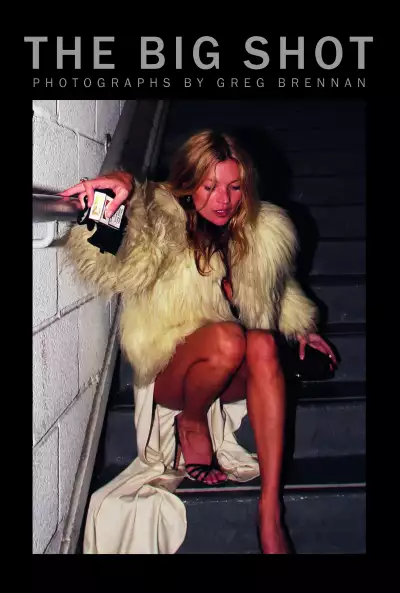
The Big Shot: Photographs by Greg Brennan is a stunning monograph published by ACC Art Books showcasing more than 100 candid images. Priced at £40. See accartbooks.com.