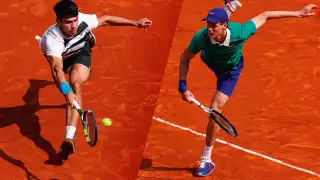
And now there are two. Carlos Alcaraz and Jannik Sinner have ruled tennis over the past couple of years, splitting the last eight slams and contesting the last three finals – with their 2025 Roland Garros epic a contender for the greatest match of all time. The Italian is 24, the Spaniard 22, and their only real threat is each other.
Who could have predicted such abrupt and total dominance? Giri Nathan, one of the finest sportswriters in America and author of Changeover: A Young Rivalry and a New Era of Men’s Tennis. The book is a vivid account of the historic 2024 season, a year that transformed the landscape of men’s tennis as, for the first time since 2002, none of Roger Federer, Rafa Nadal or Novak Djokovic won a major title.
The book is a blast, Nathan’s prose as spectacular as the shotmaking of his protagonists. Winners are dispatched on every page. You can read more of his work at Defector, an independent sports website and rare media success story of recent years. (Google ‘Jim Spanfeller is a herb’ for more.) But first, enjoy the insights from one of the sharpest minds in tennis on the sport’s two brightest stars.
Square mile: Congratulations on such a prescient book. If 2024 was the changeover, I guess you’d call 2025 the consolidation, right?
Giri Nathan: Yeah, I think that’s fair. I’m writing a short introduction to accompany the paperback version that comes out next year, and I don’t really know what to add because 2025 was so much of a repetition of 2024. You have Sinner and Alcaraz breaking away from the pack even more, you have Djokovic in this second class unto himself, and then you’ve got everyone else after them. It’s very much a continuation of the same themes.
SM: Was there a particular match or moment that inspired the book?
GN: I think it was that quarterfinal match between Sinner and Alcaraz at the US Open 2022, which I describe in the prologue. Stupidly, I went home and watched it on my sofa instead of watching live, even though I’d been on the grounds that day. After all those years of wondering what the future was going to look like, that match was the clearest glimpse.
Those two players seemed capable of technical skills that I hadn’t seen from any player in their age cohort. A mental fortitude that I had not seen from anyone in that age cohort. The creativity and athleticism that was really infectious to watch for anyone lucky enough to see that match live. You watch tennis your whole life hoping to catch a match like that.
I had the idea in the back of my head and then it was a matter of timing. By the end of 2023, Alcaraz had already made his big leap, Sinner was starting to rise to meet him. That was the moment I decided to start putting together the proposal for the book.
The way the tour looks right now, I have a hard time seeing any of their peers unseating these two guys at a slam next year
SM: Before Sinner wins the 2024 Australian Open?
GN: Yeah, a couple of months before. He had gone on a really long winning streak at the end of 2023, he had beaten Djokovic in the Davis Cup and the ATP finals. Djokovic is the true gatekeeper for any young tennis player. The fact that Sinner was able to beat him twice in quick succession was the evidence that I needed to move forward.
SM: It’s funny they only played three times in 2024, and never in a slam final…
GN: Narratively speaking, it was kind of nice they had yet to meet in the final of a Slam. It was like, ‘Hey, we’re building up to this point and then once we get it, it’s going to be phenomenal.’ We got it this spring at the French Open and it was indeed phenomenal.
SM: Watching that match, you must have been tempted to write a sequel?
GN: Hundred percent. It’s that mix of, ‘Well, I’m really glad that I called it’, but ‘I could add three more chapters to this book right now.’ Using the 2024 season as a framing device was good because I could have just been on this infinite treadmill to keep updating it, updating it, updating it. I’m working on this epilogue now. I have had months to digest that match and put it into the context that it deserves.
SM: You open the book with a Philip Larkin poem The Trees that ends with the line: “begin afresh, afresh, afresh.” It nicely encapsulates this new generation and also the yearly tennis cycle…
GN: As we head into the off-season, it’s a time for players to renew their hope and take on bigger goals for the season ahead. But the way the tour looks right now, I have a hard time seeing any of their peers unseating these two guys at a slam next year. Maybe the year after, but next year, I don’t think anyone’s close enough to pull it off. Maybe you can take one of them out but two of them seems too much to ask.
SM: There’s a temptation to portray Alcaraz as the Federer and Nadal lovechild, and Sinner as Uber Djokovic. It’s reductive but is it entirely unfair?
GN: There’s a reason those descriptors have stuck around. Anytime you’re trying to make sense of a new player at the beginning of their career, it does help to have some frameworks from the past.
I would say their development as players was shaped by the excellence of those older players who had accomplished so much by the time they were being funnelled into the developmental pipeline. So it was possible for a coach to see the way that, say, Djokovic slides on a hard court and think maybe this is a movement pattern that we can develop in our young players. So it’s not incidental, the resemblance.
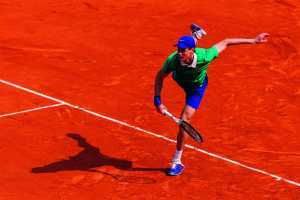
I think the slide is the signal innovation of Djokovic’s tennis in the last 10, 15 years. He showed there’s a way to hit offensive shots from defensive positions using this innovative footwork. Sinner and Alcaraz are two of the only young players who seem as comfortable as Djokovic in those deep splits, sliding in and out of the corners.
They really are singular talents that come around a couple times in a generation, and perhaps we rolled double sixes twice in a row
It’s one of the things that makes them so dangerous. They can run all the way to the corner of the court and yet not be out of the point because they’re hitting an offensive shot and the slide allows them to recover a half second faster.
The Federer-Nadal lovechild thing I think is equally true. When he was in his late career, Federer kept looking for young players who wanted to attack the net with conviction. He saw it in Stefan Tsitsipas but it’s there in a much higher magnitude with Alcaraz. The way he’s so comfortable moving forward in the court and his ingenuity and improvisation with his volleys and half volleys and drop shots.
It feels like some of the Federer instincts taken to even more dramatic extremes. A lot of Rafa as well: the physicality, the top spin. So I think both of those comparisons are entirely fair and probably rooted in some direct inspiration from those players.
SM: We had the Big Three era, now it’s Sinner-Alcaraz. Was their emergence an inevitable result of sporting evolution, or has tennis basically hit the jackpot twice?
GN: It’s a really good question. I think the partial answer is that the reward system of the sport is structured to greatly favour the successful players. It’s kind of a ‘rich-get-richer’ sport. The winnings are super concentrated in the top 15, 20 players on tour, and then it falls off pretty dramatically. If you’re 80, 90 in the world, you might be breaking even by touring.
Once you do break into the top, you have a payroll that can get you the best trainers in the world, best nutritionists, sports psychologists. Whatever talent advantage you already had is being amplified, multiplied by what your resources can buy you. So I think that’s part of why we tend to see the eras of dominance with these same players popping up over and over again.
But it’s definitely not the full explanation. At some level they really are singular talents that come around a couple times in a generation, and perhaps we rolled double sixes twice in a row.

Credit: corleve / Alamy Stock Photo
SM: Who got lucky they weren’t born a decade earlier? These two or the Big Three?
GN: That’s one I thought about a lot over the last five years. There was a window where the Big Three were more beatable than the results made it appear to be. I think there was a huge psychological element, entering the match feeling that you’ve already lost. You’ve held these guys on a pedestal for so long, you don’t realistically see yourself beating them.
There’s a line in the book that Francis Tiafoe says: it’s like a Mount Rushmore effect where these are faces that have been on posters in your bedroom since you were ten years old. There’s something very psychologically deflating. Sinner and Alcaraz have benefited from having that respect, but not having it put limits on what they think they can accomplish.
SM: You quote Tiafoe saying he isn’t intimidated by these younger guys – I imagine a mentality shared by many players. Do you think it survived 2025? →
GN: I made sure to include as many of those quotes as I could because I knew that sentiment wasn’t going to last very long. There’s one from Taylor Fritz where he’s like, “I actually like playing against Sinner. I feel like he hits a good ball for me.” I thought, we’ll see how long he stands by that. He loses to Sinner in the US Open final a couple of weeks later. Fritz probably plays the best match I’ve ever seen him play and loses in straight sets.
I wanted to capture that brief moment in time where they actually did seem beatable, before that sense of inevitability set in among their peers. 2024 was the season when their aura was still solidifying. By 2025 you started getting some quotes, not of outright futility like in the middle of the Big Three era, but the early feelings of futility – ‘I don’t know what I have to do to keep up with these guys.’ A lot of those optimistic sentiments you heard in 2024 maybe didn’t survive to the end of 2025.
We had a long time in men’s tennis where there were no prodigies because the game was so physically demanding
SM: You write a brilliant chapter on Daniil Medvedev who embodies the frustration of his generation of players…
GN: That late-twenties cohort probably thought they were going to inherit everything once Djokovic finally hung it up. But that was a very false impression because they could not have anticipated just how good these guys were going to be so early in their careers.
Factor in the late-twenties guys may now be in physical decline. It’s possible they have physically peaked and the remaining improvements they have to make are purely technical. Whereas I think Sinner and Alcaraz are still a few years from their physical peak, which is kind of scary.
SM: I saw Alcaraz practice at Queen’s Club. He’s built like a tank…
GN: He’s a big dude. There was the off season from 2021 into 2022, I think, when he was working with his physical trainer. The quote he gave was something like, “I turned him from a boy into a man.” He came in looking like 15 pounds heavier from November to January, which should be physically impossible but there’s a lot of things that guy does that should be physically impossible.
One other detail that could separate these two players from the past eras is the physical training side of sport has developed quite a bit, I would say, from the early aughts when the Big Three were coming out. There is a much more holistic sense of what kind of work needs to be done in the gym and what will have a direct translation onto the tennis court.
We had a long time in men’s tennis where there were no prodigies because the game was so physically demanding; you had to wait for players to enter their mid-twenties to win a major title. These two are well ahead of schedule in terms of their physical development. There’s a lot more forward thinking than there used to be and so much more money in the sport. I keep circling back to that, but I think it’s a big deal because you can afford to have people thinking really hard about the things you need to do.
SM: Andre Agassi wrote in his autobiography how he used to do endurance running. Then he hires a new trainer who gets him doing short, explosive sprints, much more suitable for tennis. Obvious now but a revelation in the 1990s…
GN: I think about that anecdote all the time. That trainer Gil Reyes was coming into tennis from basketball. He already understood that for athletes, you don’t have to run five miles at a slow tempo. You need to be sprinting, stopping, accelerating, decelerating. He correctly diagnosed all the similarities between a basketball court and a tennis court.
The innovation he brought with Agassi was building his lower body in a way that allowed Agassi to kind of sit on top of the baseline, use the strength of his lower body and just take the ball super early and dominate baseline rallies. Djokovic has an extension of that same legacy. Sinner and Alcaraz have just taken that and run with it.
The things they do are so specifically tailored to what you need to do to be good at tennis. It’s not anything to do with someone’s impression of general fitness. You might think a civilian should be able to run four or five miles at a good tempo but that actually has very little to do with what a tennis point is.
Who knows? Maybe there could be actual resentments bubbling under the surface that they’re not willing to voice
SM: There’s a lot of Djokovic in the book. He’s such a compelling figure…
GN: I don’t think they will be making them like Djokovic anymore. I am very interested in the class angle of professional tennis. Federer and Nadal were coming from pretty well-heeled middle class to upper-class backgrounds in Western Europe versus Djokovic coming out of the Yugoslavia Wars. His father was taking money from loan sharks to make his career work.
It was a very different trajectory to reach the same point in professional tennis. And I think that sensibility of breaking in as outsider, none of this was taken as a given, very much shaped who he is. It makes me more sympathetic to some of the defiance and perhaps spiteful or cantankerous moments he’s had on a tennis court.
You might think, ‘What could this guy possibly have left to prove?’ And then you think about where he came from and it’s a little easier to sympathise with. This is a guy who’s gone back to the tennis courts, the hitting walls he’s trained on as a child, and he’s found they’re in ruins, they were bombed by Nato.
So there’s a real scrappiness and resourcefulness that makes him more of an endearing figure to me. The trend in pro athletes now is to sand away your eccentricities, remain palatable and marketable. He seems very unwilling to do that. For better and for worse.
Corleve / Alamy Stock Photo
SM: Could a young athlete with the spiky personality of Djokovic, or even Agassi, thrive in the social media age?
GN: We’re in this era of super-curated personal brands. You do the Netflix documentary where you get personal say over what makes it in, you tell exactly the propaganda narrative that you want to tell. As fans there may be some pendulum swing in the other direction where you start craving some kind of uncensored or unfettered authenticity. One of the reasons I am drawn to a Medvedev type is because he’s so utterly unconcerned with his marketability and he’s so committed to saying whatever is on the top of his mind at any given time.
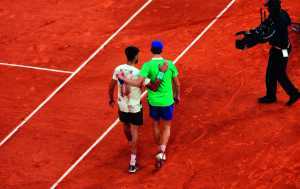
I remember a time when athletes were talking crazy shit to each other. I grew up with the NBA of the early 2000s. There was a lot of trash talking. I have a craving for that sometimes, watching sports these days. You get a more civil discourse on tour, you have the Sinner-Alcaraz friendship or what appears to be a friendship on the surface. But who knows? Maybe there could be actual resentments bubbling under the surface that they’re not willing to voice because they’re both so concerned with, say, being the face of Nike for the next 15 years or whatever.
I happen to think we’re in an absolute dead zone for learning and saying interesting things about athletes and most people in public life. The curation and carefulness and caution is at an all-time high. But I would love to see things move in a different direction going forward. The access you get to these athletes has absolutely cratered the last few years, to the point where I genuinely had to figure out if writing a book like this was even viable.
At the end of the day, the things they say aren’t actually that interesting. So it’s more about contextualising it and providing history and commentary and technical breakdown and all this stuff that I had fun doing in the book. Selfishly, I do hope things open up a little bit. That these athletes and their teams realise that independent journalists, filmmakers, there is a value to that. You get a more complex nuanced portrait than you would get posting photos on Instagram.
With more serious fans, you’re starting to hear a few complaints of tedium. No one else can even win a tournament
SM: There’s something poetic about Djokovic exiting the sport the same way he entered – the unwelcome third man attempting to break a beloved duopoly. He won three slams as recently as 2023…
GN: Things are trending in very much the wrong direction for him. It goes so fast. The other wild thing is he has played an unprecedentedly streamlined schedule in 2025. Just Roland Garros, Wimbledon, US Open. I couldn’t find a historical precedent, a player just playing those three events. That’s how good he is. The only things that brought him down in these slams were his own hamstrings and Jannik Sinner, twice.
SM: Do you think the Sinner-Alcaraz duopoly is good for tennis?
GN: That’s a very good question. I think the answer varies depending on what layer of fandom you occupy. If you are a casual fan who’s just tuning into the semi-finals, finals of these tournaments, there is some comfort – you turn on the TV, you know the narratives, which of these two guys you like. There’s no homework on your part. And the charisma that they have when playing each other does loop in more and more of those casual fans.
With more serious fans, you’re starting to hear a few complaints of tedium. No one else can even win a tournament. And the hardcore fans, they’re already looking ahead to the future, to the 19-year-old players on tour such as João Fonseca and Learner Tien to try to figure out who’s going to be the one to break through.
But for the architects of the tour and the people who sell the sports to the masses, I think they’re all pretty excited by these last two seasons of dominance. Right when all the old household names were phasing out, they got two immediate household names. That transition has been pretty seamless and effortless. But I think the more nuanced answer is a lot more interesting and one that I hope to dig into maybe in a future book or an article.
SM: A homegrown player like Jack Draper winning Wimbledon or Ben Shelton winning the US Open would be massive. Those guys are the same generation as Sinner and Alcaraz so can it even happen?
GN: Yeah, the age thing is what I keep coming back to. It’s hard to see how they will both make up the ground and then outpace these guys who are only going to get better, and will probably get better at a faster rate than they get better. It really is kind of an arms race that seems to be just between them.
SM: One of the most insane statistics in sports is that only two male players born in the 1990s have won a slam.
GN: It’s absolutely outrageous. An entire generation was just swallowed up. I won’t immediately rule out Medvedev this time, and I’m obviously interested enough to write a whole chapter about him, but things are really not trending in the right direction for him, either. This is a guy who as recently as 2024 was beating Sinner at Wimbledon. Right now he is wrapping up a season where he won exactly one match at the major tournaments. So it’s hard to see those late twenties guys closing the gap.
SM: People love the Sinner-Alcaraz bromance but might a little more animosity between them add to the spectacle?
GN: It would be very entertaining and to my layman’s perspective, it would be a lot more understandable. In these rare situations where it does boil down to just two players who more or less know they have to beat the other guy to win any title of note, I do find it hard to believe that they can remain completely decent and civil in all of their innermost thoughts about one another. I feel like there must be some kind of resentments playing under the surface.
As a fan, it would be pretty captivating if those occasionally broke through from time to time. Even if they did ultimately maintain that sportsmanship and respect, blah, blah, blah. Even if they maintain good terms with each other, I would like to see the occasional moment where that facade breaks and we see a little bit more of the completely understandable human emotions that might arise in such pressurised situations.
I think that would be cool, but maybe that’s really not who these guys are. I don’t know the answer yet. I still can’t rule conclusively whether these guys are so polite and decent all the way down or whether that’s all they’ve shown to the world so far in their very limited time in the public spotlight.
If you are a person who seems to love life the way Carlos Alcaraz does, why would he be doing this at age 37?
SM: Will a third player emerge in the next two, three years? And who’s the most likely candidate if so?
GN: I go back and forth on this. João Fonseca is one of the names that gets bandied about the most, and there are aspects of his game that are absolutely on par with what you see in these two. The pure ball striking ability he has, it looks like Sinner in some ways, so talented, both forehand and backhand. No real weaknesses technically but the physicality isn’t quite on par with them.
The kind of sliding footwork that I mentioned earlier in our conversation, how important that is at the very highest level of tennis now, we’ve not seen that yet for him – which is not to say he won’t figure it out eventually. He’s still so young, still a teenager, but I think he’s one of the leading candidates to break out and challenge these two.
For a long time, Holger Rune was treated as the third figure in this rivalry. He just had an absolutely devastating achilles injury which has pretty much busted the whole 2026 season for him – and who knows what kind of condition he’ll be in when he does come back. So I think that more or less removes him from this conversation. Not to say he wouldn’t have success in his late twenties but he’s not going to be keeping up with these two.
You look at their direct age contemporaries like Draper, Shelton, and I think the talent gap is a little too much to overcome. So I’m actually looking to the younger cohort. I could be wrong. There are plenty of players like Stan Wawrinka who put it together in the late twenties, early thirties, and become such forces that they can challenge the pirates who have been controlling the game. But at the moment, it’s very hard for me to imagine.
UPI / Alamy Stock Photo
SM: The schedule is increasingly packed. Is the greatest threat to these two tennis stars actually tennis itself?
GN: One of the questions I’ve been asked since writing the book is whether I anticipate these two having the same longevity as the Big Three. If I’m just evaluating the current moment, I would say absolutely not. If at age 21, 22 you’re hearing Alcaraz talk about these feelings of burnout because of how demanding the season is – he takes a weekend to go Ibiza and it’s like a whole thing, it’s a whole conversation. The lifestyle they have to live is basically ascetic and you’re travelling all around the world.
If you are a person who seems to love life the way Carlos Alcaraz does, love people and different experiences, why would he be doing this at age 37? Going through these extremely logistically and physically demanding things when you could be enjoying life as an internationally beloved sportsman. It’s very hard for me to imagine these two guys pushing themselves for as long as those guys did.
Part of that is the schedule. The game currently operates on a schedule that would work if this was the sport of 15 or 20 years ago, which is a less physical sport, a less physically demanding sport. It’s gotten so explosive and so athletic. It’s not feasible to play 11 months a year at this high of a level, especially if you’re the players who are going to the end of every single tournament. Some things have got to change.
On the one hand, you’ll never see tennis authorities remove revenue generating events from the schedule. But there’s little doubt that the overuse injuries we’re seeing as well as the sudden acute injuries we’re seeing could be related to how demanding the sport is and how much of the season they have to play.
I could totally envision a tennis calendar that’s eight months long. They get four months off season and nobody’s complaining about anything. But I don’t think we’ll see that in my lifetime.
SM: Go on – what’s your predicted slam total for each player?
GN: Let’s say 16 for Alcaraz, 14 for Sinner. I know they’re going to keep doing it for a while. The question is longevity and how much they want to keep doing it. But I’ve already pencilled them in mentally for winning all four slams next year.
SM: No two male players have played more than nine slam finals against each other. These guys have played three already. That record is surely falling?
GN: Yeah, that number must be going up to 14, 15. They’re going to meet in a lot.
The way Alcaraz won the US Open was one of the most out-of-character things he’d done in his career. It was so businesslike
SM: Who completes the Grand Slam first? They’re both one away – Alcaraz needs the Australian Open and Sinner the French.
GN: I was shocked to see Sinner close the gap on clay as quickly as he did, I thought that was going to be the surface that Alcaraz had the most long-standing edge on him. And obviously, he was one point away from snatching Roland Garros. But yeah, I wonder who’s going to complete it. Who do you think will do it first?
SM: Surely the smart money would be on Alcaraz winning the Australian Open, the ‘happy slam’ as Federer describes it. In theory you start the season at your freshest and his peak is higher than Sinner’s peak. It’s funny their two other Slam finals this year went to the perceived underdog in quite undramatic fashion.
GN: Yeah, not the most captivating matches. Certainly not in comparison to Roland Garros, but very interesting dynamics. In both matches, the better server cruised to victory. For Sinner, it’s kind of a statistical oddity, but anytime he plays Alcaraz his first serve percentage plummets. You’re playing the best returners ever and you want to go for a little more. You don’t want to play it safe because he’s going to punish you.
In that US Open final, he dipped below 50%. I think he was 48% in the match, really bad for him. And his season average is high fifties or low sixties. So that’s going to be one of the biggest dynamics in their rivalry now. I would say Sinner was first to become an elite server and Alcaraz is rounding up to that form, but whoever maintains that edge is going to be controlling the matchup in the season ahead.
SM: Alcaraz can play a five-setter mid-tournament and it doesn’t affect him…
GN: Seems to enjoy it in fact. The way he won the US Open was one of the most out-of-character things he’d done in his career. It was so businesslike. Dropped one set all tournament, in the final, and he had his serve broken, I believe, three times in the tournament, which is the lowest in Open era history. It was the first businesslike Carlos Alcaraz slam. If you can keep doing that, it’s going to be very, very hard to beat.
SM: Finally, what most excites you about the season ahead?
GN: What I’m most excited about is the continued matchup-specific improvements that these guys make. They’re a bit cagey about talking about it openly, but you can read between the lines and watch some of the matches and figure out what these emphases are. After Wimbledon, Alcaraz and [his coach] Juan Carlos Ferrero did a two-week training block to focus specifically on the things they needed to do to beat Jannik. We saw those things come to fruition in New York a few weeks later.
One of the things was the running forehand, the crosscourt forehand. Alcaraz had been struggling with that at Wimbledon and he was absolutely annihilating that shot at the US Open just a few weeks later.
Post US Open, we’ve seen Sinner tweak his first serve and his first serving percentage has been ticking up ever since that match. He probably understands that he needs to have that under total control if he wants to have a chance of beating Alcaraz in these slam finals again.
So I love seeing the kind of chess match between these two. As much as we might like novelty or new names in the mix, I think it’s equally captivating to see these micro-adjustments made every week as they try to get the best of one another.
View on Instagram
Changeover: A Young Rivalry and a New Era of Men’s Tennis by Giri Nathan is out now.