What does it take to become a professional arm-wrestler?
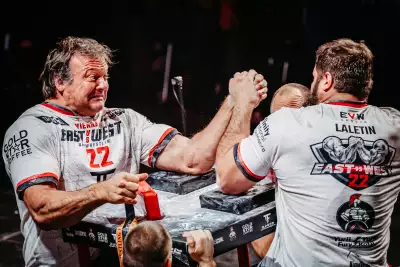
The playground pastime has turned into a world championship sports league led predominantly by promotional company East v West. The company was founded by two polar opposite people. Robert Baxter and Dexter Tan. Baxter is the largest owner of the Five Guys franchise; Dexter is a pre-med at Cambridge turned business savant. Together, they’ve unified the leagues for the first time in history.
The fringe combat sport might seem, well…fringe, but it’s quickly going mainstream. Their last championship showdown on Youtube pulled in over 1M+ views. Audiences become transfixed by two men’s fists for all of 20 to 30 seconds. People travel around the globe to see these tournaments. The athletes train for months. Their arms are larger than my body. I sat down with the most famous arm-wrestler in the world, and a large part of why the sport is entering mainstream consciousness: Devon ‘No Limits’ Larratt. He alone has over 1.4M followers; people are obsessed.
Larratt is about the closest thing to a real-life X-Men character we currently have on this planet. He’s a genetic ‘freak,’ and I mean that in the most respectful way. His body and brain are literally being studied by geneticists. A mission that Larratt believes is his higher purpose. ‘The God Project,’ they call it.
But I can promise you that Larratt is much more than just muscle. (although he has many) The ex-JTF special forces member did 20 years in the military, 16 of those years in active combat. He’s largely overcome PTSD, and has gone on a philosophical journey through the sport of arm-wrestling. “It’s my teacher,” he tells me.
So while his forearms may transfix you, it’s his story that will stay with you. Read on to hear how he became the greatest in the world.
Square Mile: Your arm-wrestling story seems to begin with your Grandma. She was the first person to ever teach you - tell me about her.
Devon Larratt: My grandma was a widow. She was wonderful to me. She was from Alberta, Canada, and we lived in Ontario. She was so nice. She’d bake pies every day, and I’d arm wrestle her. She was reportedly the women's arm-wrestling champion in Alberta. This was my father’s mom. I don’t know how she got into it, but it has a cultural place in Canada.
SM: Where does that come from?
DL: Everyone starts at playgrounds, doing it on desks in school, on the regular. We did it all the time. Now there are actual championships and tournaments. There are incredible champions coming up out of Canadian high schools now. There are leagues that go back a hundred years here. But there’s been no money or eyes on the sport until recently.
SM: When did that happen?
DL: They started showing up at the turn of the millennium. There was the PAL. The World Arm Wrestling League. Until Covid smoked all of them, and then from the ashes came East v West. When there were different leagues, they were segmented by country and continent. There was no understanding of who was the best in the world. There wasn’t enough crossover. But now all of the best go to East v West. It’s the first time in history that the best in the world are repeatedly getting together every 6 weeks. It’s never been this organised, this funded, this viewed. It’s an awesome time.
SM: Why do you think it resonates with people?
DL: I tell people all the time that one of the reasons it’s so appealing is that anyone can do it. You don’t have to go to university to do it to be on a team. You don’t need to own anything. You just need an arm. Everybody can do it, and everyone can relate to it.
SM: But certainly, people have a competitive biological advantage. Your strength is absurd.
DL: Of course, people have gifts. But I’ll tell you I’ve been shocked and amazed at the progression, or lack of progression, of athletes in this sport. I’ve seen people come into the sport and thought they were going to be the next big thing, and then nothing happens. And vice versa.
There was this guy called Crazy George. He became world champion and stayed champ for 25 years in the 80-kilogram division. Super competitive place. He is a short, fat guy with little baby hands. If you were walking on a street, you’d never pick him. When he joined the sport, he lost and lost and lost. He never gave up, and he really revolutionised the sport. He was one of the founders of the King's Move, which people go crazy over. He stayed at the top of the division until his late 60s. Love, dedication, and relentless hard work. You need both. You need gifts and to be crazy.
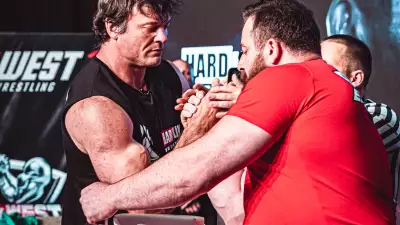
SM: You’ve spoken about how being exposed to Russian philosophy made a massive impact on your life. I would love to hear about the journey of that belief system in comparison to what you used to believe.
DL: It’s how they view time. I used to look at a problem, and it would expand. When I was younger, I thought I needed to solve things right now. I needed to have the hardest workout right now. I needed to break records right now. I needed to up my intensity right now. I needed to go super hard, push further, push further. There is a lot of merit to this, and I don't want to knock it too hard because under these systems, I did become a world champion.
SM: Yes, but were you happy when you approached life like that? Or was it never enough?
DL: It’s never enough. What I’ve discovered for me is that you can give me what I want, and I’ll still want more. It’s just in my nature. I’m not doing it to reach a goal. I’m doing it for the art of mastery. The mastery of arm-wrestling. Arm wrestling is my teacher. I learn about life through the sport. When you look at something this small, focus so deeply on it, and unravel it, it teaches you a truth that applies to everything.
As I evolved and aged, I began to understand more about how you adapt to your lifestyle and the struggle between order and chaos. I had to learn balance, to allow chaos, so I could have prolonged periods of order. The Russians made me understand the subtle difference between intensity and volume, and where that balance lies.
When you look at something over a longer time frame, like a year, what your body holds onto is how much work you did that year, not how many hard workouts. It’s cumulative. If you can do 10 pull-ups on Friday but can’t do them again until Sunday, that is less effective than if you can do 8 pull-ups every day. Your adaptation will come quicker by reducing the intensity and upping the volume. The Russians spoke so much about the respect we have for our bodies. The connection between the mind and body. In the West, we have this separation of mind and body. We think the mind controls the body; it tells the body what to do. Whereas what I was exposed to was that it’s the same thing: if your body asks you for something, give it. I wish I had understood this when I was a kid.
SM: Why?
DL: Because I was so hard on myself as a kid. I was so hard on my body. I beat myself up a lot. My workouts were crazy. It was abusive. Way too demanding, way too hard. It’s great that I could do them, but it was doing more harm than good. Instead of feeling like I had to beat my body, I wish I had listened to my body and let it be part of the discussion. I’m much more mature now.
SM: It sounds like you changed from a goal-oriented life to a journey-oriented life.
DL: Yes. That’s a good observation. It’s tricky to do. There is so much monotony in this arm-wrestling lifestyle. You really have to fall in love with the simplicity of it, and understand that things take time. You have to be at peace with living in the process. I am doing really long workouts now. They are eight to nine hours now. The biggest challenge is how mind-numbing they are.
I look at these long pictures of how I can get it better. How can I fine-tune the tiny details to make it run even smoother? I can only hold on to this if there’s a deadline. I do it for four or five months, and then after that, I travel and let go. I open up, I try new things.
I’ve got one month left to go. I do all of the things. I embrace sobriety. I stay super focused. If I try to live a certain way thats demanding on my discipline, and I don’t have an end goal, a date, then all sorts of things creep in. But if I have that date. On the 19th of April, all these things that are my temptations and my crutches and people I want to see, as long as I have that date, then I can stay in my meditative state of prayer until I get across the line.
SM: What are the things you allow yourself to do after a competition?
DL: A professional athlete’s life is about a day, a moment; for me, it’s 15 minutes. I find that if I live a very, very long period of structure where I’m getting my sleep. I’m not travelling. I’m eating good food. I’m staying super hydrated. I’m doing all my exercise. This is when I grow. But at the same time, you’re not trying new things - you’re not growing in other ways to challenge you. So I find you need this balance. The things I’m drawn to: lack of structure. I want to stay up with my friends, I want to go to a play, and I want to go to an expo around the world. There is no place for that when getting ready for a world title. And travel. Book a one-way, don’t know when I’m coming back. And then in that unstructured living, I find new revelations and ideas, and this is how I take steps towards mastering this sport and everything it teaches me.
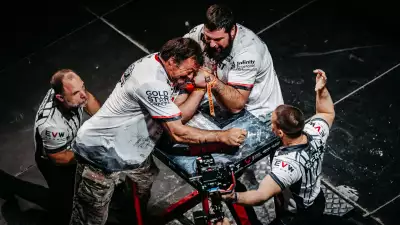
SM: At this point in your life, what do you think your relationship to control is? And how healthy do you think it is?
DL: When I look at control over my life, it makes me think about what I’m trying to control. Like control what? Why am I arm-wrestling? Why even have this control? Why work towards this goal. For me, it’s so much about mission. Arm-wrestling is a testament to personal mastery. If you can become a champion, it’s just a testament that you have control over yourself and the discipline to accomplish something outside of your basic urges. They are important, but you have to overcome them to achieve something greater than yourself. Arm wrestling has brought me all sorts of places. It’s bringing me to greater missions.
SM: What is that greater mission?
DL: So I am all about performance, right? I’m always trying to perform at a higher level. Being 50 now, I’ve had surgeries, medical interventions, this and that. In the time, I’ve met incredible people. I got into stem cells. I started speaking to doctors. I started thinking that so many incredible things are possible. All these therapies together synergistically would be unreal. We called it The God Project.
The latest instalment is a guy called Ryan Rosner. He is a geneticist. I love arm-wrestling, but it’s a personal journey for me. We’ve been collecting genetic data from elite performers from all over the world for the last year and identifying favourable mutations and drawing therapies from them. The mastery of the sport has led me to these higher missions.
SM: Why does that excite you?
DL: I think deep down I’m very scared of dying. We used to play this game as kids if you had one wish, what would it be? I always wished for immortality. I think being alive is so cool. I don’t want to die. I’ve always been terrified that an asteroid would hit, and it would be the end of us. I feel like one of the most important things we can do as a species is get off this planet and expand into robotics and space travel. Genetics is super important for us to get off this planet.
SM: If you had the fear of death very young, why did you choose to go into the military, which is the career field that’s most likely that you could die?
DL: I’m very extroverted. I connect with people really easily. I kind of believe we’re all one thing. We’re like an ant colony. I view immortality as us. As a kid, I had super ADHD. I was either super into it and hyper-focused, or I couldn’t engage with it. There were only a few things that made me go. I am an adrenaline junkie. I am a fighter. My parents were university professors, and I was pushed very hard in academics. But there was just no fucking way. I thought we were trying to build our civilisation so it could survive. I thought the military was the best contribution I could make. I thought I could add stability and make the world a safer place. That’s why I joined.
SM: What percentage of your military career was in combat?
DL: I did the reserves first. Then four years of regular force infantry, which is pretty chill. Then, for the last 16 years, I was a special forces with JTF. We were actively fighting that whole time. I did seven tours of Afghanistan. I did Bosnia and Africa. I did a lot of tours.
SM: What was your mindset when you were there?
DL: We just had to survive. I had blind faith. I had faith in the people in front of me and my leaders, and did the best job I could, and trusted that they are doing theirs. That becomes challenging the more you put things together. It’s tricky. For the most part, war is just terrible. For the most part, it’s highly unproductive. As a species, we need to stop.
When I was a kid, growing up, my grandparents left World War II. They came to Canada, and every week, my father would debate with my grandparents about war. I was always spoken to about sport and war, sport and war. And the differences between the two. Sport trains you for war, but sport is building community. The community that I have grown into as a result of arm-wrestling is amazing. I go up against Russians, Ukrainians, people we’re at war with, and sport rises above all these conflicts. We are much more human with each other. It was sport that made me leave the forces. They made me choose.
SM: What do you mean they made you choose? What was the choice? Arm-Wrestling or Combat?
DL: It was 2014. I was 39. I had done 18 years of service. It was my 14th year with JTF. Arm Wrestling at the time was WAL. I was a champion with WAL. I really downplayed everything. I didn’t have social media. When people asked me what I did, I said I was a farmer. When we went on ESPN, it really started blowing up.
SM: Why did you not want the public to know?
DL: Visibility. As an operator in JTF, you have to be able to travel without people knowing who you are. When it was growing, that was a problem. It would be difficult for me to do clandestine operations. I wouldn’t be able to operate anonymously. At that point, they made me choose. Devon, you have to stop arm wrestling, or you're done.
SM: And you chose arm wrestling. How hard was that decision?
DL: It was so hard. We have a family. We have three kids. We weren’t loaded in any way. It was our only source of income. Arm Wrestling at the time didn’t pay. I spoke to my wife, Jody, for a long time, and basically, they said I could take a one-year leave without pay, and we could revisit it in a year.
SM: So kind of like a sabbatical?
DL: Yes. We were broke. We were picking apples off of local trees. I ate sardines and apples for that whole year. I was only one year away from getting my pension, so after the year I went back but I went into recruiting to get my pension, and then I got out. That was my career. Then I became a full-time arm wrestler.
SM: You’ve publicly acknowledged that there was some kind of PTSD after your time in combat. To whatever degree you are comfortable with, can you explain how that manifested for you?
DL: My first combat tour was very difficult. It was 2005. When I got back, I had the textbook symptoms - waking up out of breath, sweating, heart beating, bad dreams - all of it. To some degree, I worked through it. But it was ongoing. I did seven more tours after that. PTSD is an exposure to a stress that you weren’t ready for. Like getting hit by a car because you weren’t strong enough for the impact. Hopefully, you get stronger in some ways and rehabilitate after but that’s what happened. I did all kinds of mental adaptations and coping skills to perform and get through the tours. A lot of those learned behaviours have translated into my performance in the sport.
SM: Can you identify some of those? What comes out in your arm-wrestling that you learned as a soldier?
DL: As a soldier, I learned how to flip a switch. We all have switches. We have our personalities and how we interact with people. When you go into combat, you find a new personality that can excel under those circumstances. You allow yourself to become this thing. It’s darker, more violent. Its lust for violence is a good way to describe it. That mentality thrives in that environment. If you aren’t like that, your chances of survival plummet. I developed an alter ego, this persona. To a certain degree, that’s stuck with me when I compete. I feel like a bit of a different person around competition. It’s easy for me to jump in and out of these mindsets.
SM: Can you describe to me what that mindset is? What are you thinking going into competition?
DL: It was stronger years ago. I’ve done so much therapy. But I think that it’s something to do with what I’m willing to do for victory. I become combative, really. In arm wrestling its not as extreme as missions. I still get that feeling like I’m going back. But I’ve done so many therapies. I am mostly clear of all symptoms now.
SM: How are you preparing for this upcoming competition?
DL: This will be my pinnacle. My highest level of achievement. My highest form I’ve ever had in competition. Everything I’m bringing to Germany - I’ll be the best I can ever be. I need it because this guy is awesome. This competition is for the interim number one in the world. I feel better prepared than ever.
DL: My training is nothing like what most people do. I don’t lift heavy weights anymore. The hardest training I do is with people. My son is actually a professional now. He’s 21. He loves the sport, maybe even more than I do. He’s a very good gauge for me. Arm Wrestling has been in the Larrat family for a long time. I never pushed him to do it; he’s doing it for him. I know how strong I am based on how I do with him. I think I’m the strongest I’ve ever been. Off the table, I train very light but I work out all day long. Nobody in the sport does this. This is a bit of an experiment.
SM: Walk me through a day of training.
DL: I’m a night owl. I go to bed at like 3:30 am. For me, morning is like 11:00 or 12:00. I’ll crawl out of bed at lunch, and I’ll eat a ton of food. I’ll check my media and everything I need to do. Then, 1:00 ish, I’ll get to work. I’ll do circuits. The circuit will last 50 minutes. After each circuit, I’ll eat and drink, and I’ll repeat all day. Then I’ll spend time with Jody or take the dog for a walk. Mondays and Thursdays are hard training I just go to the club and I vow to be the last person there. I do four hours of arm wrestling. This is my time of order. For these four months, it’s like Groundhog Day over and over and over.
SM: What are your plans post-championship?
DL: The first thing I’m doing is a week long of fast. I’ll plant a vegetable garden. I’ll visit my mom. I’ll party a lot. I have a lot of trips planned. I’m going to Malaysia. I’m going to China. Unstructured living.
SM: Mom. Fasting. Gardening. The holy trinity.
DL: Exactly.
You can follow Devon Larratt's arm-wrestling journey HERE, and watch his world-championship against Vitaly Laletin on Saturday, April 18th, exclusively on East v West.