In the world of menswear, few innovations can claim to be as culturally significant as the introduction of the K-Jacket.
By stripping away the rigid architecture of traditional tailoring and perfecting the art of garment-dyeing, Boglioli didn’t just create a new blazer; it pioneered an entire aesthetic of ‘unstructured elegance’ that has come to define the modern man’s wardrobe.
Leading this charge into a new era is Francesco Russo, CEO and President of Boglioli. Since the brand was acquired by the Spanish fund PHI in 2017, Russo has been the strategic architect behind Boglioli’s global revitalisation.
His mission is a delicate balancing act: preserving the soulful, artisanal spirit of the Italian house while implementing the industrial rigor necessary to navigate a competitive global landscape – stretching from the streets of Milan to the boutiques of New York and Mumbai.
In this exclusive conversation, Russo reflects on the enduring power of ‘Made in Italy’, the evolution of the brand beyond its founding family, and why ‘quiet luxury’ is a mindset rather than a trend.
Square Mile: Can you tell us about the importance of the brand’s heritage and how that resonates today?
Francesco Russo: Boglioli has developed and refined its garment-dyeing technique, studying specific treatments and recipes for each item in the collection, carefully calibrated according to color and fabric type. This approach, born of passion, research, and expertise, allows the creation of garments that maintain their quality, fit, and authentic artisanal spirit over time.
The garment-dyeing process gives the fabric a naturally lived-in feel, characterised by nuanced tones and chromatic depth that make each piece unique. The garment-dyed jacket represents a true innovation in menswear, helping to define a distinctive style.
This creation opened up an entirely new scenario in menswear, introducing an original aesthetic defined by lightweight lines, exceptional comfort, and a range of tones that give each garment a refined vintage effect.
The garment-dyed jacket represents a true innovation in menswear, helping to define a distinctive style.
SM: Boglioli’s iconic K-Jacket is the most obvious example of this…
FR: Yes – the K-Jacket has helped define a trend destined to endure over time. Until the early 2000s, a concept of a jacket like this did not truly exist on the market. Due to its cultural and stylistic impact, this innovation can be compared – on a societal level – to the revolution introduced by jeans in the 1960s.
It continues to resonate strongly today, perhaps even more than in the past. In a contemporary context where consumers are increasingly drawn to authenticity, craftsmanship, and individuality, Boglioli’s approach feels particularly relevant.
The garment-dyeing technique, with its unique tones and lived-in character, responds to a growing desire for pieces that feel personal and distinctive rather than mass-produced. At the same time, the K-Jacket’s unstructured, comfortable design aligns perfectly with the evolution of modern dressing – where the boundaries between formal and casual have become more fluid.
Today’s customer is looking for versatility, ease, and understated elegance, all of which are embedded in Boglioli’s DNA.
The introduction of the K-Jacket redefined the concept of tailoring by combining structure with lightness and comfort, while the garment-dyeing process added a unique aesthetic dimension, giving each piece depth, character, and individuality.
These elements have allowed Boglioli to position itself as a pioneer in modern menswear, creating a legacy that continues to influence the industry and reinforce the brand’s credibility and desirability over time.
SM: Do family members still work within the brand, is it family owned?
FR: No, the family is no longer involved in the ownership of the brand. In 2017, the Spanish investment fund PHI acquired Boglioli with the aim of initiating a new phase of development.
The focus was on implementing more structured strategies and industrial plans, with the goal of restoring Boglioli as a strong and distinctive brand in the market.
From a product perspective, the brand’s relaunch was entrusted to Marco Re, a designer who had worked with the company for many years.
SM: How important is community and interaction for Boglioli – and does this translate into partnerships and collaborations?
FR: Community and interaction are very important for Boglioli, as they reflect the brand’s broader philosophy of authenticity, human connection, and shared values.
In this context, partnerships and collaborations play a key role and naturally extend this sense of community. Boglioli engages in collaborations across different worlds – from sport to culture, working with renowned architects as well as with accessory brands. These collaborations are not just about product, but about dialogue. They allow the brand to connect with diverse creative fields, bringing new perspectives while staying true to its identity.
At the same time, they help strengthen the relationship with the community, making it feel involved in a broader cultural and creative process.
Partnerships and collaborations play a key role and naturally extend this sense of community
SM: What are your key markets and why?
FR: Boglioli’s key markets reflect both its heritage and its international outlook. Italy remains the brand’s primary market, where there is a strong appreciation for contemporary tailoring that combines elegance with comfort. This aligns perfectly with Boglioli’s philosophy, making Italy a natural and strategic focus.
America follows as the second core market, accounting for approximately 30% of total revenue. Here, the brand benefits from its deep cultural roots and longstanding reputation, resonating with a clientele that values craftsmanship and authenticity.
At the same time, Boglioli continues to expand into new regions. In 2025, the brand debuted in India with a presence at Galeries Lafayette in Mumbai, marking an important step in reaching a growing and increasingly sophisticated market.
In Europe, growth is driven by the expansion of the shop-in-shop format, allowing for a more flexible and targeted retail strategy within key department stores and premium locations.
Looking ahead, new development is also focused on Middle Eastern countries, where there is rising demand for high-quality, refined menswear and a strong alignment with Boglioli’s aesthetic and positioning.
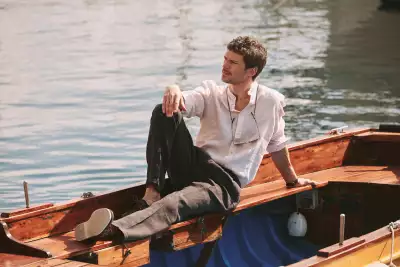
SM: Is Made in Italy still as important today as it has been historically as a mark of quality?
FR: Yes, Made in Italy remains as important as ever, but its meaning has evolved. Historically, it has been a mark of quality, craftsmanship, and manufacturing excellence, values that are still strongly recognised and respected worldwide. Today, however, it represents something broader: a combination of cultural heritage, artisanal know-how, creativity, and a distinct lifestyle.
For brands like Boglioli, Made in Italy is not just about where a product is manufactured, but about how it is made, the attention to detail, the human touch, and the continuity of expertise passed down through generations.
At the same time, modern consumers are more informed and selective. They look beyond the label itself, seeking authenticity, transparency, and true value. In this context, Made in Italy remains a powerful and relevant signifier, especially when it is supported by genuine craftsmanship and a coherent brand identity.
Made in Italy remains as important as ever, but its meaning has evolved
SM: Describe your customer?
FR: Boglioli’s customer is a discerning, culturally aware individual with a refined yet understated approach to style. He values quality over logos, substance over trends, and seeks garments that reflect his personality rather than define it. Typically, well-traveled and informed, he appreciates craftsmanship, heritage, and the story behind what he wears. His lifestyle is dynamic, moving seamlessly between professional and social contexts, and he looks for clothing that can adapt with ease, offering both comfort and sophistication.
Boglioli garments naturally support this versatility: they can be worn at work, in leisure time, and even into the evening, accompanying the wearer through different moments of the day without ever feeling out of place. What distinguishes him is a preference for quiet elegance, a natural sense of style that is never forced or overly constructed.
SM: Which designers – past or present – do you most admire, and why?
FR: I deeply admire designers who have managed to balance heritage with innovation. Among the great figures of the past, Giorgio Armani stands out for redefining modern tailoring with a softer, more effortless approach that still feels incredibly relevant today. His ability to strip away excess while maintaining elegance has had a lasting impact on menswear.
Among contemporary designers, I appreciate those who reinterpret classic codes with a fresh perspective – designers who understand the value of tradition but are not constrained by it. This balance between past and present is something I find particularly meaningful, especially in a brand like Boglioli, where craftsmanship and modernity coexist.
SM: What item in your wardrobe could you never part with?
FR: There are a few pieces I value deeply, but if I had to choose one, it would be a perfectly tailored unstructured jacket. It represents everything I appreciate about modern menswear: ease, versatility, and understated elegance. It reflects a philosophy of dressing that is timeless rather than trend-driven, which is something I strongly believe in, especially working at Boglioli.
SM: What’s your biggest fashion faux pas – what do you hate to see, and why?
One of the biggest fashion faux pas, in my view, is overcomplicating an outfit – when too many elements compete for attention without a clear sense of balance.
Whether it’s excessive branding, overly coordinated looks, or forced trends, it often takes away from the authenticity of personal style.
I believe elegance comes from restraint and intention. The way garments fit, the quality of the materials, and the ease with which they are worn matter far more than trying to make a statement at all costs.
When style feels natural and effortless, it becomes truly timeless – something that aligns closely with the philosophy of Boglioli.
See more at bogliolimilano.com