For City professionals making the London-Paris circuit multiple a year, the journey itself is rarely the issue. The flight or the Eurostar gets booked, the hotel gets booked, the meetings get booked. What sits in between – getting from Gare du Nord or Charles de Gaulle to the actual address where someone is expecting you at 10:00 – tends to be the part that goes wrong.
The reason is structural: Paris ground transport has an idiosyncrasy gap that London, with its black cabs and (mostly) reliable Underground network, simply doesn't share.
THE EUROSTAR-OR-FLIGHT QUESTION
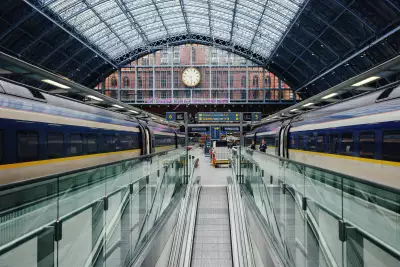
Most City travellers eventually settle into a pattern. Eurostar for trips inside Paris itself, particularly when the schedule allows a 7:30 departure from St Pancras and a working morning at the destination. Flights through London City to Charles de Gaulle for circuits that include a regional French stop, or for meetings near the western arrondissements where CDG access is less painful than crossing the city from Gare du Nord.
What rarely gets factored in: the 35 to 60 minutes that separate the Eurostar arrival hall at Gare du Nord from the actual meeting address. Or the variable forty-to-eighty minutes between CDG arrivals and a hotel in the 8th. The "saved time" of the faster train evaporates if the ground leg falls apart.
THE TAXI RANK PROBLEM AT GARE DU NORD
Anyone who has rolled into Gare du Nord at 8:47 on a Tuesday morning has seen this: the official taxi rank with twenty to forty people queuing, regulated price, no ability to pre-book. On normal days the wait is fifteen minutes. On strike days, school holiday Mondays, or after a delayed Eurostar arrival, it becomes thirty to forty-five minutes. The taxis themselves are fine. The waiting is the issue.
The Uber alternative requires walking out of the station footprint to a designated pickup zone, then either waiting for a driver who may or may not speak English, or accepting a Black tier vehicle at variable pricing that occasionally surges past two hundred euros one-way to suburban addresses. Neither option lends itself to a 10:00 meeting in the 8th.
GROUND TRANSPORT – WHAT EXPERIENCED TRAVELLERS ACTUALLY DO
The pattern that has emerged among frequent City travellers is simply pre-arrangement. A driver booked the night before, fixed rate confirmed at booking, vehicle waiting at the agreed point inside or just outside the station. The cost premium over a taxi rank queue is, on the maths, smaller than executives expect: somewhere between fifteen and forty euros depending on destination, against thirty minutes of unpredictable queuing and the residual stress of a meeting starting late.
Services like KAR GO have built a private chauffeur service in Paris round this specific use case – fixed-rate Mercedes V-Class transfers with English-speaking drivers, useful when arriving from London with three meetings before lunch and no margin for the taxi rank to take longer than usual. The vehicles are large enough for luggage plus the standard travel kit (laptop bag, garment bag, the occasional carry-on with documents). The pricing is published in advance: €130 from CDG to central Paris, €95 from Orly, regardless of arrival time or traffic.
The bigger value, however, is the booked-in-advance certainty rather than the vehicle itself. On a Tuesday at 8:47 in Gare du Nord, the executive who has pre-arranged ground transport simply walks out of the platform, finds the driver holding a name card at the agreed spot, and is in the car within four minutes. The executive who has not is queuing.
THE FREQUENT TRAVELLER'S CHECKLIST
What the more methodical City travellers do tends to share these elements:
Ground transport booked the same time as the Eurostar or flight, with the meeting address, not a vague "hotel in the 8th".
A standing arrangement with one or two providers, so the booking is a thirty-second action rather than a research project each time.
An hourly chauffeur option held in reserve for compressed meeting days. A driver staying with the vehicle from 9:00 until 17:00 across three or four meeting locations runs at around €90 per hour, removes the friction of finding ground transport between locations, and turns out to be financially comparable to taking taxis or Ubers between each leg once parking and waiting time are properly counted.
Late-evening Eurostar returns arranged from the hotel directly, rather than improvised from the 8th to Gare du Nord at 21:00 on a weeknight.
THE COST-OR-TIME EQUATION
The framing matters. A taxi from Gare du Nord to the 8th is around €25 to €35 depending on traffic and time of day. An Uber Black, if available, ranges from €35 to €110 with surge. A pre-arranged Mercedes V-Class transfer is €130 fixed from CDG, less from Gare du Nord depending on the company.
For an executive billing at £400 to £800 an hour, the cost differential between Uber and pre-arranged service – twenty to fifty euros on a given trip – is recovered in five to fifteen minutes of meeting time. The far bigger value sits in the unpriced category: meetings that start on time, no mental energy spent decoding ground transport in a city where the rules differ from London, and the soft signal that arrives with a driver opening the door rather than an executive arriving slightly damp and irritated.
THE INFRASTRUCTURE DECISION
This is the part that often goes unremarked. Pre-arranged ground transport in Paris is not, for the frequent City traveller, a luxury decision. It is an infrastructure decision – the same category as choosing where to bank, which mobile provider to use abroad, or which hotel chain to give loyalty to. The decision gets made once, the friction disappears, and the executive stops thinking about it.
For someone making six Paris trips a year, the math compounds quickly. Twelve transfers, two to three hours per transfer saved by removing queuing and the cognitive load of figuring out ground transport on landing, twenty-four to thirty-six hours a year recovered. At £500 an hour billable, that's twelve to eighteen thousand pounds of recovered productivity. The fixed-rate transfer cost over the same period is around three thousand euros.
The City professionals who fly Paris frequently tend to figure this out within the first year. The ones who haven't, are still queuing.