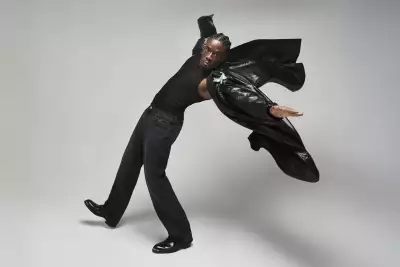
“He’s a savage,” says Charles Babalola with no little admiration. He’s referring to the legendary boxing promoter Don King, and clearly intends the term as a compliment.
King is among the least scrupulous men to ever live. He’s also fiercely intelligent, driven, uncompromising, and charismatic enough to charm the countless fighters, writers and moneymen who know he’s among the least scrupulous men to ever live but can’t resist his dizzying verbosity and megawatt smile. As a showman, he makes Eddie Hearn look like Keir Starmer.
We are discussing King in reference to Babalola’s upcoming TV series set in the boxing underworld. Fightland is the story of a former British champion, newly released from prison and seeking revenge on the London crime family that put him there. Babalola plays Zeke Marshall, an aspiring promoter and by all accounts a bit of a headcase.
Press material refers to Zeke as “brash and unpredictable”. Naturally, Babalola studied King for inspiration. “I don’t want to say he informed the character,” says Babalola, “but it gave me a lot of tips on how to be a savage because Zeke is quite a savage in this story.”
The initial plan was to meet at a Soho members’ club but the place is packed for a birthday celebration so we decide to relocate. Wednesday afternoon in a heatwave isn’t the ideal time for unplanned reconnoitring, especially when every drinking den round here is spilling onto the street. Eventually we discover a quiet upstairs room in a pub just off Carnaby Street. A less glamorous location but perhaps more fitting to talk Fightland.
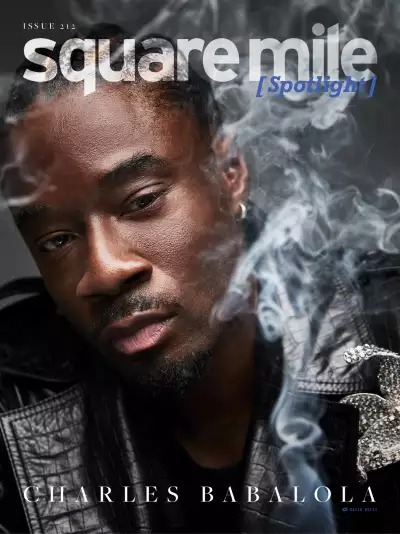
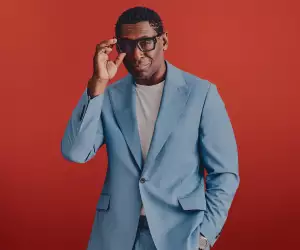
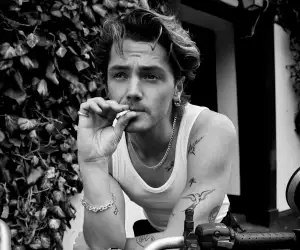
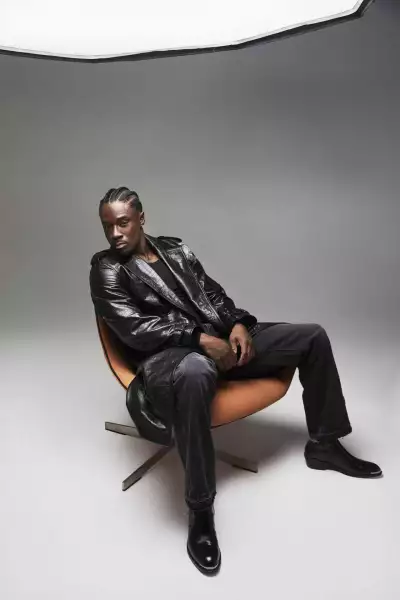
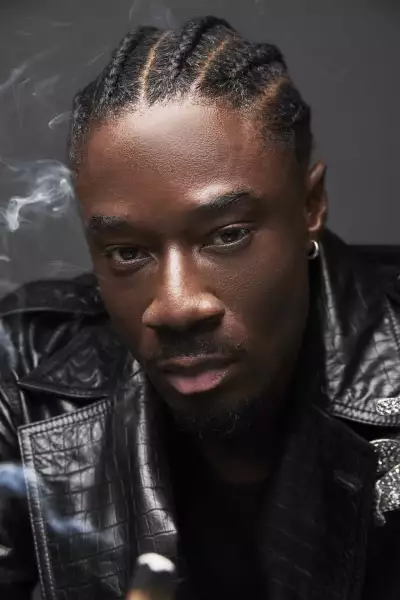
Unlike the mercurial Zeke, Babalola comes across as a cool customer, thoughtful and measured in his answers. He could easily pass for a boxer himself, the budding superstar a promoter might build a stable around. He’s wearing a Balenciaga top, tinted sunglasses, and his muscular frame is covered in a pleasingly eclectic range of tattoos. “I started getting them years ago,” he says. “I have a friend who is a tattoo writer so I just kept going.”
His tats include a Japanese geisha, a reproduction of Dizzee Rascal’s Boy In Da Corner album cover – “that was a pretty seminal album for me” – a pineapple – “I like pineapples” – and the Nigerian singer and activist Fela Kuti. There are also phrases such as ‘Lead with Love’ and a simple ‘Breathe’. The latter is “a daily reminder that life takes you in many obstacles and roundabouts. Through the stress and anxiety, I just remind myself to breathe.”
Boxing promoters rarely pause for breath: Eddie Hearn published a book called Relentless. (Its cover was a photo from his square mile shoot.) In Fightland, Zeke’s father Kingsley (Nicolas Pinnock) is also a boxing promoter; Babalola compares him to Barry Hearn. This naturally makes Zeke the Eddie of the Marshall family, “but very much in his own way.” He watched the Netflix documentary The Greatest Showmen during filming, and saw many similarities between Matchroom and the Marshalls.
He also watched documentaries on Don King, and plenty of YouTube. He cites a quote from the promoter Kalle Sauerland. “I remember him saying in an interview that to be a promoter, you’ve got to be bonkers. You have to be a character.” He carried that mentality into Zeke. “He’s in a business with balls. You know what I mean? He needs that charisma. That thick skin.”
I interviewed Sauerland a few years back. His WhatsApp bio read ‘Orchestrator of controlled violence’... Babalola laughs when I tell him. “I love that! Love that.”
Fightland was shot across London, locations including the legendary Peacock gym, the Tottenham Hotspur stadium, and the Mecca of small-hall boxing, York Hall. The latter naturally involved a fight scene. “They packed it out with extras. And honestly, it was electric in there! Oh my God. Probably one of my favourite days ever on any set.”
Presumably Babalola sat ringside? “I’m ringside. I’m there. I’m watching one of my fighters in our stable in a very contentious fight. So I had to bring that intensity from the front row. But shoutout to all the extras that came that day because they really fed me. It felt like a real, real fight in there.”
Curtis ‘50 Cent’ Jackson serves as executive producer on the show. Babalola met the rapper on set. “I sat down with him for over an hour and 15 minutes, just talking about work, life. It wasn’t even so much about the work, actually.” He was part of a small group who attended the Chris Eubank vs Conor Benn rematch, knowing in advance that 50 Cent was walking Eubank to the ring. The entrance proved the highpoint of Eubank’s night. “The hydration clause really messed him up for that one,” says Babalola ruefully.
Filming at the Peacock gym was another surreal moment: Babalola played for their football team as a kid. “I had not been back there for like 25 years, which was a bit of a trip. But yeah, I trained with those boys. They really put me through my paces. Oh my God! That shit was crazy.”
Judging by his trajectory, expect plenty more crazy days to come.
None of this was ordained. Babalola grew up in Newham. His dad worked for the council, and then the NHS. His mum is a social worker. “She looks after elderly and disabled. She’s done that for years. So nothing creative.”
How did he get into acting? “It started in secondary school in year seven. I went to an all-boys Catholic school in Forest Gate, and I had a great drama teacher.” So many career paths start with a great teacher; Babalola’s was called Maria Waldron. They stayed in touch. A few years ago, she came to watch him perform alongside Bryan Cranston in a National Theatre production of Network.
“An amazing man,” says Babalola of Cranston. “He taught me how to be a number one.” Strangely enough, I once knew an actor who appeared in that very same production. (Shoutout to Danny Szam.) Apparently Cranston gave everyone a gift during the run? “Two whisky glasses with ‘Network 2017’ on them. Beautiful man, beautiful soul.”
Maria Waldron sounds another beautiful soul; her former student couldn’t be more effusive about her. “She was teaching a bunch of naughty, mischievous black boys in the ends in Forest Gate. But drama was a release for us. We could go in there, or at least I could go in there, and express myself. Take this pent up frustration and anger of being shouted at in my maths class and just explore and play. It was play. That’s what acting is. She was definitely instrumental in the foundation, in the beginning of my journey.”
He trained at LAMDA. “One of the most prestigious drama schools in the world, little old me from East London.” He recalls the photographs of past productions all around the school. There would be the likes of Benedict Cumberbatch, David Oyelowo, Ruth Wilson, Jim Broadbent.
“All of these great British actors who came to the school. You really felt like you were in an institution. And on top of that, I loved the teaching. I would say LAMDA was probably some of the most formative years of my life. Not just in terms of my training, but my life.”
How so? “When I stepped into drama school, it was like, ‘Okay, this is real.’ Because you’re not the best. You walk into your class, right? You’re in a class of 30. You’re not the best kid anymore. You were the best, or one of the best in school, in college, but you step into drama school and you’re like, ‘Okay, there’s quite a few good actors here.’ But that was the motivation. That kept me sharp.”
Now his fellow students were no longer East Londoners. They came from all over the country, all over the world. I draw the inevitable parallel with a fighter’s sparring; you want to train and test yourself with the best. “There we go,” says Babalola. “You can’t be afraid of competition. Competition is healthy. Healthy competition – that inspires me. I see something good, I’m like, ‘I’m going to do that better.’”
One major influence was a director from his foundation year named Andrew Norton, formerly of the Drama Centre – a drama school that leaned heavily on the Stanislavski’s system. (Big of physicality and psychological realism.) “I think he’s in his late 70s now. “I see him every now and then but he’s still in touch. He lives in between here and Sweden. His thing was he had very unique, quirky acting methods.” Like the scene from Rocky where coach Mickey has the boxer chase chickens around a yard? Babalola laughs.
Can he share an example of Norton’s methods? He describes a dialogue with a female actor. “She was playing my love interest, and he gave us two animals to be. I can’t remember what he was trying to get out of us. I think it was something along the lines of he wanted more of the rawness, the animalistic qualities in the character. And so we crawled around as animals.” Afterwards, they replayed the scene as humans. “And yeah, it brought out something really nice between me and my scene partner.”
“He’s had a big influence on my life,” says Babalola of Norton. “So can I just say one more thing about him?” He cites former Manchester United manager Sir Alex Ferguson. (He’s a United fan, and plays football regularly.) “People say Sir Alex Ferguson was a good tactician, right? You can’t have that level of success and not be. But his thing was getting in your head. His thing was his man management. That’s how I would describe Andrew. Great methods but he was a man manager.”
In his final year, he auditioned for the 2016 film The Legend of Tarzan. It was a major production, starring Alexander Skarsgård, Samuel L. Jackson, Margot Robbie, and Christoph Waltz. Babalola read to play the son of Djimon Hounsou’s warrior chef. During his final LAMDA show, he got a call from his agent saying director David Yates wanted to meet.
“I finished the show. I get picked up at the theatre and I get taken onto the set at Warner Brothers studio in Leavesden.” He got offered the role right then. “I was like, ‘Man, I’m here! I’ve arrived!’” The only downside: he missed his graduation due to filming clashes. A small price to pay, surely? “I was a naughty kid in school, man. So I wanted my parents to see me graduate.”
A couple of years later, he landed what he describes as his favourite job to date – playing Andrew the apostle in the 2018 film Mary Magdalene. The film starred Rooney Mara as Mary, one of Babalola’s acting heroes Joaquin Phoenix as Jesus, and the great Chiwetel Ejiofor as Peter – one of the graduates once watched over him in the LAMDA corridors. “Chiwetel was one of my idols,” says Babalola. “Growing up as a Nigerian from London who went to LAMDA as well.”
He cites Network as another favourite, along with Fightland. “I know you just asked me for one,” he says, almost apologetically. “But Fightland was an incredible time. I had an interesting couple of years in the business and this felt poignant.”
I assume he’s referring to King Shaka, the $90m epic Showtime series about the founding of the Zulu empire. Babalola was cast as Shaka. The production lasted for nearly a year but the series was shelved when Showtime merged with Paramount+. Today, Babalola is disappointed but phlegmatic. “You can’t control anything in this business. And that was one of those situations where I was the lead in something really special.”
They filmed in South Africa? “For eight months. Again, a life changing job. A life-changing job, man. I had a real spiritual time out there. So it was a shame.” Unsurprisingly, he chose his next project with care. Fightland was the result. “I always felt like the next step that I stepped on, it had to be right. It had to mean something. Yeah, it was a great job. Great cast, good people and a great role. ”
Our conversation returns to boxing. Who were his favourite fighters growing up? “So Lennox Lewis for sure. Prince Naseem Hamed, definitely. Roberto Duran. If we’re taking it back, I love the middleweight era of the Four Kings.” (The quarter of Duran, Sugar Ray Leonard, Marvellous Marvin Hagler and Thomas Hearns who shared multiple epic fights across the 1980s.)
Like many of our generation, he’s a big Anthony Joshua fan. “I love AJ. That’s the boy.” He once bumped into Joshua on Carnaby Street, right around the corner. “He was with some security and I was just like, “What’s going on, champ?” And he came over, dapped me up. It’s lovely.” Babalola smiles at the memory, then recalls how he asked Joshua when the Tyson Fury fight was happening. “And this was years ago!”
Joshua and Fury may finally meet in New York (because where else would you hold the overdue clash of two British boxers). Hopefully Babalola won’t have to wait equally long to fulfil his own career ambition of working with director Steve McQueen. “That’s my dream, man,” he says. “Steve McQueen’s one of my idols in this business. He’s my kind of director. So it will happen. It will happen. It’s just about when.”
Beyond that? Keep grinding, keep taking the big swings. This is an actor who’s scored some major wins, taken his licks and come back stronger than ever. Don’t expect him to rest on his stool. “I want to do impactful stuff. Stuff that makes a difference. Stuff that shows my range. I feel like it’s so easy to get boxed into one kind of character.
“There’s a lot to my toolbox which the industry hasn’t seen yet. So watch out.”
Fightland premieres on 27 August 2026 on Sky Atlantic and NOW TV