It’s out there, somewhere, in someone’s shed: a child’s Kuwahara BMX bicycle. Not just any Kuwahara BMX, but one with a handlebar-mounted milk crate – one of two known to have survived the production of Steven Spielberg’s E.T., whose whereabouts is unknown. Or maybe the cherry red Gibson ES-345 played by Marty McFly in Back to the Future, also missing.
“And there must be an original 1927 UK edition of the poster for Metropolis out there too, but none has been found,” sighs Alastair McCrea, consignment specialist with Propstore, a leading auction house for film memorabilia. If you happen to have one, happy days: you’ve got £1m on your wall.
Finding such holy grails is not impossible – Harrison Ford’s blaster from Blade Runner, Han Solo’s jacket and Chewbacca’s bowcaster from Star Wars were lost for decades before resurfacing. And they would definitely spark a buying frenzy. Collecting film memorabilia has become a big business, with specialist auction houses dealing in items valued anywhere from a few hundred dollars to multiple millions.
Film memorabilia is a hugely diverse world: not just props but costumes, scripts, artwork, posters, set decoration, clapper-boards
Certain factors determine the standing of any piece of film memorabilia. Most valuable of all is a ‘hero prop’ that played a key part in the film’s plot or in defining its lead characters – the Rosebud sled in Citizen Kane, for example, the Maltese falcon in, well, The Maltese Falcon, or Dorothy’s ruby slippers from The Wizard of Oz. They’re the current auction record holder for film memorabilia: a pair sold for $28m (before fees) in 2024.
“But film memorabilia is a hugely diverse world: not just props but costumes, scripts, artwork, posters, set decoration, clapper-boards. We have clients who only collect costumes worn by men in westerns, or by women in musicals, or only memorabilia from film noir, and a lot of these pieces are still accessible – under $5,000,” says Catherine Williamson, managing director of Hollywood for Julien’s Auctions in California.
It also matters if a prop was made in multiples, for example – there will be dozens of James Bond’s pistol made for each film, but there were only five fedoras supplied for Raiders of the Lost Ark. Indeed, because most modern blockbusters are made on much larger budgets, there tend to be more multiples.
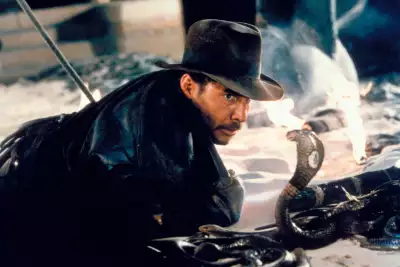
The record price for an Indiana Jones fedora is £487,000 – worn in The Temple of Doom.
Allstar Picture Library Ltd / Alamy Stock Photo
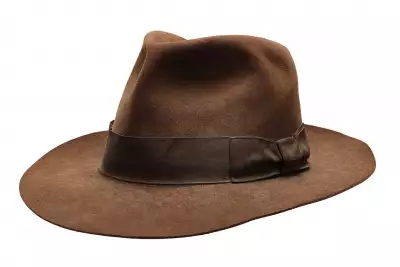
The record price for an Indiana Jones fedora is £487,000 – worn in The Temple of Doom.
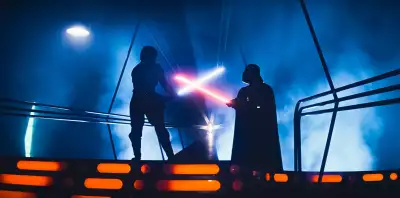
Other factors include whether the prop was created for background shots, special effects or stunts – and therefore made from softer, less detailed materials – or for close-ups; and whether it is merely ‘production used’ or actually ‘screen used’, meaning it made the final cut. And then a Star Wars lightsaber used on screen is one thing, but the one Darth Vader uses to remove Skywalker’s hand (“No, I am your father!”) quite another, which is why it sold for $3.65m last year.
These items tend to be what’s called ‘screen matched’ – some forensic poring over high-resolution stills from the films, matching scratch for scratch, paint spot for paint spot, manufacturing quirk for manufacturing quirk, goes into giving them the gold standard seal of provenance.
“Items already in the marketplace can be harder to authenticate,” concedes Williamson. “Is there a clean document trail? Is the way the item is made consistent with the times? And you’d be surprised by how often a piece of film memorabilia fails screen-matching. There’s always someone trying to pull a fast one – sometimes with fakes, sometimes with misattribution. Sometimes we just can’t verify a piece and have to let it go.”
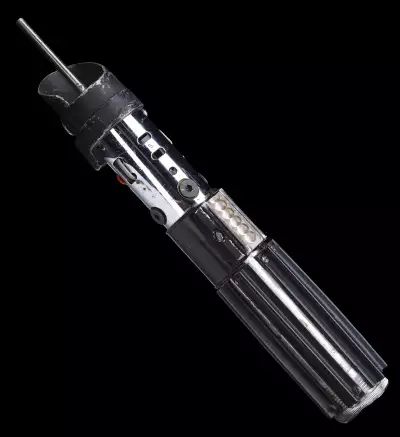
Darth Vader’s lightsaber sold for $3.65m
Provenance really matters: as Andy Simpson of film memorabilia dealers moviemaniaonline stresses, all this detective work – checking signed letters, studio receipts, production tags, set Polaroids – counts when collectors are paying considerable amounts of money for what they regard as treasured relics. “And they quite understandably want to be assured that it’s the real deal,” he says. It helps that often pieces are offered for sale by people who worked on the film. In 2024, Propstore auctioned off a significant chunk of the private collection of Anthony Daniels – the man better known as C-3PO.
There was a window of opportunity when the film studios didn’t much care if an actor or crew member took a prop as a memento. This fell between two eras: the old habit of reclaiming props for reuse in other productions, and the later realisation that they had value – either as archive pieces or as assets that could help offset production costs.
That all changed gradually in the years following 1970. That year, MGM sold the entire contents of seven sound stages – including 350,000 costumes, tanks, space capsules and the full-size sailing ship from Mutiny on the Bounty – to auctioneer David Weisz for a bargain $1.5m. Weisz made his money back eightfold – what he couldn’t sell went to the MGM Grand Hotel Las Vegas’s gift shop – and the movie memorabilia business was off…
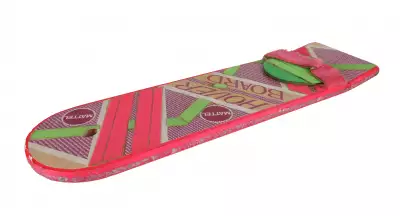
Marty McFly’s hoverboard sold for £36,900
“Actually, many props from the 1950s, 1960s and 1970s were simply thrown away. And if you think of a saga such as Star Wars, nobody at that time knew how successful it would become,” says Simpson.
“Some of the original Stormtrooper helmets were discarded into industrial skips at Elstree Studios when the first film was made. Some of them have surfaced over the years, when the film’s carpenters and set builders back then thought it was a nice idea to take something as a souvenir and store them in their attics. For them, it was somewhat of a whim that evolved into a lucrative turnaround.” He isn’t kidding: helmets of proven Imperial provenance can fetch up to £250,000 at auction.
If you’ve spotted a trend here, you’d be right. One reason why fantasy, horror and especially science fiction films tend to now be leading genres for film memorabilia is both because they’re prop-heavy and because the props tend to be recognisable, often even to people with no interest in film. Props from the classics still count, of course, for sheer rarity – indeed, from Marilyn Monroe’s dress in The Seven Year Itch to Audrey Hepburn’s in Breakfast at Tiffany’s, from the Goldfinger Aston Martin DB5 to Steve McQueen’s racing suit in Le Mans, these tend to become the Old Masters of the market. But items from even recent Marvel Cinematic Universe and DC films are hot tickets.
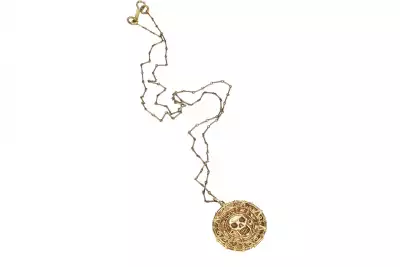
Will Turner’s cursed Aztec medallion necklace from Pirates of the Caribbean: The Curse of the Black Pearl sold for £126,000
“Sci fi, horror and fantasy inevitably give us items that are inherently interesting to look at, but also because they tend to be films that create entire cultures around them. People get passionate about these films – as they look to do with Dune, for example – and desperately want to own an object associated with them,” explains Sarah Hodgson, of entertainment memorabilia specialist Wallace & Hodgson. But, she adds, beware bubbles: back in the 1980s, anything related to Charlie Chaplin was “hugely collectible” but then interest in the silent film era rapidly faded away.
Ultimately, as with art, the price of film memorabilia comes down to what someone is prepared to pay for it. While streaming has boosted interest in films old and new, other factors can also push up prices: major anniversaries – expect a Star Wars bounce for its 50th birthday next year – and the gradual elevation of certain films to critical or historical importance
Nostalgia too is increasingly a driver, which is why films of the 1980s are a sweet spot at the moment. Buyers grew up in that era and now have the money to indulge their interest. As the 1980s is relatively recent, plenty of film memorabilia survives. It’s pop culturally very rich, too.
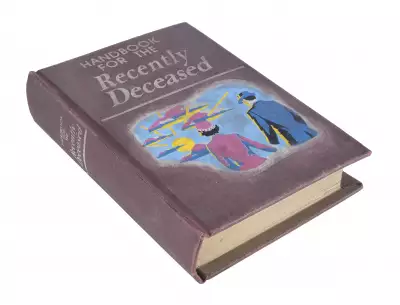
Handbook for the Recently Deceased from Beetlejuice sold for £107,100.
“It’s great that there are the hardcore film fans who love certain items but don’t necessarily have deep pockets – and there are things they can buy. But increasingly the market is seeing buyers who regard film memorabilia as an asset on which they expect a return. More people are prepared to take a punt,” explains McCrea. And returns there are, sometimes on blue-chip picks, sometimes on the unexpected. He cites an axe used in The Shining, which sold for around £50,000 a few years ago but more recently sold for £200,000. Then there’s the ID badge used in The Fifth Element bought for £20,000 which, remarkably, sold a decade later for £190,000.
As McCrea points out, there are not many of the really iconic pieces around – more now end up in museums as much as private collections – so prices keep rising, and all the more so since props were typically not constructed for longevity. Foam latex, for example, goes brittle fast. That’s one reason why those that do come to auction often make the news, especially given film’s standing as arguably the dominant global entertainment medium.
“Film memorabilia resonates,” says Claire Tole-Moir, who oversees the category for Bonhams, where no less than Sam’s piano from Casablanca, Robby the Robot from Forbidden Planet and the Maltese falcon from, well, you know, have been multi-million dollar sales over the last 15 years. “Wherever you go in the world, people know about certain films. Certain films just cut through to become something everyone talks about. And yet the really great thing about movie memorabilia, whether collector or investor? It’s always fun.”