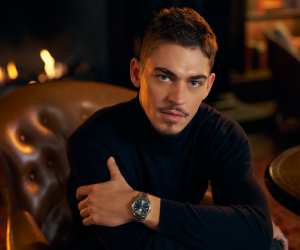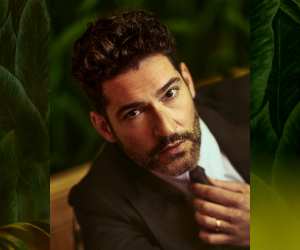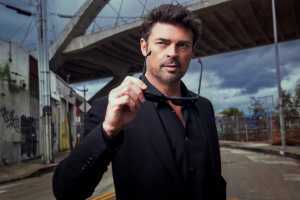
Karl Urban sits down for our interview. Clean-shaven, sharply dressed, the actor is a world away from the dishevelled menace of Billy Butcher. From his calm demeanour, you’d never guess he’s also navigating one of the busiest stretches of his career.
The New Zealander has just wrapped a global press tour for The Bluff, in which he stars opposite Priyanka Chopra Jonas. He’s also returning as Butcher in the hotly anticipated fifth and final season of The Boys – a portrayal that has become a cult favourite among fans around the world.
Next up, he’s back on the big screen in May with Mortal Kombat II, stepping into the role of Johnny Cage. Cage joins a crack team of fighters battling to overthrow the tyrannical emperor Shao Kahn, whose ambitions threaten the very existence of Earthrealm. As one does.
Over the course of a career that includes global juggernauts such as The Lord of the Rings and Star Trek, Urban has travelled the world doing the job he loves alongside some of the industry’s most celebrated directors and actors. Some might call that luck; Urban prefers a different view, one he shares with the legendary golfer Gary Player. “It’s funny that the harder I work, the luckier I seem to get.”
Square Mile: What was it like to step into the world of Mortal Kombat II and take on the role of Johnny Cage?
Karl Urban: This was certainly the toughest challenge of my career to date, at least physically. I like to sign on to things that I don’t necessarily know how to do because I find that embarking on those journeys helps me evolve. It’s how I learn.
The more work I put into a project, the better the result. Always.
SM: What did you learn this time?
KU: Many things. It was important to ground the character of Johnny Cage with a real backstory and a real history and a foundation that I could build upon. As part of my research, I went to a bunch of karate tournaments and saw a young generation of athletes and martial artists practising their craft and competing in tournaments.
It’s very interesting to see how these kids would deal with their wins and their losses. I also saw how their parents would be there to support them – and just the culture and community around it. I found that really fascinating.
For me, it helped cement some early origins of the character. Everything is specific, particularly pertaining to what I do in my work, and I have to have a very solid foundation of where to start. My work starts from the early origins and the beginnings of the character.
SM: I love how the movie is full of fantasy but Johnny Cage has that human element that keeps it grounded.
KU: Yeah. Otherwise, you’re painting with broad brushstrokes; to me, that’s like death by a thousand cuts. It’s got to be specific – and I inherently find that the more work I put into a project, the better the result. Always.
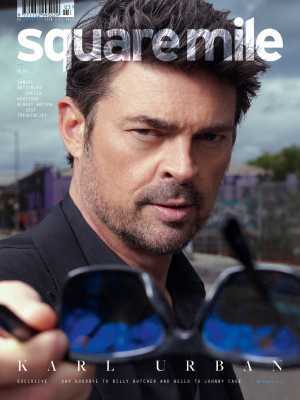
SM: Talk us through the martial arts?
KU: Martial arts, whether it’s karate, Jeet Kune Do, taekwondo or whatever it is, it’s so exact and specific. The choreography, the style and the tempo of what you do, there’s nothing general. You can bullishly plough your way through other forms of fighting, whether it’s sword fighting or brawling, but not in this case.
I had to embark on an extensive training programme over three months, not only ensuring my physical fitness was at an absolute peak but also working with a super-talented stunt coordination team and martial artists to get me up to speed so I could execute what I needed to do.
SM: So you learnt everything from scratch in a limited timeframe?
KU: Yes – you’ve got to start with the basics. You begin with basic movement, moving on the balls of your feet, finding your balance and moving with fluidity and grace. It was a huge learning curve.
SM: One thing that struck me watching the movie is that you were fighting in a leather jacket. Surely that was restrictive?
KU: In all honesty, that partly came about as a result of the action required from Johnny. At one point, Johnny gets flung through the roof of a hut and then 60-70 metres across a village into another hut. To me, it seemed he needed a certain degree of armour and protection. That’s where that element came in. It also fits into the canon of Johnny Cage’s looks. He’s always had a great style – especially utility styles – so it all coincided nicely.

SM: As you’re stepping into a world with such a big fanbase, were you mindful of keeping the essence of Johnny Cage’s character to your performance?
KU: Most definitely, it was important. I’m a long-standing fan of Mortal Kombat. I played it with my kids many times when they were super into it. It was important for me to mind the history of the character and try to infuse many elements into a realistic complex character that was moulded by the writer of the script, Jeremy Slater – and marry those two together.
Historically, Johnny Cage is full of ego, and at times, a bombastic, arrogant and fun character. The character that we have in Mortal Kombat II doesn’t start like that. He is ostensibly a very broken man. He is a man that the world has forgotten about. His movie career is in the tank and he has neglected his martial arts training, and it’s at this juncture that he gets called upon by Lord Raiden and Sonya to defend the world in the tournament of Mortal Kombat.
To me, that was really fertile ground to launch the character into. That gives me somewhere to go as an actor. It means you avoid playing the whole character on one level, which isn’t particularly interesting. There’s got to be a journey.
SM: How did your experience working on films with massive pre-existing fanbases such as Star Trek or Judge Dredd help prepare for Mortal Kombat II?
KU: There has been a pattern right throughout my career of embarking on projects that have massive fanbases: The Lord of the Rings also comes to mind alongside Star Trek and Dredd. It is one thing if you’re a pre-existing fan yourself – but then if you’re not, it’s your duty to do deep dives and learn as much as you can as quickly as you can.
You need to make sure that you work with the team around you and deliver something that is going to resonate with that fanbase and that audience.
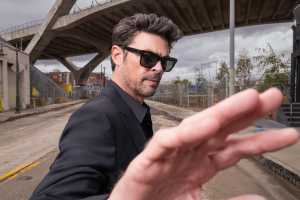
SM: Star Trek and The Lord of the Rings existed before the social media boom. It will be interesting to see if you will have different experiences with fan reactions…
KU: When I’m making a project, I try not to concern myself with the outcome of how it may be received. I put enough pressure on myself to get it right without taking into consideration other people’s thoughts and opinions.
Once I hand a character and a film over to the audience, then they can do with it what they will and interpret it the way they want to interpret it. In many ways, the film that is mine becomes theirs and it is no longer mine.
SM: Are there any other game adaptations you would like to step into?
KU: Red Dead Redemption is one of my favourites. Red Dead is a fantastic game. It’s interesting because I didn’t really have too much of an opportunity to get that heavily invested in the gaming culture.
Although I absolutely enjoy the opportunity to indulge in that kind of escapism, when gaming consoles came out in 1994, I was an unemployed actor living in Sydney. I couldn’t afford those consoles.
By the time I could, I was so busy working on various projects around the world that I was never able to get into it. From time to time, when I did get the rare opportunity, Red Dead was certainly one of the games that spoke to me.
SM: Yes! Red Dead Redemption was the game I had in mind…
KU: I mean, come on, John Marston! I’d love to play that character.
SM: Let’s speak it into existence. I’m also super excited about the final season of The Boys. What can fans expect? `
KU: People can expect the stakes to be raised. People can expect to be shocked. No character is safe. Everything is coming to a crunch and everything is coming to a climax. This season, Butcher is like a guided missile. He is the most dangerous, formidable, and smartest version of the character after what he went through last season. He is powerful and he is on a guided track targeting Homelander. He is relentless.
SM: What has it been like to live with this character for so long?
KU: I feel a particular affinity to Butcher. I have lived with him – and lived his life – since 2018. He’s a character that is very close to my heart.
It was a great joy to not only work and collaborate with such an extraordinarily talented cast and crew and to work with Eric Kripke and develop the character, but also to have the luxury of time to evolve the character and discover many facets and eccentricities about him.
To get the opportunity to really push the envelope and do things with that character that I’ve never done before, I’m incredibly grateful for the whole experience and I can’t wait for the audience to see where it all ends up.
SM: When you go back to film after a break, what snaps you back into Butcher?
KU: If I’m perfectly honest, I don’t think he ever really leaves! He’s within me. When I go back to season after season, I would put on the boots and the jacket and the shirt – and there he is. It’s like your favourite jersey; you put it on and it’s that easy.
SM: Do you remember the first moment you realised you had something special with this show?
KU: Just reading the pilot episode and then actually seeing it once we had completed it. That moment where Hughie is standing on the street with his girlfriend and A-Train smashes right through her and he’s just left there holding her hands. I was like, “Oh, this is something that an audience hasn’t seen before.” That is when you know you’re on the right track.
SM: Have you kept any mementoes from Butcher or the show in general?
KU: I did, actually. Many along the way from season to season, including shirts of his that I can never wear in real life but I still kept them. Finally, at the end of season 5, I took his jacket. I’ve got that – and every now and then I’ll put it on and feel Butcher again for a minute.
SM: Are you going to do what they do in the NBA, and frame and retire the jersey?
KU: I haven’t got plans to do that, no. But my wardrobe and my office are just steadily filling up with memorabilia. I’ve got my Lord of the Rings helmet, my Dredd helmet, my sunglasses from The Bourne Supremacy, Butcher’s jacket, and various swords and weapons from other things. I’m getting quite a collection – and one day I’ll probably auction it all off to charity.
SM: Speaking of The Bourne Supremacy, what was this experience like so early in your Hollywood career?
KU: It was pivotal in many ways. The challenge with that character is that it was skeletal on the page. He was a Russian assassin who was sent to get Bourne. The challenge was to see how much I could convey with the limited amount of time and dialogue that I had.
But I was blessed to work with Paul Greengrass, who is a truly great director and one of the best there is. He was directing this scene one day, where Kirill comes onto the bridge after shooting Jason Bourne’s girlfriend. They had just gone off the bridge in their Jeep and they’re in the river. My character comes onto the bridge and peers over the side. On the very first take, I peer over the bridge and I touch the side of the railing as I look over. The director comes over and says, “Great, we’ll go again. Don’t touch the railing.”
As he walked away, I thought it was really curious. I asked him why I shouldn’t touch the railing. He thought about it for a beat and said, “Because it connects you with this environment, but you’re not part of this environment. You’re just like a shark swimming through the ocean.”
That one piece of direction encapsulated the entire character for me and that’s what happens when you work with the best.
SM: That’s crazy how instinctual that direction was. He might not have even fully known why himself until he had to think about it and explain his decision.
KU: Yeah, exactly. There was something intrinsic about the way I was moving that lent itself to that, very still and gliding through. I remember going to the movie theatres in New Zealand and watching The Bourne Identity, thinking that was exactly the movie that I would like to do.
The universe provides. People often say, ‘Man, you’re so lucky.’ But it’s funny that the harder I work, the luckier I seem to get.
SM: It’s the 25th anniversary of The Lord of the Rings – you played Éomer in The Two Towers and The Return of the King. How did that exposure help prepare you for the career you’d go on to have?
KU: I’m eternally grateful to Peter Jackson and Fran Walsh for giving me the opportunity to be a part of that because it was really the foundation of my career in many ways. I had worked before then but for a young actor to step onto the set of The Lord of the Rings and to work with and watch truly great actors apply their craft, it was the steepest learning curve and the richest experience that I’ve had to date.
Those movies still stand up and hold a very special place in people’s hearts all of these years later. There’s not a day that goes by that The Lord of the Rings doesn’t come into my life in some way, shape or form. Whether it’s an interaction with someone who is a fan of it or even me just catching myself going, “Wow, I was in Middle-earth”
I was standing on the steps of Edoras looking out onto Middle-earth – and it’s so surreal. It’s just one of the many lives that I have lived but that one, for some reason, resonates stronger than anything else.
SM: To have experienced such a massive blockbuster so early in your career must have made it even more special…
KU: You’re being dumped into the middle of the biggest film on the planet. Half of my time was just trying to contain my nervousness, you’re definitely dealing with imposter syndrome and thinking, “I must have made a mistake. I’m going to get fired at any minute.”
But then once I relaxed into it, I’d be working on an adjacent sound stage, we’d do a couple of takes and we’d dump that footage down into a little video monitor. I’d walk through into another soundstage where Peter Jackson was directing Sir Ian McKellen and Christopher Lee.
I’m waiting to show [Jackson] what we’d shot and I’m just watching two of the greatest actors that have ever lived do their thing. It doesn’t get better than that. It was incredible. And then I’d show the footage to Peter and he’d say, ‘This is great. Go back and try this or that,’ and off you’d go back to your studio.
Working with Viggo Mortensen is still one of the greatest experiences of my career. He is hands down one of the most altruistic and caring human beings that I have ever encountered, and watching the way that he approached his work and what I’ve learned from him has really stuck with me. He’s a true artist.
SM: What is on the career bucket list?
KU: We never really know what’s around the corner or where the road is taking us. The destination isn’t important, but it’s the experience of the journey along the way.
Right now, I’m at the point of releasing The Bluff, the final season of The Boys and Mortal Kombat II. Instinctively, what I would like to do now is something that I haven’t done before. It’s going to be something completely different from those three characters because that’s what creatively satiates me.
I’m not an actor who could comfortably sit on a show for ten or 12 seasons, I’ve got to keep moving. I want new experiences and I want to work with different people and I want to work with the most talented and highest-calibre collaborator that I can.
To me, that’s where you get the most interesting results and that’s where you grow, evolve and learn.
Watch The Boys season 5 on Prime Video. Mortal Kombat II is in cinemas 15 May.