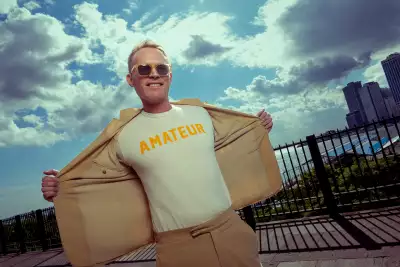
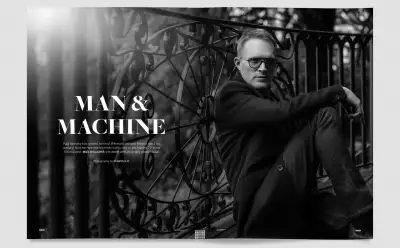
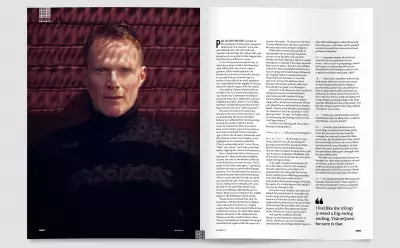
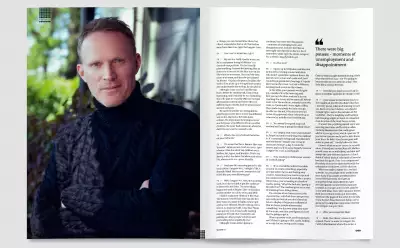
Paul Bettany breathes rarified air. The adolescent busker who conquered Hollywood. The character actor who went blockbuster. The self-confessed “weirdo” who became the coolest kid in the playground, a key player in the biggest film franchise the world has ever seen.
It hasn’t been an easy road. He was 16 when his younger brother Matthew died after falling from the roof of a tennis pavilion. Paul’s world imploded. He forwent his A-levels and moved to London to seek his fortune. He ended up as a busker. Eventually, his musical ambitions were abandoned and he applied for drama school. It’s hard to argue with the results.
His Geoffrey Chaucer stole the film in A Knight’s Tale. In a better world than this one, Master and Commander would have launched a franchise. Both films achieved middling box office. Both are now widely beloved, swashbuckling examples of ‘The Type of Films They Don’t Make Anymore’.
Of course, the story of 21st-century cinema is the story of the superhero – and predominantly the story of the MCU. Bettany was onboard from the beginning, voicing AI assistant J.A.R.V.I.S. in the surprise 2008 hit Iron Man. Seven years later and he finally appeared onscreen as the crimson android Vision in Avengers: Age of Ultron, his climactic showdown with the villainous robot the strangely serene highlight of an extremely noisy film. (“You’re unbearably naive,” snarls Ultron. “Well,” says Vision, “I was born yesterday,” before zapping the robot out of existence.)
Here I should mention a vital piece of Bettany lore. Despite his early noughties success, the turn of the decade produced a few duds. His career was in a rut. “You’ll never work in this town again,” a producer told him during one particularly fraught meeting. “You should mind your manners,” retorted Bettany with admirable bravado. “This is a town that has second acts, third acts and fourth acts.” A few minutes later, he was sitting on the sidewalk, feet quite literally in the gutter. His phone rang. It was Joss Whedon, offering the part of Vision. Bettany turned and gave the middle finger to the building he’d just exited.

Vision had an eventual time of it. He found love with Elizabeth Olsen’s Wanda, a rare example of romance in a largely sexless franchise. Unfortunately Wanda had to kill him to ensure his Mind Stone didn’t fall into the grasp of the megalomaniac Thanos; a sacrifice rendered moot when Thanos rewound time, brought Vision back and killed him again within the space of a minute. No matter – he returns in the 2021 TV show WandaVision, the most successful Marvel project since Avengers: Endgame.
Witty and inventive, each episode of WandaVision was inspired by American sitcom eras of the 20th century, with Wanda and Vision playing a married couple throughout. Gradually it becomes apparent their town is under a hex, the show-within-a-show has been manifested by Wanda as a way of coping with Vision’s loss. Ultimately, the original Vision is resurrected, by the US government this time, receives his memories but not his emotions from Wanda’s ‘Hex Vision’, and flies off to find himself all over again. Cue VisionQuest.
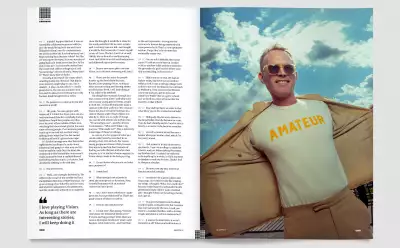
The series is the final act of the unofficial trilogy that started with WandaVision and continued with Agatha All Along. Vision’s great love Wanda won’t appear – supposedly – but his former enemy Ultron will, played by an extremely hirsute James Spader. Does it mark Bettany’s swansong as the character? Not if he can help it. “I love playing Vision,” he says. “As long as there are interesting and moving stories to tell… I will keep doing it.”
So Vision isn’t through yet. Nor is Paul Bettany, thank goodness.
Square Mile: Tell us about VisionQuest?
Paul Bettany: The last time we saw Vision, White Vision, he was flying off having just received his memories from Red Hex Vision. We find him living a discreet life in Scotland working at the pub that he used to frequent with Wanda, and he has all the memories, but he can’t quite attach feelings to them.
So at night, he goes into what we call his mind palace, which is this memory mansion that he has in his head. It is populated by all of these AIs that he has saved, and they have differing personality traits that help him understand his interactions with human beings of the day. But again, it’s a really discreet life, and he’s nervous to take part in life.
There are many AIs there: the arms that helped Tony Stark build the Iron Man suit are in charge of maintenance inside this mansion in his head. There is Friday, who replaced Jarvis when Jarvis was placed into Vision’s body. There is Edith, who was the AI given to Spider-Man after Tony Stark’s death. There is, of course, a Jarvis there.
And upstairs, behind a firewall living in a sort of prison / urban loft, is Ultron. Ultron acts as a sort of shrink, psychopathic, psychologist father figure to him. What will happen is that Ultron will force the issue – and Vision will be pushed out into the world in a more visceral and perhaps violent way.
SM: Superhero movies don’t always seem the most nourishing roles for actors – there’s a lot of pretending a tennis ball is your mortal enemy. Whereas in WandaVision and VisionQuest, there’s a lot to get your thespian teeth into, right?
PB: I don’t have a problem with acting with tennis balls! I’ve acted with crosses on matchboxes when they’re trying to get the eyeline closer. You can still have a relationship with the idea of the person. Obviously, it’s much easier if the person is there. But yes, this is a really satisfying end to this trilogy, and a big swing in the same way that WandaVision was a big swing. I feel like the trilogy is owed a big-swing ending, and this for sure is that.
SM: When you read the initial script for WandaVision, did you think this is madness or brilliance – or a bit of both?
PB: I had the idea pitched to me by Kevin Feige, so I knew what it was going to be. But [screenwriter] Jac Schaeffer managed to make such a beautiful little puzzle box. She backed Kevin’s idea, which was essentially half-hour sitcoms in black and white with canned laughter. He had that in his head, and she backed that into this puzzle box about grief. I thought that was incredibly clever.
We didn’t feel any pressure because we thought our show was coming out second on Disney+, and for various reasons it ended up launching [first]. It’s nice to be the bookend to all of that, because I think this will be the last huge Marvel TV show.
SM: You mentioned grief. Obviously you had this celebrated line: “What is grief, if not love persevering?” Did you recognise that line as a banger when you read it?
PB: It didn’t happen like that. It was an incredibly collaborative process with Jac, and she would bring both me and Lizzie [Elizabeth Olsen] into the conversations. We all knew what the line had to carry, but I kept pushing back because I didn’t feel like we were quite there yet. So it was months of going back and forth about that line. In the end, it was Jac’s assistant who walked into the room with coffees or bagels and said “persevering,” and we all went, “Wow, that’s it.” Then I knew that we had it.
Actually, if you watch the scene, what’s amazing is also the editorial. That line in your memory might play on me, but it doesn’t – it plays on her, which is a really great choice. It’s over my shoulder onto her, and it’s about her receiving that really human, kind thought from a robot.
SM: Do people ever come up to you and mention it at all?
PB: Oh, yeah. I’ve seen people with tattoos of it. I think the show came out at a very emotional time for everybody during lockdown. People lost people, and they were in a sort of hex bubble of their own, watching this show about grief at the same time as losing people. I’ve had many people come up to me and tell me their story, talking about what that line has meant to them and how it’s given them hope.
It’s kind of incongruous that this rather lighthearted medium of a comic-book robot touched people in that way, and it’s hard to explain really. But I do think the clockwork inside WandaVision was so well-made and crafted that it really delivered something big for people. I, of course, had absolutely nothing to do with that.
SM: You delivered it.
PB: Well, a lot of people delivered it. The editors who cut all of my terrible stuff out, the brilliant direction of Matt Shakman, the great writing of Jac Schaeffer and her team, and also the management, the producers, and the studio who allowed us to make this show. We thought it would be a show for the nerdy outsiders like we were as kids – well, I certainly was as a kid – we thought it would be for the weirdos. I count myself as one of them. The fact that it hit so well, I think, was to do with a really amazing team. And Lizzie is an extraordinary actress and delivered a great performance.
SM: Do you have more places to take Vision, or is this your swansong with him?
PB: Those are decisions for people further up the food chain than me. But yes, I love playing Vision. As long as there are interesting and moving stories to tell that are fresh, I will keep doing it if I’m asked to be involved.
The thing I have noticed through fans that connects with them – and why there are so many young fans of Vision, people in their 20s – is that all characters make a contract with their audience. The contract Vision has made is that he is always in a state of change and trying to figure out who he is. There are a couple of things you can do with robots: one is Pinocchio – “I’m a real boy now” – and the other is Frankenstein – “Who am I? What is my purpose? Who made me?”. This is definitely a marriage of those two things.
In a sense, it’s the apogee of what you can do with Vision because he’s in an identity crisis. I think that’s the reason young people are drawn to him, because they are very much in that business of finding out who they are and what their purpose is. It’s a matter of some urgency. So Vision always needs to do that questing.
SM: Do you know who you are and what your purpose is?
PB: Some days!
SM: When you got cast as Jarvis in 2008, the concept was so futuristic. Now, essentially anyone with an internet connection has a Jarvis.
PB: Yes. I don’t know whether it’s quite Jarvis yet, but it probably will be. That’s the good version of what it could be.
SM: How do you feel about AI?
PB: I think that’s like asking, “How do I feel about the Industrial Revolution?” It’s here and happening. I think there are various dystopian versions of what could happen. Jarvis represents – and Iron Man in the suit represents – an augmented version of a human being endowed with superpowers by AI. That’s a very optimistic version. I hope that’s the version that eventually comes true.
SM: Can we talk a little bit about your career? I read you were born in London with an outdoor toilet and then moved to the grounds of a girls’ school where your dad was teaching. Is that correct?
PB: That’s sort of correct. We had an indoor toilet, but there was an outdoor toilet as well. It was a railway cottage built to house the men working on the railroads in Willesden. Then we moved to Hendon, where my dad got a job in the rural suburbs of Potter’s Bar at a girls’ school, and we lived in a close of houses for the teachers at that school.
SM: Your dad had been an actor. Is that what drew you to the profession initially?
PB: Obliquely. My dad was a dancer in the Royal Ballet. Then he became an actor. Then he had a family, and it’s hard to raise a family as an actor, so he became a teacher.
SM: You left school at 16 and became a busker after your brother died, which I’m very sorry about.
PB: I left school at 16 and chose not to do A-levels. I went to a college to study for A-levels, and just before taking the exams, my brother died. I couldn’t be bothered with anything for a while, so I left and went to London to seek my fortune. I didn’t find it; I became a busker.
SM: Did you have any idea what that fortune entailed initially?
PB: I wanted to be a guitar player and sing songs, but I didn’t really like singing my songs. I thought, “What else could I do?” because I wasn’t particularly academically gifted and I knew I didn’t want a normal job. I thought I’d try out for acting schools, and I got in.
SM: One gets the impression busking could be quite a romantic life, but I assume that isn’t necessarily the case. I read you lived in a Camden flatshare with a lesbian couple and about a million cockroaches?
PB: It was on Turnmill Lane. It wasn’t romantic at all! When you look back on things, you can romanticise them, but I don’t romanticise that at all. The further away from that time I got, the happier I was.
SM: Your son’s a musician, right?
PB: My son is a really special musician. He’s a composer doing his Master’s in classical composition. He can literally play anything. I remember putting him in front of a drum set for the first time in his life when he was seven. He found the bass drum and snare, and then he just played ‘In Bloom’. He plays the piano, he plays the violin. If he picks up a stringed instrument and understands the tuning, he can play it.
I thought I was musical until he was born. Before he could speak, I heard him humming, and I realised he was humming the cello part to ‘I Am the Walrus?’ So I got all my guitars down and tuned them to different open chords, and he would crawl around and play.
He can’t remember not being able to play the guitar. He hears music in a different way to me, like how a fish sees more colours. His experience listening to music as a baby was very different from my other children. He never had a moment where he didn’t know what he wanted to do.
SM: What’s the story behind the tattoo on your left arm?
PB: It’s a rose that has a banner that says ‘Jennifer’. After my last child was born, I put a banner that has all of my children on it: Stellan, Kai, Agnes, and Jennifer. That’s my family, which has been the adventure of my life, always with me – quite literally.
SM: You have this amazing period in the early 2000s: Gangster No. 1, A Knight’s Tale, A Beautiful Mind, Master and Commander. Did it feel like you were blowing up?
PB: Well, Gangster No. 1 became a calling card, but I don’t think it got the audience it deserved until later. The same thing happened with A Knight’s Tale – it found its audience later on cable, video, and DVD.
I didn’t really ever think of it like that. The most it ever felt like that was the first time I saw my name in lights, when I got a job at the Aldwych Theatre taking over a role in An Inspector Calls. I was like, “Wow, I can pay my rent. I’m actually making money at this job that I wanted to do, putting on other people’s clothes and pretending to be somebody else.”
I thought it was always going to continue, but there were big pauses – moments of unemployment and disappointment. It didn’t feel like an overnight star experience for me. But I remember when I got the movie Gangster No. 1, which I largely lied to get.
SM: In what way?
PB: I grew up in Willesden and Hendon in the 1970s running around with kids who didn’t speak like I spoke at home. My parents were actors and spoke well, but I would have gotten daily beatings if I spoke like that on the street. So I had a different language and accent on the streets.
In the 1970s, your parents would give you a sandwich in the morning and kick you out the door, and you’d just be roaming the streets at five years old. When I went in for the audition, nobody knew who I was, so I pretended I was a right ruffian. That made everybody feel safe enough to offer me the job. I think they were all rather disappointed when I showed up at rehearsal as middle-class Paul Bettany.
SM: You weren’t tempted to go full method and keep it going the whole time?
PB: No! Largely that’s not what method is. People misunderstand what the method is. It’s not people being mad. Stanislavski’s method doesn’t require you to stay in character 24 hours a day. It would be insane, and you’d be a psychopath, because Gangster No. 1 was a psychopath.

SM: How would you define your version of method acting?
PB: It’s a teachable method to enable an actor to create something, especially at times when they’re not feeling very creative. Sometimes you read a script and you understand it and it lands like a prayer. Other times, you’re looking at a hunk of marble going, “What the fuck am I going to do with this?” The method gives you a way of breaking those things down.
You analyse what characteristics the character has, which of those you possess naturally, and which you don’t have but have to display. It helps you understand that in drama, people always want something. You discover what they want in the scene, and then you figure out how they’re going to get it.
What transitive verbs are they going to use? If they’re going to flirt, cajole, belittle, or terrify. For me, being at the Drama Centre, which taught method acting, that’s what the method was – not ‘I’m going to become this person 24 hours a day.’ That feels like a mental disorder.
SM: How did you psych yourself up for those incredible speeches in A Knight’s Tale?
PB: I just stayed in the mood, much to the chagrin of the DP, who didn’t like that. I was very jovial, jokey, and wanting to have fun. But I very much believe sets should remain light. Look at the outtakes of The Godfather – they’re laughing and having a ball. Keeping a light set leads to relaxation even in some of the most heavy scenes.
It wasn’t like psyching myself up; it was learning your lines and having an idea. Anthony Hopkins has this really great advice to young actors, which I pass on: “If you’re five minutes early, you’re late. Know your lines. Be bold – the theatre gods will come to your aid.” I really believe in that.
I love it when an actor comes to set with ideas. [VisionQuest co-star] Ruaridh Mollica would come to set with ideas, and that isn’t always the case with young actors. I don’t think it’s their fault; it’s the fault of how the business has gone. Time is so compressed that they underwrite their shows with the exhaustion of the crew and the director.
When we made Gangster No. 1, we had 12 weeks. You would get three weeks if you were lucky if you made an independent movie like that today. Time gets so compressed that many directors have already figured out where they want you to stand, so younger actors aren’t asked to come with ideas. I love when an actor knows their lines without looking at their sides, which are the pages of the script for the day. If you haven’t done that work before, we’re going to be using that compressed time for you to figure out your lines.
SM: Were you always like that?
PB: Yeah. That doesn’t mean it can’t expand. There’s a scene in Gangster No. 1 with Eddie Marsan where the entire → → interrogation at the end of the scene was made up in the moment. But having an idea, a plan, and something you understand where you are in the story… otherwise, what are you doing? You’re just like a performing monkey unless you have a plan for how to tell the story.
SM: Do you have any memories from filming A Knight’s Tale?
PB: There are many stories from that film. It’s a hard one for me to think about and rewatch. Heath – when you met him, you knew immediately that he was a star. He was the most alive person you’ve ever met. It’s a great sadness. He had so much more to do, not just as an actor, but as an incredibly creative human being full of joy. There’s so much said about the darkness, but my experience of him was a young man full of love, joy, and life. You just knew immediately that this kid was a superstar.
SM: Did you anticipate the film would still be beloved 25 years later?
PB: No, I thought it was going to die a death. We made it and clearly Sony didn’t want to put any money into the release of it. They didn’t know what it was. It was an uphill struggle, and it sort of failed at the box office and found its audience later. I suppose a bit like The Princess Bride or a movie like that where they had no idea what it was. But that was a great old time.
SM: Master and Commander has enjoyed a resurgence, partly because of the old-school craft, but also the positive masculinity in the friendship between Captain Jack and your character, Stephen. Is that something you’ve been aware of?
PB: I know that people love that movie. It’s sad that there could have absolutely been a franchise out of that movie. What makes me sad is that it made its money back – it just didn’t make enough profit for people to be bothered to make another one. There were for sure more adventures for Stephen and Jack to go on in all those books, but they didn’t. It’s a movie that I’m proud of, and a movie where I never think, “Why the fuck did I do that?” – which I can’t say is true of all the movies I’ve made.
SM: I’m sure you’re glad you made A Beautiful Mind, because you met your wife, Jennifer Connelly, on that set.
PB: I did meet Jennifer on that job. We became friends, and then much later – like two years later – we got together. I also met Ron Howard, who has become a lifelong friend, and Akiva Goldsman, who has become a lifelong friend. It was an amazing time of growth for me as a human being.
Subscribe to the magazine
SM: I read that she was your childhood crush from Labyrinth. Is that true?
PB: That’s been slightly overblown, but I absolutely knew who she was. When she walked into the read-through, I just thought, “I don’t think I’ve ever been in the same room as a person this beautiful and radiant.” That’s absolutely true. But we became friends just chatting, and then a few years later got together. People tend to meet the people they fall in love with at work. If you take the movie business out of it, we basically met by the water cooler.
SM: You were told “you’ll never work in this town again” by a producer before getting the call from Joss Whedon offering you Vision. Is it true that happened as you were leaving the initial meeting?
PB: I was sitting down on the pavement on Sunset Boulevard thinking, ‘I’m never going to work again. Maybe he’s right, maybe my career’s over.’ And then my phone went, and it was Joss Whedon.
The crazy thing is, I got on really well with Kevin Feige and Louis D’Esposito and the directors I had been working with, but mostly remotely in a recording studio. When Joss Whedon asked about playing Vision, questions were raised about whether I could play a superhero. They showed them a film of me in Priest.
Priest is an incredible story because that movie was supposed to go in what was then called the ‘underworld slot’ in January, where it was totally unpopulated with other movies like that. Instead, Sony decided to put Michel Gondry’s $100m movie, The Green Hornet, in our slot, and put our little $30m movie in a summer slot sandwiched between Thor and other blockbusters. We were like a Prius on the freeway. We just got crushed. It got totally destroyed by the juggernauts on either side, and I couldn’t get work.
When Joss Whedon was convincing Marvel that I could play a superhero, they showed him that film. The film that had been the nadir of my career was actually the reason people had confidence to cast me as Vision. Life is really curly, and you never know what’s coming down the pipe.
SM: Have you encountered that producer in subsequent years?
PB: No, and I doubt that person is reading any of this – or would even recognise themselves in the story.
SM: What has surprised you most about your career to date?
PB: The honest answer is that you were lucky enough to make a career for yourself and get paid well to do the thing that you love doing. I had no expectations to succeed. Far better actors than I don’t work. People I went to drama school with, who I rate among the best actors I’ve ever seen, just couldn’t make a career.
Auditioning is a separate thing from acting. Getting the job is a different skill, and there are some people who are really good at getting the job and some who are not. I feel very blessed. Why would I have had the confidence? My dad, who was an actor, became a teacher because he had a family. I’ve been fortunate enough to be able to keep dreaming.
SM: What other dreams do you hope to realise in the years ahead?
PB: There are so many. I’d love to write and direct again. But mostly, just to keep working with fun people. It so often happens when you’re making a show that there’s one person whose job seems to be to try and make the experience miserable for everybody.
The people who get to work in this industry are the luckiest people. The days can be so fun, and at some point, it becomes about the hang – who you’re hanging with. When you have one of those times where there isn’t someone disrupting and sapping the joy out of the experience, it’s just the best job ever.
VisionQuest is on Disney+ from 14 October.