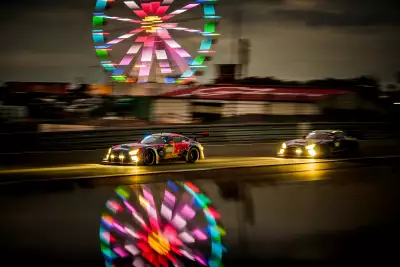
It’s around 1:30am local time when Max Verstappen screeched away from the pits for his next double stint of the 2026 Nürburgring 24 Hours. The race debut of the four-time Formula 1 World Champion had brought more attention in decades to the track colloquially known as ‘The Green Hell’ – 352,000 people were reported to be in attendance over the weekend, with the main YouTube livestream ratcheting up a total of 7.8 million unique viewers watching from afar – and this is the moment the racing world had been eagerly anticipating. Forget the mammoth first shift that saw the Dutchman thrust his team’s Mercedes-AMG GT3 from 10th to first place earlier in the day, that’s the same old same old, but seeing arguably the world’s fastest driver with his foot to the floor in the dead of night? Pass the popcorn, please.
As the headlights of Verstappen’s Mercedes illuminated a whirring ribbon of tarmac in the inky gloom, you could sense the entire motorsport community shift to the edge of its seat. The legendary endurance race, held on a 15.7-mile composite of the Nordschleife and Grand Prix circuits in Germany’s Eifel forest, is well known for separating the men from the boys (as well as bodywork from a car’s chassis), but here in the deepest, darkest phase of the contest is when racing acumen is at its most premium. Verstappen, a rookie in name only on the Nürburgring after dark, was setting off into the unknown.
A passionate advocate for the merits of sim racing, Verstappen had completed thousands of virtual laps of the Nürburgring circuit, but this was surely a different kettle of fish. It’s one thing to risk it all when it’s only pixels at stake, it’s another thing entirely when it’s your own body and a good £1m worth of equipment on the line. Somewhere far away, Oracle Red Bull Racing team principal Laurent Mekies was likely praying to Santa Maria for his prized F1 driver to emerge unscathed.
And this wasn’t an empty track. There are slower cars from different classes everywhere, each with different levels of speed and different lines. At the Nürburgring 24H, overtaking isn’t simply about being faster, you have to predict what another driver is going to do before either of you can properly see the other. Fail to make the right call and you’ll career into the barrier, your body jarred and your race in ruins. Just ask Alessio Picariello, the wreckage of whose Dunlop Motorsport Porsche 911 GT3 R was cleared from the track at the time Verstappen clambered into the cockpit – a timely reminder of the consequences should things go amiss.
On the night shift
Verstappen on track at the 2026 Nürburgring 24 Hours. His team were leading by more than 30 seconds when a driveshaft failure ended their victory hopes.
Philip Platzer / Red Bull Content Pool
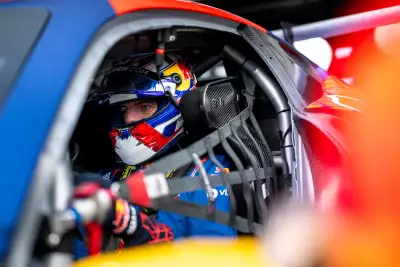
On the night shift
Verstappen on track at the 2026 Nürburgring 24 Hours. His team were leading by more than 30 seconds when a driveshaft failure ended their victory hopes.
Joerg Mitter / Red Bull Content Pool
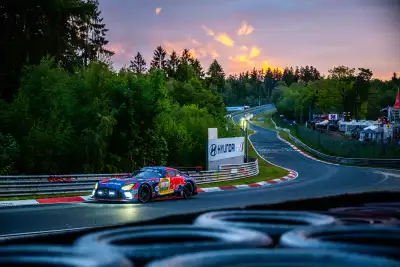
On the night shift
Verstappen on track at the 2026 Nürburgring 24 Hours. His team were leading by more than 30 seconds when a driveshaft failure ended their victory hopes.
Sebastian Kraft / Red Bull Content Pool
But to the 28-year-old, extraordinary as it may seem, it was just another day in the office. As he told me a few weeks later: “I’ve done so many 24-hour races or endurance-style races [in sim racing] and it’s exactly the same. It’s just that in real life, of course, you have the G-forces and the car in general, you feel the movement more. People were saying things like, ‘Oh, yeah, but he’s so inexperienced. That will be the real test.’ But for me, I was thinking, ‘They will see. That will be no problem for me.’”
The scary thing is how little the dark appeared to change Verstappen’s approach. He attacked the corners as if he could see the entire circuit in 8K technicolour – picking out braking points, perfectly placing the Mercedes over the kerbs at will and carrying speed through turns that are scarcely visible in the blackness before you arrive at them. There are 89 official corners at the circuit, a count that rises to north of 150 when you take into account more minor variations in the track, and yet Verstappen would have you believe he could tackle them all blindfolded.
Back home in the UK, knowing this interview was on the horizon, I set my alarm for the early hours of the morning and joined the masses watching transfixed as the onboard camera showed just how claustrophobic that twisting strip of track was with the Armco and rain-soaked grass runoffs (did I mention that conditions were wet?) encroaching on the racing line. I’m not afraid to admit that I was bricking it on Verstappen’s behalf, a fact that I confessed to the Dutchman as we spoke about the race: “Yeah, my teammates probably were as well. That’s why I told them to go to bed!” says Verstappen. “It’s always a bit more scary watching the onboard because I feel like it was always under control, but at the same time it’s not always your fault – sometimes it can be the other person that doesn’t see you. Other than that, it’s just vision, feeling, and instinct to make the right calls.”
Making the right calls was high on the agenda at the start of Verstappen’s night-time stint as he swiftly found himself embroiled in a tussle for the lead with the sister Winward Racing-operated Mercedes of Maro Engel, an experienced Nürburgring racer and GT3 specialist. Verstappen entered the stint six seconds down on his foe, but it wasn’t long before the red brakelights of the other Mercedes-AMG GT3 were squarely in his gaze. He made his move on the run down the Döttinger Höhe straight, getting right underneath the rear wing of Engel’s car before jinking right and taking the lead as he entered the shallow left-hand corner of Antoniusbuche. It would be a textbook overtake in broad daylight, but in the strange otherness of night racing, it’s positively heartstopping.
I’m not going to take stupid risks but you cannot race without taking any risk
I’m reminded of a fantastic old quote from Fernando Alonso, who said of his famous side-by-side pass on Michael Schumacher during the 2005 Japanese Grand Prix at Suzuka: “Of course I can overtake; he has a wife and kids at home.” The implication being that Alonso’s status as a bachelor left him with less to lose on the track compared to the family man. I wonder out loud to Verstappen if he’s learning to suppress some of his bolder manoeuvres, especially around a fearsome circuit like the Nordschleife, with one-year-old Lily and partner Kelly waiting at home in Monaco.
“Did it look like that?” Verstappen raises an eyebrow at me and grins as I bumble through a retort. “No, for me, I know when things can be dangerous. And honestly, it doesn’t change when you suddenly have kids yourself because you are already, I think, aware when stuff might be dangerous or can be tricky. Of course, I’m not going to take stupid risks, but at the same time you cannot race without taking any risk. If that’s how you feel, it’s better just to stay at home and not do it. But I love racing and I know some bits can be risky, but it’s the same thing if you take a shower – you can slip because the soap is slippery and you can also then shunt and break your neck. There’s risk in everything you do. If you start thinking like that, that is a problem. Yeah, I might take maybe a bit more risk than someone else, but for me, that is calculated risk.”
Across the night stint, he took the fight to Engel and eventually came out ahead. At one point, the two Mercedes ran incredibly close together, even making momentary contact while negotiating traffic, but ultimately the Dutchman pulled away.
It wasn’t one spectacular corner or audacious move, Verstappen simply kept grinding out the lap times as the mental and mechanical war of attrition slowly started to take hold. His stint was 7.07 seconds faster than Engel’s own commendable performance. In the following stint, Verstappen was 26.46 seconds quicker than Maxime Martin.
By the end of his six stints across the event, he had been faster than the sister Mercedes in every one of them, building a theoretical two-minute advantage over the course of the race. Even after accounting for Code 60 periods (a strict local speed limit of 60 km/h used to safely manage accidents), he found more than a minute of advantage attributable to pace.
Courtesy of TAG Heuer
Cruelly, Verstappen’s team were leading by more than 30 seconds when a driveshaft failure ended their victory hopes with just three hours and 20 minutes remaining on the clock. A fact of life in the gruelling world of endurance racing but no less galling for a driver who had already shown his worth and then some outside of his familiar domain. It would have been the most impressive cross-discipline achievement by an active Formula 1 driver since Alonso won the 24 Hours of Le Mans in 2018 and 2019.
Teammate Jules Gounon had nothing but praise for Verstappen’s efforts: “I think every generation has drivers of this calibre: Ayrton Senna in my father’s generation, Michael Schumacher in the next, and Max Verstappen in our generation. These drivers have something very special; there are very few of them. Witnessing Max’s talent, seeing how he drove and the risks he took, was truly impressive. I remember one night; I was in the pit box with his father Jos [Verstappen] and we were laughing, because what Max was achieving was simply exceptional.”
Sadly, the late retirement from Nürburgring 24H was an all-too-common story for the Red Bull Racing driver who has cut a frustrated figure during this season’s regularly scheduled Formula 1 World Championship. Fantastic qualifying performances like a last-gasp second at Monaco were followed by engine failure off the line in the Grand Prix itself, while an issue on Red Bull’s experimental ‘Macarena’ rear wing at both qualifying in Austria and then the British Grand Prix led to two heavy crashes in as many races.
Verstappen has spent much of his Formula 1 career, including when narrowly failing to reel in McLaren’s Lando Norris last season, vying for race wins and generally being a menace to those at the top of the starting grid. Languishing in 6th in the Drivers’ Championship without a victory to his name, as he finds himself at the time of writing, is almost unprecedented – in fact, you’d have to go back to his first full season at Red Bull in 2017 to find him occupying anything lower than 4th in the standings.
So, where is the car right now? “It’s probably in more of an all-around phase. It’s just still not quick enough. We need to make sure we are quicker sometimes in low-speed corners, or we need to find a bit more high-speed performance. It’s a bit track-dependent,” he explains.
I can very easily switch off and on. That’s why my emotions are not going up massively
Without sticking the knife in, Verstappen does fleetingly mention the latest reboot of Formula 1 regulations, which he has made no secret of disliking. In particular, the high-powered electric motor from which drivers deploy a Mario Kart mushroom-style boost, once they’ve collected sufficient energy, is the source of much of his disdain: “It’s so energy-dependent with the engines and the batteries at the moment that you think you have it under control in one race and then the next one you go to you don’t, it’s all a bit harder to understand. I think that’s also the criticism you can hear from a lot of people.”
When it comes to quantifying talent in Formula 1, the ultimate conundrum is how much of the performance should be attributed to the car itself or the driver behind the wheel. It’s a question that has plagued the theoretical ‘GOAT’ debate between Lewis Hamilton and Michael Schumacher, both of whom enjoyed periods of mechanical dominance in their careers, and has arguably gotten even harder to discern in the latest generation of F1 cars where overtakes are frequently dictated by how much juice you have in the battery. For a thoroughbred racer like Verstappen, the notion that Formula 1 needs to manufacture action goes against the very foundations on which the sport stands.
Regardless, it would have been no surprise were Verstappen’s present car troubles to have been greeted with a degree of ‘them’s the breaks’ mirth from. Yet Verstappen’s talents are so undisputed that they are seemingly impervious to the present shortcomings of the car; no one doubts that the Dutch star is extracting the maximum performance from the Red Bull, not even his closest competitors.
I ask the 28-year-old if this season has required a mental shift and whether his current difficulties are, in a way, more tasking than fighting for world championships: “I have to say, most of the years that I’ve been fighting for the championship, they’ve actually been very nice. This year, probably the beginning was not so nice, but I don’t know, I can very easily switch off and on when I need to. That’s why my emotions are not going up massively when I win, and they also don’t go down massively when I’m not winning. And that helps me a lot in every situation, to be quite relaxed about it in a way. Of course, I like winning and I don’t like when I’m retiring or the performance is not great. But I also know that, at the end of the day, I always do my best and I cannot do more than that anyway.”
Verstappen is renowned as a fiery customer in the cockpit, an aggressive ‘elbows-out’ driver in wheel-to-wheel combat, but my short time in his company is a reminder that he’s matured into a remarkably measured, objective individual. It’s easy to forget that more than a decade has passed since Verstappen burst onto the scene at the 2015 Australian Grand Prix, making his scintillating debut in the sport aged just 17 years and 166 days – still the youngest driver to have ever started an F1 race. His raw pace and composure may have been visible from the outset on that fateful Melbourne weekend, but the driver has since replaced some of his youthful impetuousness with the kind of racecraft that only comes from years of experience.
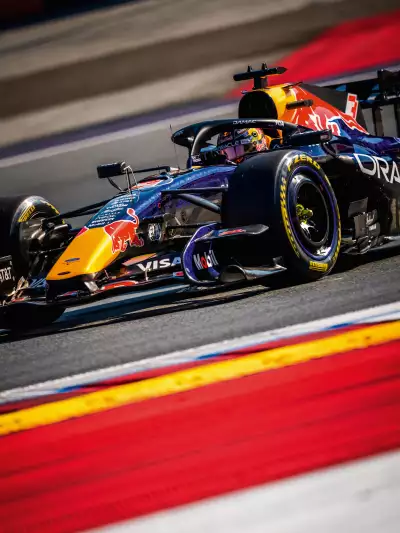
Philip Platzer / Red Bull Content Pool
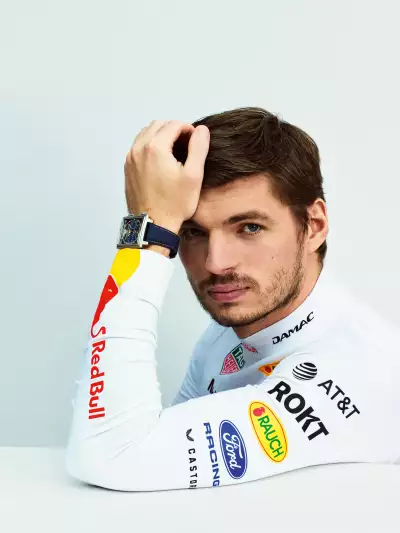
TAG Heuer
Verstappen has one of the most extraordinary racing brains in the sport, so I’m keen to discover what makes him tick. The answer is perhaps not as complex as I might have thought; quite the opposite in fact. Simplicity is the Dutchman’s secret sauce: “For me, sometimes it’s a bit hard to even comment because it just happens naturally. I don’t need to overcomplicate the situation. It’s just something that happens maybe a bit easier than with other drivers – I don’t want to say everyone, of course, but with some,” Verstappen tells me.
“I just try to keep life in general very simple. I think through the years that I’ve raced in Formula 1: you get a little better at handling a race weekend, you learn how to deal with your year, the travelling, all of that. Of course, you know yourself a lot better over the years – what you want, what you don’t want, how you want it. But that’s normal. You learn, you grow as a person also, because I started when I was 17.”
This idea of compartmentalisation and mental decluttering is nothing new in the world of sport psychology, but I find it curious that it still applies in a discipline that involves talking to your race engineer over the team radio, manually adjusting brake balance and engine modes on the steering wheel, as well as the small matter of driving as fast as possible; it’s a bit like patting your head and rubbing your tummy, while also talking someone through the day’s Sudoku puzzle. But, for Verstappen, finding that fractional bit of head space is the differentiating factor.
“There are a lot of people that can do a fast lap in this world, but with the really good drivers, it’s like even when you can’t drive at 100% all the time, just taking a step back, surveying, having a better awareness of the situation, being able to manage the tyres a bit better, all these kinds of things add up. It comes down to having a bit more capacity while still going fast,” he explains.
There is also the matter of Verstappen’s distinctive car setup and driving style, which over the years has been tuned to the very razor’s edge of performance. A few years ago on the High Performance podcast, the Dutchman’s former teammate and current Atlassian Williams F1 Team driver, Alex Albon, offered a tremendous analogy on just how acute that performance window is for fellow racing drivers.
Even if I come across a bit upset sometimes on the radio, it’s not like I lose my focus
“A lot of people say that the car is built around him. Truthfully, the car is what it is. He is very quick and he has quite a unique driving style, it’s not that easy to get along with. Everyone has a driving style. My driving style is a bit more on the smooth side, but I like a car that has a good front end – so quite sharp, quite direct. Max does too, but his level of sharp and direct is a whole different level – it’s eye-wateringly sharp,” Albon told Jake Humphrey.
“To give people an explanation of what that might feel like, I don’t know if you guys play computer games at all, but if you bump up the sensitivity completely to the max and you move that mouse and it’s just darting across the screen everywhere, that’s kind of how it feels. It becomes so sharp that it makes you feel a bit tense.”
Albon goes on to explain why this becomes such a problem for Verstappen’s team-mates: as Verstappen asks for an increasingly sharp car and gets faster, the team-mate has to take more risks to keep up, which can create a “snowball” effect as confidence deteriorates. For most drivers, that level of sensitivity makes the car feel nervous and unforgiving; Verstappen, Albon suggests, is unusually comfortable operating right on that precipitous knife-edge. It’s what has created a veritable merry-go-round in the second Red Bull seat as a flock of strong drivers have each failed to extract anything like the performance Verstappen continually finds in the car.
I mention Albon’s detailed explanation to the 28-year-old to see if he agrees with his former teammate’s assessments. In truth, he says, it’s difficult to put himself in another person’s shoes when it comes to ‘feel’: “For me, it’s a bit hard because, of course, it does not feel like that [sensitive computer mouse]. I do like a strong front end, but at the same time, for me, that feels normal. That’s just what I think a car needs to go fast. It’s a bit hard to fully explain how that feels to me because I just adapt to whatever the car needs to go quick. And if that requires an extreme amount of front grip or the other way around, then I will have to adjust to that because that’s the fastest way.”
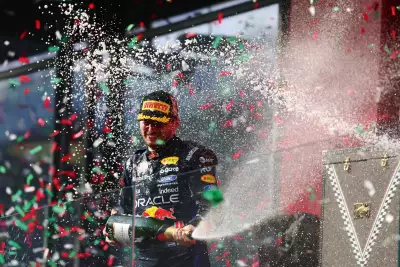
Hungary for more
Verstappen celebrates second place at the Formula 1 Grand Prix in Hungary this July 26.
Getty Images / Red Bull Content Pool
The son of former-Formula 1 driver Jos Verstappen and Belgian international karter Sophie Kumpen, who competed alongside future F1 racers Jenson Button, Giancarlo Fisichella and Jarno Trulli, it’s no surprise that young Max demanded to go into the family business from a tender age.
The Red Bull racer has said one unusual advantage of his childhood was coming home from testing and being able to talk technically about karting with both parents – he didn’t have to simplify things for his mother because she understood racing at an elite level herself.
His foundational years karting certainly appear to have helped cultivate the car control that has brought him fame and victories. Where most drivers want a little more stability as the car approaches the limit, Verstappen seems comfortable allowing it to move beneath him.
“It’s just about being comfortable with the car being a little bit on an edge with the rear axle. I know that when the car understeers mid-corner, you cannot push. Yeah, maybe it drives a bit more comfortably, but when you really want to find one or two tenths around the lap, yeah, you will not find it with a car that understeers. You’re leaving lap time on the table,” Verstappen tells me.
I mention Jackie Stewart’s old quotes about “driving gently to go faster” when you have a car that is finely poised, but it appears I’ve missed the mark: “I don’t know, everyone always names it a bit differently. I can give you a beautiful story, but there is no beautiful story. I like front end in the car. If it understeers too much, I’ll try to fix the understeer and I will try to find that front end that I need and just go from there. Every year, of course, the car responds a bit differently or has different areas that maybe have problems.”
A championship is won over a whole season, not by one decision in the last race
It helps when you can rely on your team, too. Race engineer Gianpiero ‘GP’ Lambiase has been the guiding voice from the pitlane since Verstappen was promoted from Toro Rosso (now Visa Cash App RB) ahead of the 2016 Spanish Grand Prix – where the young star famously took his unexpected maiden F1 victory. In the bubbling cauldron of a race weekend, Verstappen’s at times expletive-laden radio messages paint the picture of someone who you might think is a bit of a bear to work with, but his brotherly squabbles with GP are built on a mutual trust that they will get the most out of the car as a team.
“I think I’m in general very sensitive to a lot of things because I always want to be better and I want to improve certain situations. Even if I come across maybe a bit upset sometimes on the radio, it’s not like I lose my focus because I can very quickly then switch and focus on my driving again,” he says. “Some weekends, of course, that is maybe a little bit more complicated than others. Sometimes, you don’t get it right. But it’s a combination of the discussion that you have as a driver with your engineers behind the scenes, how you can quickly try and make the best of a tough situation. I think that’s just also the group that I’ve been working with for a long time. They know me well, I know them well, and we always try to optimise.”
The human element of Formula 1 is often pushed to the periphery when you are marvelling at state-of-the-art machines lapping at eye-watering speed, but Red Bull Racing employs approximately 1,200 people for its team, excluding its new engine division, and that sense of camaraderie runs deeper than is frequently appreciated by those with only a passing interest in the sport. Calum Nicholas, former member of Verstappen’s pit crew for a number of years, talks about the feeling of affection for his long-term driver: “I’ve never before, and will likely never again, experienced an atmosphere like the one in the Red Bull Racing garage during that final lap of that 2021 season, when Max overtook Lewis,” he wrote in his book, Life in the Pitlane. “As he crossed the line to become the 2021 Formula One World Champion, I looked around at the tears of joy in some of my teammates’ eyes and realised what it meant to all of us. It was everything.” That’s what Verstappen means to his team.
The toxicity surrounding the famous Verstappen-Hamilton duel for the 2021 world title, culminating in the unsavoury outcome of the Abu Dhabi finale, has unquestionably impacted on perception towards the driver in the UK. Following the thrills and spills of the most dramatic season in recent memory, Formula 1’s fanbase had already splintered into two vociferous tribes of supporters, Team Max and Team Lewis.
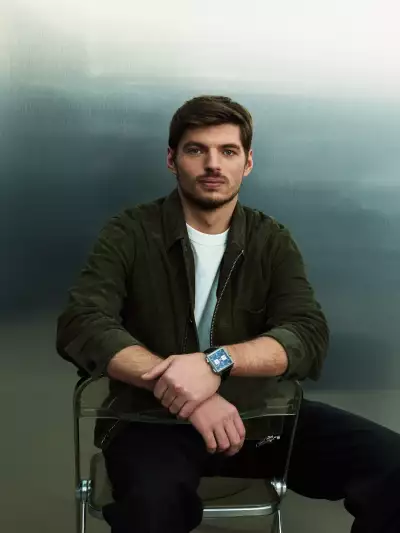
On the wrist
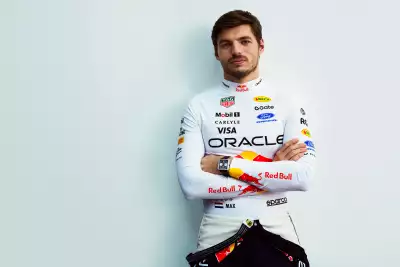
Max Verstappen wears the TAG Heuer Monaco 39mm Titanium Chronograph Automatic Men’s Watch, £7,900, tagheuer.com
A brief reprisal if you were living under a rock at the time: after Nicholas Latifi’s late crash brought out the Safety Car, five lapped cars were controversially allowed to unlap themselves while others were not permitted to do so, setting up a one-lap showdown in which Max Verstappen, on fresh soft tyres, dramatically overtook Lewis Hamilton on old hards to win the race and the championship. Race director Michael Masi failed to follow correct race protocol, a decision the sport’s governing body later ruled a “human error”.
In 2022, Verstappen told De Telegraaf that he wasn’t “lucky” to win his first title, he deserved it, and it’s difficult to argue with his firm stance on the matter: “A championship is won over a whole season, not by one decision in the last race. I also think I deserved the title, absolutely.”
Five years have passed since Abu Dhabi, but the court of public opinion hasn’t really moved on from those events. Every tussle with another driver or a decision from the race marshals that goes the Dutchman’s way is met with a “Here we go again!” from certain corners of social media.
In the same way that critics discuss how one should separate the art from the artist, perhaps it’s time we separate the champ from the championships, as well? And, yes, British racing fans and Hamilton zealots, I’m talking specifically to you.
Of course, winning four World Championships has a habit of softening some of those previously jagged edges, but it’s clear to me that Verstappen is a palpably different person – or, far more likely, was never the person he was initially perceived to be. He’s not the pantomime villain that ex-Red Bull boss Christian Horner wanted him to play (and revelled in playing himself), nor is he quite the cold-blooded killer his mentor Helmut Marko tried to shape him into. He’s a nice guy, a collaborative and considerate teammate who is beloved by his comrades, a bit of a goof when he wants to be, and speaks multiple times during our chat about the virtues of not “wanting to overcomplicate things”.
Winning is the goal, but also it depends on how you’re winning
Two-time Formula 1 champion Alonso gave me a balanced explanation for why the media concocted this ‘bad guy’ reputation when I spoke to him in 2023: “I think Max and I got to Formula 1 and we were maybe not politically correct in our answers to the media, in our behaviour, in our driving, because we just focused on winning and racing, and we don’t give any attention to anything else. That was not always understood,” he said.
“We were both always fighting with the legend of that moment. Michael Schumacher had a huge fanbase worldwide, and I was just the kid that was beating Michael, so I was a bad guy at that moment. When Max came to a position to win championships, it was Lewis Hamilton in that position of dominating the sport. So, again, it was the new guy beating your hero and the one that you support.”
The truth is, if you love motorsport and care about its interests – strip away the Drive to Survive part-timers and the frippery that surrounds the Liberty Media era of Formula 1 – Verstappen is the people’s champion. He’s the very embodiment of “Let’s go racing.” Not a businessman or an entrepreneur, but a dyed-in-the-wool racing driver. Cut him and he’d probably bleed engine oil.
“For me, it’s not only F1 in my head, which is probably a little bit different to other drivers, but it’s also because I just like to drive any kind of car. I just like to race,” he tells me as our time draws to a close. And I think that’s his inherent charm: there’s no ulterior motive other than wanting to race or, indeed, helping others to race.
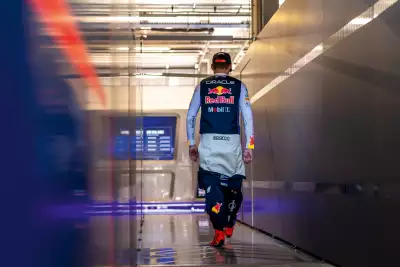
The long goodbye
Early in the season, there was much conjecture about Max leaving Red Bull. These rumours were put to rest with a four-year contract that sees him with the team until 2030.
Jörg Mitter / Red Bull Ring
Verstappen’s sim-racing team began life as Team Redline, one of the most successful outfits in competitive sim racing, before being renamed Verstappen Sim Racing in March 2026. Verstappen has been closely involved since joining Redline in 2015, regularly racing with the team himself and helping develop its drivers. Its purpose now goes beyond e-sports: Verstappen sees sim racing as a genuine talent pipeline into real motorsport, with Chris Lulham providing the clearest example after progressing from Redline to GT3 racing with Verstappen Racing.
For Verstappen, there is no talk about his own legacy or breaking the records of those who’ve come before him. Talk to him about his sim team, however, and his passion burns through: “For us at the moment in the team, it’s about coaching these young drivers on how to act like a professional driver. The way we set up meetings, how we prep before race weekends, all that stuff. The focus is on eventually trying to move sim drivers into real-world racing and, when they get there, it’s not a big shock or a big change in their lives. They need to see it as a job and they need to take it very seriously,” he says. “Winning is the goal, but also it depends on how you’re winning, how you are preparing the drivers, and making them understand what needs to be done if you want to succeed in real life.”
In that sense, Verstappen is a relic of an era of Formula 1 we had long thought to have finished. Unscripted, unapologetic, and unafraid to be his own man. He very well might be the last of a dying breed. Enjoy him while you can. Or at least until he takes to the endurance circuit and drives off into the night.
Max Verstappen is a TAG Heuer ambassador.