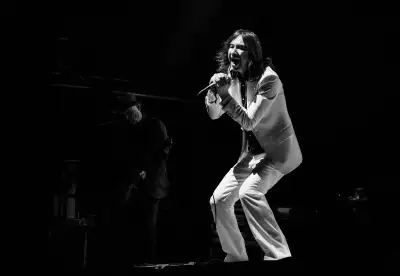
For those of us who can remember the 1990s (which, if you were there, can be a tad tricky), two of the standout tunes were Primal Scream’s 'Loaded' (from which a disreputable magazine took its name) and 'Rocks' – whose oft-heard refrain "get yer rocks off, get yer rocks off honey" seemed like an instruction manual for those who were lucky enough to party through the decade that forgot to say "no".
Primal Scream owned the early ’90s, dipped in popularity in the middle, and then between 1997 and 2002, the band made three albums in a North London studio they had built themselves and nicknamed "The Bunker". It held a fairground mirror up to the decade that loved itself – but which The Primals saw less as Cool Britannia and more as a precursor to a Britain that was far more sinister, which many would see as having come rattlingly true.
Vanishing Point, XTRMNTR, and Evil Heat were the sound of a band going in exactly the opposite direction from everyone around them, dismantling the idea of a rock group and rebuilding it out of dub, electronics, industrial noise, and rage.
This autumn, all three return as The Bunker Trilogy: newly mastered by Matt Colton at Metropolis under the supervision of the band’s guitarist Andrew Innes and frontman and lyricist Bobby Gillespie, with new mixes by Brendan Lynch, unheard recordings, and the B-sides collected properly for the first time. Vanishing Point landed on 7 August. XTRMNTR follows on 4 September, and Evil Heat on 30 October.
"We were never ‘Britpop’. We wanted to burn the flag, not wave it."
It is worth remembering how these records were received. Vanishing Point went to number two and finished fourth in NME’s albums of the year, its lead single "Kowalski" debuting at number eight—a Top Ten hit with a video scripted by Irvine Welsh in which the band are executed by Kate Moss and Devon Aoki. XTRMNTR reached number three in 2000, mixed by a cast that included The Chemical Brothers, with Bernard Sumner (of New Order and Joy Division) on "Shoot Speed/Kill Light". Evil Heat hit number nine, with Robert Plant of Led Zeppelin on harmonica.
The XTRMNTR reissue is the collectors’ prize: Massive Attack’s remix of "Exterminator", a newly mixed "When The Kingdom Comes" with a Paul Weller twelve-string solo, and two previously unreleased recordings: a cover of "I’m Five Years Ahead Of My Time" and "The Reckoning", both featuring Can’s Jaki Liebezeit on drums.
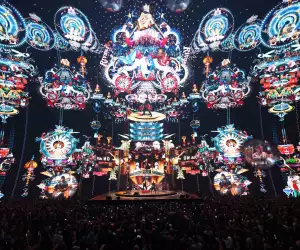
All of which is prologue to the main event. In September, the band will play XTRMNTR live in its entirety across the UK, closing in London at Outernet Live on 15 and 16 September. Twenty-six years on from a record about surveillance, dislocation, and a country coming apart, the timing seems spot on.
You’re playing XTRMNTR in full, and the Bunker albums are all being reissued. What were those three records, to you?
Those albums were the complete antithesis of everything that was going on in UK music in the 1990s. We were making uncompromising aggressive experimental pop and rock music with lyrics about psychic dislocation, addiction, alienation, depression, questioning our very existence and documenting the dark sleazy underbelly of UK youth culture.
We were wary of New Labour and its neo-liberal trojan horse policies and we were prescient in our prediction of the resurgence of fascism, militarism and Imperialism to come in the 21st century. We were not ever ‘Brit Pop’. We wanted to burn the flag, not wave it.
Let’s go back further. Your music marked the transition from the eighties into the nineties. How did that change feel at the time?
Didn’t really notice anything, to be honest. The only thing that was different was that there was this indie rock scene going on, which, apart from a couple of bands I was impressed by, it just felt like there were no real rock and roll bands around. The indie music was so… there was no rhythm to it. No blues, no rhythm. And it was very of a piece. It was American student rock like The Pixies, which were venerated by the music papers here, who were also college educated, university educated sort of guys, so they related to that kind of thing. It just felt that everything was pretty dull and unglamorous.
And then acid house happened. Suddenly it went from a dull, grey, dreary indie world to this bright, technicolor, druggy, sexy, high-energy world. That was the thing that took us out of the eighties and into the nineties. It took youth culture in Britain through that transition too, but our band rode that wave because we were so disillusioned with white indie rock music, and obviously our place in it wasn’t very high.
When the acid scene happened, we started getting into that music, going to the clubs. We were listening to a lot of Black music. We started to find an identity outside of where we’d been in the eighties. And that lent itself to the work with other people later on, with Andy Weatherall. For me, acid house was the thing that made the difference.
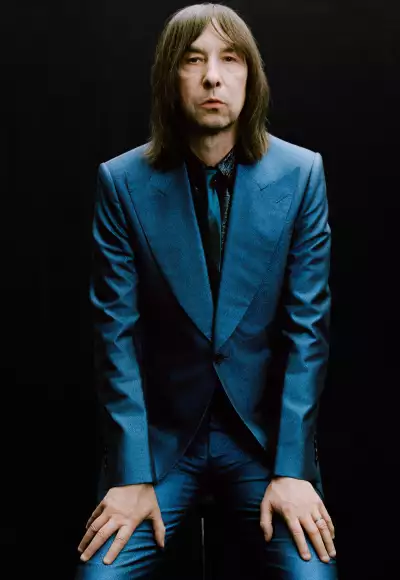
Adam Peter Johnson
Did it feel like a revolution, if that’s not too big a word?
For me, in the eighties, obviously Mrs Thatcher came in in 1979, but by 1987, when she’d been voted in for the third time, all of us in the band felt… I’ve said it before… that Britain was a diseased country. Mainly I was talking about England, because it was mainly England voting her in. Scotland was red. Wales was red. It felt like this island couldn’t be saved.
The miners’ strike. The politicisation of the police under Thatcher. The constant attacks on the trade union movement. After the miners they went for the print workers at Wapping. They were taking it apart bit by bit, Thatcher’s government and the full force of the British state, MI5, the police, the army, Special Branch, all of them, attacking the workers’ movement. Sowing the seeds. Basically it was class war. Neoliberal class war. And you just thought, well, there’s nothing you can do. It just felt like we were defeated.
So when acid house came in. Thatcher was pushing for a version of society that was atomised, in order to break up working-class power and working-class solidarity. And what I saw in acid house was people building solidarity. Ecstasy is a drug that encourages empathy in people. I felt that was a beautiful thing at the end of that decade, because it was a violent decade.
People were angry. There was a promise in the sixties. The workers’ movement was at its most powerful in 1977. That’s when median wages were highest right across the West: 1977, when the two sevens clashed, the summer of punk. Two years later Thatcher comes in.
When you’re young you don’t think about all that. You just want to have fun and go out and see bands and go to clubs and buy clothes and listen to records. But by the late eighties, when you’d been on the dole for five years, you’re just going, man, this can’t go on. I thought acid house had the potential to be a utopian movement.
I saw a lot of my friends, people who wanted to do creative stuff, get addicted and take themselves right out of the game
You were bringing indie and dance music together at the time. Having DJs supporting a rock band on the Screamadelica tour felt genuinely radical.
Well, Happy Mondays had done it before us, with the WFL remixes, with Paul Oakenfold and Vince Clarke. That inspired us, I’ve got to say. But yes, when we went out on tour we took The Orb, Alex Paterson, and we took Andy Weatherall, and we ran it like a club night. We got the venues till two in the morning, so we didn’t have a support band.
Alex would play all his ambient stuff as the crowd came in. Then it’d build up, he’d start putting beats in, then Scream would come on and play for an hour, then we’d go off, Weatherall would come on and get everybody dancing till two. We’d take an E and go out on the dancefloor with all the kids who’d just watched us play a gig. We were trying to combine a rock and roll gig with an acid house club. That was the idea.
On ‘Loaded’, the Andy Weatherall remix that started that decade, you’re barely on the record. A lot of frontmen wouldn’t have worn that.
I had no choice. That’s just the way Weatherall mixed it! And it’s fine by me. I thought it was a great track. It opened a lot of doors for us. We’d been going to the clubs, we were enjoying the remixes. I just saw it as a dub mix. I love dub music, I love reggae music, and I just thought it was a dub mix, and the dub mix became the hit. That was fine by me.
Your follow-up to Screamadelica, 1994’s Give Out But Don’t Give Up, felt at the time like a precursor to Britpop: heavy, guitar-based, widely read as a homage to the Rolling Stones. I don’t think you see it that way at all.
No, because we were listening to a lot of American soul music. Black music. We were influenced by Sly Stone, Miles Davis, George Clinton, Parliament, Funkadelic, Isaac Hayes, Stax, Motown, Southern soul ballads. O.V. Wright, Bobby Bland, Percy Sledge. Songwriters like Dan Penn and Spooner Oldham.
So we went to Memphis and recorded with Tom Dowd, who’d made records with Aretha, Clapton, Lynyrd Skynyrd, Dusty Springfield. And we worked with the Muscle Shoals rhythm section, Roger Hawkins and David Hood, who’d played on countless soul records: ‘Natural Woman’, ‘Respect’, ‘I’ll Take You There’, ‘Respect Yourself’.
So it’s fair to say you felt out of step with the mid-nineties, with British music’s sudden adoration of itself?
As I wrote for the reissue, whilst the rest of the UK music and cultural scene fell in love with itself, convinced by their own genius, drowning in an orgy of narcissism and cocaine in a permanent self-aggrandizing state, we had had our times of utopian thinking at the beginning of the decade but were now full of disgust for ourselves and the world. Out of that self-reflecting mood came Vanishing Point, XTRMNTR and Evil Heat.
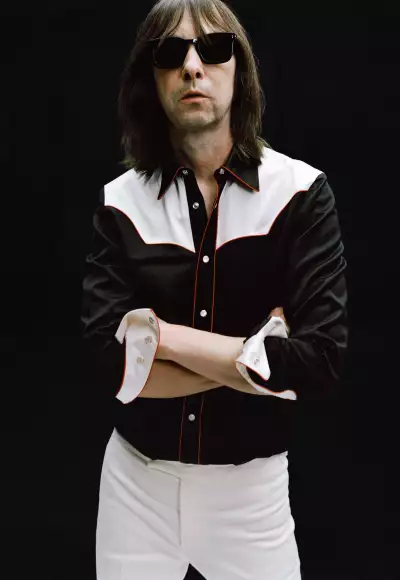
Adam Peter Johnson
What was XTRMNTR about, then?
In the early to mid nineties I’d read a lot of Black radical literature. About organisations like the Black Panther Party for Self-Defense, Marxist-Leninists organising people in the ghetto to stand up for themselves, politically educating people, breakfast programmes, doing good stuff in the community, but also standing up against the white power structure. And then at the end of the sixties the Black ghettos were flooded with heroin, and cocaine. So there were gang wars, turf wars, mass addiction. And that was COINTELPRO. You look it up, the FBI’s covert opertion, CIA. The whole thing was to destroy Black militancy and radicalism. Divide and rule among the Black population, just at the time it was becoming radicalised.
And I read that and I thought, well, we had acid house. It was communitarian, it was about solidarity. I remember cocaine was expensive in the eighties. That was for rock stars. And then ecstasy came in at twenty-five quid a tablet, and your dole money was twenty-five quid, so it was a whole week’s dole cheque. But towards the end of the eighties I started to notice that there was addiction in and around the band. Certainly, in the management. Among friends. If we went to clubs there were a lot of people getting heavier, into darker stuff, heroin. Whereas at the beginning of the decade it had been ecstasy, then a bit of coke, then the heroin started coming in.
So what I was writing about. I’m not a conspiracy theorist at all, but I did start to think, well, maybe it suits the powers that be that creative young people are taking drugs, becoming addicted, taking death drugs. We’re neutralising ourselves. We’re not a danger any more. Because I saw a lot of my friends, filmmakers, writers, musicians, people who wanted to do creative stuff, get addicted and take themselves right out of the game. And I saw it within my own band. I’m not going to name names, but formerly highly creative people just completely neutralised themselves and stopped contributing.
If you take a lot of cocaine, the paranoia was like self-induced psychosis
So I was really writing about the culture I was living in. And also disgust at myself. Just thinking, why do I keep taking this stuff? Why do I keep getting myself into these states? I’d get straight for a while, then I’d have these terrible binges for days, and then it’d take me days to recover, and during that time I’d just feel self-hate and self-loathing. And I wanted to be an artist. But this stuff was getting in the fucking way.
As much as I loved taking drugs, and I did love taking drugs, if you take a lot of cocaine, the paranoia was like self-induced psychosis. That’s how I termed it at the time. Then a week later I’d be doing it again. And then I managed to get prescriptions for drugs so I could take more drugs. If you had Rohypnols, Temazepam, Valium, you could take more cocaine, because you could take the edge off. It’s a false economy. The comedown’s always waiting for you.
I wrote a good song about it called ‘Pills’. It’s on XTRMNTR: Woke up still drunk, throwing up, pissing blood. Sick guts, sore skin, burned out, holed in. Can't move, can't speak, cracked head, can't sleep. Ripped up, ripped off, can't crawl, can't walk, fade away.
That feeling when you’re absolutely, completely debilitated yourself, and you’re just lying there for two or three days. You can’t move.
How does it feel touring albums rooted in a time when you were in such a different place?
Psychologically, good, because I think I wrote good lyrics for this Bunker trilogy. They were a montage of where I was and where we were, our lives, and the youth culture of the time, which was druggy, clubby, a subculture.
So performing them now it’s not hard to get back into that headspace?
I can still access those feelings on stage. They’re a description of how I saw Britain at the end of the nineties, and how I saw the culture, the political culture, the economic culture, affecting young people and affecting myself. It felt like a no-future scenario. It felt dystopian even back then. And that’s before the high-tech self-surveillance we call social media, and smartphones, and AI.
I think the lyrics are very prescient. ‘Swastika Eyes’ hasn’t dated either. A song like ‘Insect Royalty’, I can still sing a song about feeling that I’ve got some kind of foreign body, a foreign agent in my psyche, in my body, eating away at me. It’s a metaphor. It’s not a solid image, it’s a metaphor that can apply to many different things. So I don’t think the lyrics are dated. That’s why I can still sing them.
We came through the violence of the eighties into the optimism of the early nineties. Where are we now? Is there any optimism left?
My optimism is with young people. Because they seem very, very turned on politically. I think they know they’ve been shut out, that the drawbridge has come up. Low wages are just the way it is. They’ve been told: you have to accept this, you have to accept low wages, you have to accept you’re never going to get on the property ladder.
People are leaving university with a degree and the only job they can get is making coffees. So late-stage neoliberal financial capitalism, young people can see it for what it is. They’re very sussed about it. My hope is with the young people.
Primal Scream play XTRMNTR in full at Outernet Live, London, on 15 and 16 September. The Bunker Trilogy reissues of Vanishing Point, XTRMNTR and Evil Heat are out on 7 August, 4 September and 30 October.
Martin Deeson is host of the podcast Martin Deeson Unloaded, interviewing the characters who survived the 1990s.