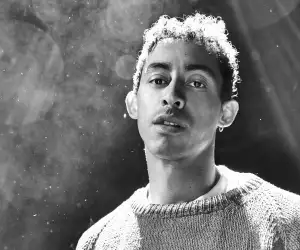
Four-year-old kid sits at the kitchen table, listening to his dad’s Stevie Wonder records. “Very superstitious, writing’s on the wall…” As Stevie sings, the kid taps out chords on the table like it’s an imaginary piano. D minor, G 7, D minor…
He’s yet to have a formal lesson but he can see the music the way most people see colour. The kid has perfect pitch, the ability to identify and play a note without any reference point. One in approximately ten thousand people have this ability.
Alexis Ffrench will spend hours and hours playing that kitchen table. In a few months when he gets an actual piano he’ll already know the chords. By seven he’ll have a red notebook to record his own compositions. He’ll study at the Royal Academy. Sign with Sony. Release multiple albums of classic music. Reach more than a billion streams. Perform around the world. And it all starts there at the kitchen table, tap tap tapping away to Stevie Wonder.
I meet Ffrench at a swanky cafe in Fitzrovia. For someone who must surely be quantified as a genius, the man is astoundingly easy company. He wears a New York Yankees baseball cap and designer glasses and could pass for a decade younger than his 56 years. He came from a pub round the corner and is eulogising its beauty the moment he sits down. When I mention my sore back from a recent padel match, he promptly stands up again to demonstrate some stretches.
You experience sorrow, loss, hardship – all of those things inform the personal psyche and your capacity to create emotion
Ideas fizz out of him. We speak for more than an hour; the interview only ends because the publicist must drag Ffrench away to the recording studio. He’s musing on AI and the myriad ways it will change the world and music specifically. He won’t ever use AI to compose himself but he finds it fascinating. I imagine he’s the kind of person who finds many things fascinating: films (which he composes for), poetry (which he writes), chess (which he plays), technology (which he did a Masters in). This is not a man short of hinterland.
He finds inspiration everywhere. “You take on experiences, you read, you go to the cinema, you go to the theatre, you experience sorrow, loss, hardship – all of those things inform the personal psyche and your capacity to create emotion. So really, I try to listen as much as I can and observe as much as I can – sitting in the pub, just watching people, trying to imagine their lives. Everything inspires me. It’s just absolutely everything.
Music is the greatest inspiration of all. When I ask for the first piece of music he truly engaged with, the man practically starts vibrating. “I remember the first time I discovered Mozart’s ‘Symphony No. 40’ – just astonishing music. I remember the first time I discovered Mozart’s ‘Piano Concerto K. 488’. The first time I heard ‘Thriller’ – and I was late to ‘Thriller’, age 14, on the steps in Harrow. The first time I heard Debussy’s ‘Préludes’. There were so many pieces of music – Messiaen’s ‘Vingt Regards’ – so many pieces of music that just blew me away. Bach’s ‘Goldberg Variations.’ Prince.”
He namechecks Hiram Bullock, Steve Vai, Mike Stern, A Tribe Called Quest, Public Enemy’s ‘Fight The Power’. “We talk about Stravinsky, we talk about Shostakovich, we talk about railing against the system. When I heard that music in the company of friends, it changed my world because it was so powerful. Music as an active agent; as an active agent of discontent, punching the doors open with such force in such a precipitous way.”
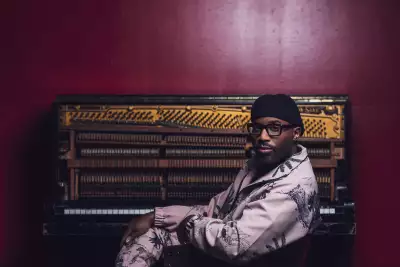
One of his ongoing missions is to recentre classical music in wider culture. Make it universal, make it now. “Classical music is often seen as a benign force: something to soothe, something soporific, something to make you sleep better and something to becalm. But classical music is so much more. There’s a spectrum of emotion that it can elicit.”
Listen to his radio show Cultural Connections and you’ll often hear Ffrench comparing historic composers with contemporary artists – the example he supplies is Béla Bartók and Kendrick Lamar. “I often think of genres as artificial constructs,” he says. “They’re human-imposed things, mostly done to sell records. In a record store you might have a basement for R&B, and you might go upstairs for classical or jazz, just so it’s ordered and people can go to the right floor and choose the right records. Basically commercial, economic practice.
“But actually, many of those borders are artificial. If you think about the function and the role of classical music hundreds of years ago, it was the popular music of the day. It’s only actually in recent times that it’s become this kind of rarefied territory. I think that’s a false imposition, a totally artificial construct.”
I want to meet the listener where they are. I want to get to the truth at the heart of the thing
His latest album, 24, aspires to fully ground classical music in the listener’s daily routine. “I like to think of it as carrying the listener on this lofted bed of piano lyricism through the undulating day.” So there’s a track for your morning coffee, your commute, your gym workout – 24 in total, taking you from dawn to dusk. Only one is more than four minutes; Ffrench deliberately keeps his compositions a similar length to the average pop song.
Does classical music have a duty to engage with the modern audience on their terms? “I think the human capacity to consume knowledge and information has changed over time, because our relationship with technology has rewired over so many years.” He notes the erosion of concentration, citing the tendency of Netflix movies to repeat the plot multiple times because the viewer is almost certainly holding their phone.
“Has that sinked into music, in the way that composers write? It depends on the function of the piece and what sort of world the composer wants to inhabit.” So his film compositions are typically longer than his records where “I want to meet the listener where they are. I want to get to the truth at the heart of the thing, not necessarily without delay, but certainly without excessive meandering. Is that a symptom of our technological reliance and technological malaise? I don’t know because I’m probably affected by that as much as anyone else.”

So he claims. His own studio is remarkably sparse, “just a chair and me.” It’s situated on a farm in the Midlands countryside, a peaceful place surrounded by sheep and cows. The peace extends within: Ffrench composes in silence, the notes on his piano emitting no sound – just like the kitchen table where he first practiced his craft.
How long did it take to find his voice as a composer? “I guess the voice modulates and changes over time,” he says. “The voice that I have today is in many ways the same voice that I had when I was five. The same intention is there. And it’s a voice which yearns to subtract. It’s basically subtracting and that’s the way that I write. It’s like a deioniser. So there’s basically noise, a massive noise, and it’s de-ionising, extracting, subtracting.” Age merely produces, “the same voice through a different echo chamber.”
Here I shall note that Ffrench’s literal voice is a beautifully modulated instrument entirely devoid of the ‘ums’ and ‘likes’ and stutters and swearwords that litter most people’s speech, mine included. One never presents an interview verbatim – the finished product would be borderline unreadable – but in this case I could probably get away with sticking the transcript into a word document, tidying up my bits, spellcheck the composers and off to the pub. It would be unforgivably lazy and perhaps more fulfilling for the reader.
Anyway, you’ve reached the interval. Treat yourself to an ice-cream.
Remember the refrain in ‘Superstition’? “When you believe in things that you don’t understand, then you suffer…” A young Alexis Ffrench understood music, and he certainly believed in it, but my word he suffered for his craft. His parents emigrated from Jamaica as teenagers. They loved their son deeply but they also instilled what Ffrench describes as the “immigrant philosophy” of working harder than anyone else.
His father worked avionics for the Royal Air Force and he would wake Alexis whatever time he left for base, typically before 6am. “Only unemployed people lie in,” Ffrench Senior told his son. “A ghastly thing to say!” smiles Ffrench today. He would win music competitions, return home and not receive a word of praise. Of course you won. That’s the expectation.
“It was that Royal Air Force discipline that was imposed on me,” he recalls. “The discipline of not only getting up early, but also reading, acquiring knowledge, learning to play the piano, doing hours of maths. Hours of maths.” He became so advanced he had to study separately in class. Unsurprisingly, Alexis often resented the endless grind. “It was so intense. Sometimes I was screaming inside because I just wanted to get – not out of the house, but just to live life, go down to the shopping mall like my friends did.”
If you know West Indian culture, you’ve got religion, you have discipline, expectation. That’s the world I know.
Reflecting on his father today, Ffrench says, “I’m grateful for his expression of love. I’m grateful for his investment, the time that he put in. There was love. That’s how it was expressed. He was of that generation. He was also of that culture – the Jamaican culture. People think of Jamaica: palm trees, chill out, all the rest of it. But if you know West Indian culture, you’ve got religion, you have discipline, expectation. That’s the world I know.”
After his father passed, Ffrench sorted through his stuff. He discovered details of all his past concerts and albums, stored safely away. Paternal pride was real yet unspoken. “I never knew how much he cared,” says Ffrench. His own children are adults now – Savannah is a dancer, Jobim a songwriter – and their dad will never stop saying, “I love you”. He hugs them all the time. When they were young, he let them lie in.
Of course, Ffrench Senior doubtless viewed his son’s success as vindication. Certainly talent alone isn’t enough. But then perhaps a billion streams isn’t, either. “Success doesn’t make you a great musician,” Ffrench notes. “There are millions of talented people in the world for whom maybe the stars have not aligned. And I also think there are millions of people in the world who’ve never had the opportunity to pursue music but have such intense musical instincts inside them. My dad was one of them.”

At what age did Ffrench realise his musical talent? He mentions a scheme for gifted children by Surrey County Council that funded his education. Then he tells me another story – how as an eleven-year-old a teacher at school identified his perfect pitch to the class. Naturally, Alexis felt proud. The following week the same teacher handed round lyrics to the old American minstrel song ‘Polly Wolly Doodle’ and instructed everyone to perform it together. One of the lyrics contained a racial slur that the teacher seemed to relish hearing the students sing.
“That was this little man’s way of saying, ‘yeah, you did that last week, but now I’m going to put you back in your place.’ It’s a very sad thing, but that’s kind of when I saw the cruelness of man and the capacity that some people have for unkindness.” Ffrench describes the incident as “heinously, egregiously racist. But at that time, I do remember that I never looked at the world like that. I probably still don’t, because we have evil, cruel, and idiotic people in every walk of life. He happened to be all of those people.”
The teacher was also alone, in every sense. “That kind of experience for me was a very singular experience. Most of the experiences I had from my childhood were being met with incredible generosity and kindness, particularly from professors. It’s the reason why I do so much work with many of the places where I studied.” Ultimately, “that was a hideous experience, but it certainly didn’t characterise or inform my formative years impactfully. I just put it away as something disgusting.”
AI is a retrospective lens – it’s always looking back. It can never look forward.
Today, Ffrench works to guide the next generation of musicians, most notably as the first artistic director of the Associated Board of the Royal School of Music. (The exam board, essentially.) He sits on the governing body of the Royal Academy of Music. And he worked as a teacher for many years, first at Rugby and then Uppingham School. “My days teaching were probably my happiest times.” He checks himself, smiles. “I shouldn’t say that but I loved working with young people.”
I’m sure the feeling was mutual. Ffrench describes the fulfilment of “guiding students through the school, helping them to give their all in their academic pursuits. Also helping them to achieve balance and go through the school happily, which I think is the most important thing. Just helping them to make choices – not just academic choices, but choices about life. It’s just such a privilege to be able to do that.”
One of his students was a boy named Charlie, a natural performer with a killer voice. Charlie saw an advert in NME placed by a band looking for a frontman. Ffrench encouraged him to tryout. “He did, he got it, and he left school. I got into a heap of trouble as his teacher!” The band was early 2000s pop-punk sensation Busted. Within a matter of months, Charlie had a number-two album and his face on a million bedroom walls. So next time you catch yourself humming ‘Year 3000’ – let’s face it, a banger – blame Alexis Ffrench.
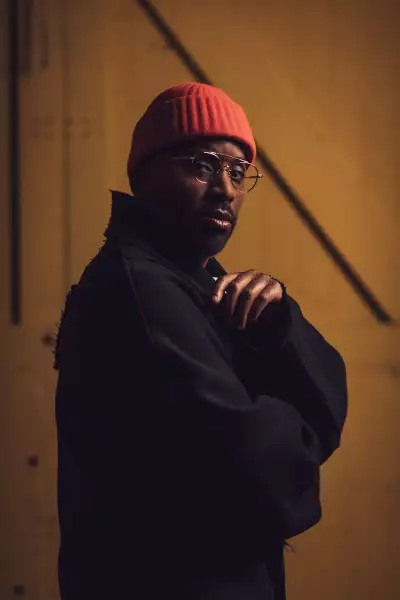
Considering a more immediate future – how might AI transform the music industry? “There are many possibilities,” Ffrench says. “I could envisage a ‘centaur’ kind of moment – like Garry Kasparov in 1998 – where a human works in tandem with a machine to create something. [After losing to Deep Blue in 1997, world chess champion Kasparov pioneered the concept of ‘centaur chess’ where humans utilised computers during the game.] “Look at Floating Points and their new ballet score about Pandora’s box: a beautiful fusion of music and AI that is extraordinary. Absolutely extraordinary.”
Ultimately, Ffrench believes, “human creativity will always be at the heart. AI is a retrospective lens – it’s always looking back. It can never look forward.”
Sure, I note, but it looks back further and wider than any single human.
Yes, says Ffrench but without human creativity AI will become an exhaustible resource, an endless retrospective loop. “Where would the new Miles Davis be to create ruptures in music every 10 years? Where would Stravinsky be? Where would Kendrick Lamar be? The people who rip up the rulebook and say, ‘I know you did it that way, but I’m going to do it this way.’”
We mustn’t lose sight of the beauty of challenge. We mustn’t lose sight of this.
Might AI ultimately evolve beyond the rulebook? Only with the introduction of predictive models that extrapolate data beyond a fixed range, says Ffrench. “It will be really interesting to see consumers’ desire for AI. There are significant pockets of society for whom music is just background noise, and if it does the job, that’s enough. But for many people, forming parasocial bonds with an artist and knowing them through their music will always be paramount.”
He can envisage a future where vast swathes of music is AI – the stuff you hear in hotel lobbies, soundtracking sports montages, even in restaurants and bars. However there will remain a hunger for the real thing. “People always want human experience. They want to go to concerts. They want to see the artists that they love.”
I could listen to him talk all day – “hey, Alexis, that pub you mentioned…” – but this particular artist has things to do and a PR understandably keen he starts doing them. A very nice lady from Sony has also arrived. It’s time for the curtain call. Ffrench leaves me with a final parting thought: “We mustn’t lose sight of the beauty of challenge. We mustn’t lose sight of this.”
Quite so. My immediate challenge is somehow doing justice to him.
24 is out now; Alexis Ffrench tours next year