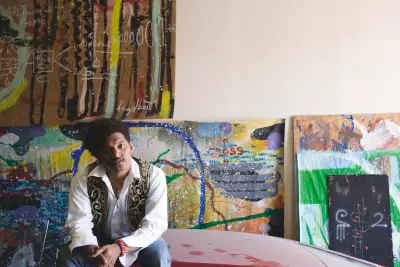
There is something alchemical about the work of acclaimed multidisciplinary artist Angelbert Metoyer. His paintings possess an archaeological quality, as though excavated from a forgotten civilisation or transmitted directly from a future yet to arrive.
In his work, coal, gold leaf, volcanic dust and other elemental substances become the foundations of mysterious worlds, in which archetypal figures appear suspended somewhere between memory and prophecy. As the imagination drifts into these vast, luminous landscapes, the distinction between past and future begins to dissolve in a liminal territory where the spiritual and material coexist, and ancient knowledge finds expression through contemporary forms.
For more than three decades, the American artist has pursued this singular vision across painting, sculpture, performance and sound. Now, with the publication of Angelbert Metoyer: The Afrofuturist Impulse, a major monograph published by Marquand Books, his remarkable body of work is brought into focus.
To understand Metoyer is to look beyond the conventional narrative of artistic development. His practice has never been interested in linear progression, nor in the reassuring idea that an artist gradually arrives at a definitive style. Instead, it represents an ongoing conversation with questions that have accompanied him since childhood.
Raised in Houston, Metoyer emerged onto the American art scene in the 1990s, while still in his teens, exhibiting at the influential Project Row Houses and the Contemporary Arts Museum Houston. The former, founded by artist Rick Lowe, brought artistic practice into direct dialogue with the surrounding community, demonstrating how art might participate in the social and cultural life of a city rather than exist apart from it.
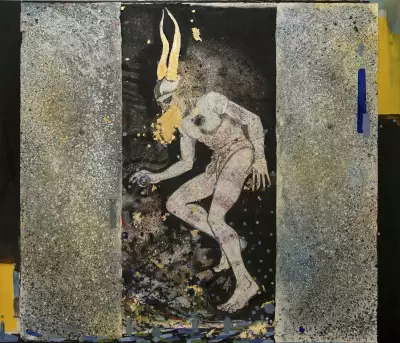
As Light, by Angelbert Metoyer, 2000-2022 acrylic, gold leaf, chalk, watercolor and artist-made materials on paper on wood 84 × 72 inches.
“I recognise the curiosity. I recognise the hunger to understand something that I couldn’t quite name,” Metoyer recalls of his younger self. “At that age, I wasn’t thinking about a career in the way people understand careers. I was trying to make sense of the world and my place within it. Project Row Houses was important because it introduced me to the possibility that art could exist within a community and participate in a larger conversation about culture, identity, and responsibility.”
That curiosity has carried him through an unconventional career in which the boundaries between disciplines, cultures and even dimensions of experience have remained remarkably fluid. His work has been exhibited internationally and entered museum and private collections, yet commercial recognition alone cannot explain the fascination of a practice that seems to operate according to its own mystical logic.
The materials themselves are central to this enquiry. Gold, coal, iron, oil and dust are not simply aesthetic choices, but substances carrying their own histories of extraction, transformation and human endeavour. In Metoyer’s hands, they become the raw ingredients of images that appear simultaneously fragile and monumental, intimate and cosmological.
I was trying to make sense of the world and my place within it.
His M-Window works, for example, employ etched and painted glass layered over refractive aluminium, with pigments and gold dust, to create compositions of extraordinary depth, their appearance shifting as the viewer changes position. Like so many of his works, they are pieces that reward sustained attention, revealing their mysteries gradually rather than surrendering them at a glance.
There is a painstaking physicality to this process, an attempt to coax meaning from matter through experimentation and transformation. It feels particularly compelling in an era when images can be manufactured instantaneously and circulated endlessly. Metoyer’s practice remains rooted in the properties of materials, the traces left by the human hand and the unpredictable dialogue between intention and accident.
The breadth of his practice is equally remarkable, with delicate drawings, elaborate mixed-media paintings and monumental bronze sculptures representing different expressions of the same restless imagination.
Nowhere is his versatility more apparent than in I Am Barbara Jordan, the extraordinary public monument unveiled at POST Houston in December 2023. Dedicated to the pioneering congresswoman, lawyer and civil rights advocate, the bronze sculpture depicts Jordan seated, one hand extended towards the viewer and the other resting upon a representation of the United States Constitution, placed above an American flag. The work occupies a particularly resonant location: the former Barbara Jordan Post Office, whose original bricks were preserved and incorporated into the monument’s base.
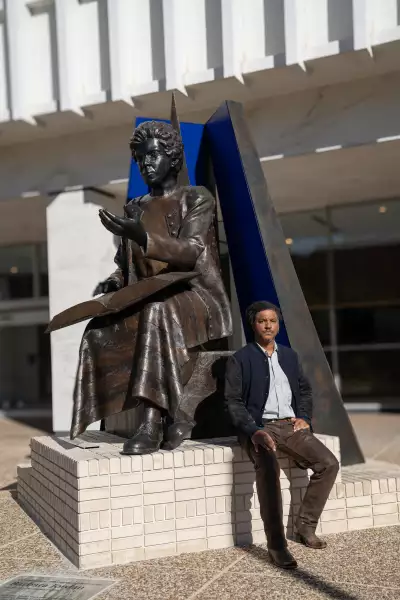
The 'I Am Barbara Jordan' bronze monument by Angelbert Metoyer unveiled on December 2, 2023, at POST Houston.
It is a striking convergence of personal, political and architectural history. The building’s past becomes part of the sculpture’s physical substance, while Jordan’s presence invites viewers to reflect upon the continuing significance of the principles she championed.
The work’s design incorporates a complex vocabulary of symbols, from the medallions and civic honours adorning Jordan’s clothing to the bell-like structure of the composition, recalling the Liberty Bell. Viewed from different angles, the monument transforms, revealing new relationships between the figure, its abstract architectural elements and the surrounding city.
For an artist frequently associated with metaphysical enquiry, the sculpture demonstrates his ability to translate complex ideas into a public language. It is at once an act of remembrance, a meditation on civic responsibility and an invitation to consider how the legacy of an individual might continue to shape collective consciousness.
“Being an artist is often a very internally driven endeavour, but making a public work moves you out of that sphere. Everything in a sense is ‘outside of the art world’, but the moment you realise that, the world becomes eternal.”
Those questions of identity, history and possibility also inform Metoyer’s relationship with Afrofuturism, the cultural movement that has gained considerable visibility across contemporary art, fashion, music and cinema. While the term frequently conjures images of science fiction, technological spectacle and futuristic design, Metoyer’s understanding is rooted in something more fundamental: the capacity of imagination to transcend imposed limitations.
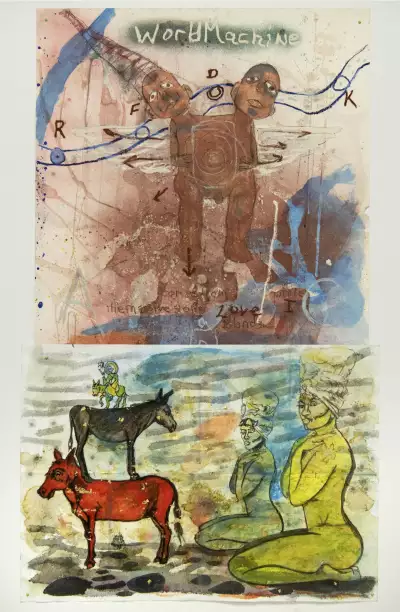
World Machine, She Passed Me, by Angelbert Metoyer, 2004-2022, artist-made materials, acrylic, earth, charcoal, watercolour, and gold leaf on paper, 41 x 67.7 inches; 50.7 x 75 inches
His practice draws upon ancestral memory, spiritual traditions and the complex histories of the African diaspora, but resists the notion that these subjects must be confined to the past. Instead, history becomes a living resource, capable of informing radically different ways of understanding the present and imagining what might follow.
For Metoyer, Afrofuturism is not simply a visual language or an exercise in speculation. It is an assertion of human agency, a recognition that the ability to imagine alternative realities has long been essential to survival, identity and cultural continuity.
The newly published monograph illuminates these connections. With contributions from Valerie Cassel Oliver, Madeleine Haddon, Anthony Pinn and Heather Pesanti, it situates Metoyer’s artistic language within a wider intellectual and cultural conversation while revealing the continuity of his personal concerns.
There is a certain irony in the arrival of such a comprehensive volume devoted to an artist whose work is so deeply invested in the unknown. Monographs are traditionally instruments of classification, seeking to establish an artist’s place within history. Metoyer’s practice, by contrast, seems determined to keep history open.
That tension becomes particularly relevant when the conversation turns to the future. At a moment when technology companies are constructing increasingly powerful visions of human possibility, Metoyer questions whether the ability to create something necessarily confers the wisdom to understand its consequences.
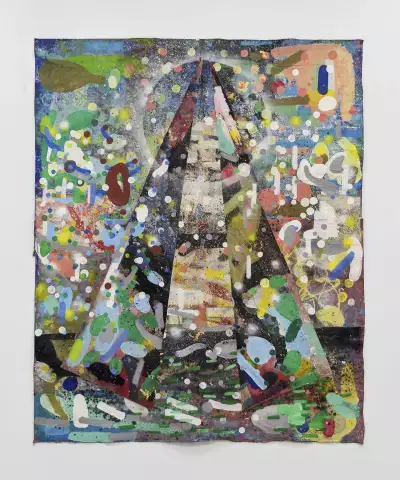
The Third Horizon (Eye of the Needle), by Angelbert Metoyer, 2024 acrylic, oil, gold leaf, gold dust, paper, and artist-made materials on canvas 126 x 103 inches
“The future should belong to the imagination of humanity, not simply to the people who control the technology,” he argues. “Technology is an extension of human intention. The question is whose intentions are being amplified. If the future is imagined primarily through economic power, then we risk reproducing the same inequalities that have shaped the past.”
It is a provocative proposition, and one with implications far beyond the gallery. We live in an age of artificial intelligence, unprecedented connectivity and accelerating technological transformation. Yet the question of who gets to determine the direction of that progress remains unresolved.
For Metoyer, artistic imagination is a necessary counterweight to systems that risk reducing the future to a series of commercial or technical possibilities.
“There are other forms of intelligence that deserve a place in that conversation: ancestral intelligence, ecological intelligence, spiritual intelligence, the knowledge carried by communities that have survived without controlling the dominant institutions of the world. I think artists have a responsibility to challenge the assumption that technological advancement is the same thing as human advancement.”
Artists have a responsibility to challenge the assumption that technological advancement is the same thing as human advancement.
This is perhaps where his artistic philosophy becomes most immediately relevant to the wider world. Imagination, in Metoyer’s understanding, is not merely a creative faculty possessed by artists. It is a fundamental human resource, one that allows individuals and communities to challenge inherited assumptions and conceive alternatives to the circumstances in which they find themselves.
That belief also informs his interest in humanity’s relationship with the natural world. Long before environmental responsibility became a dominant theme of contemporary cultural debate, his practice was exploring the material consequences of extraction and the fragile balance between human ambition and the resources upon which civilisation depends.
The coal, dust, oil and minerals embedded in his works acquire a further resonance in this context. They remind us that even our most elaborate visions of the future remain dependent upon the ancient substance of the earth.
Perhaps this is what makes Metoyer’s work so unusual. It is deeply concerned with the future yet profoundly attentive to what came before, embracing technological possibility without surrendering the mystery of human existence to the promise of technological solutions.
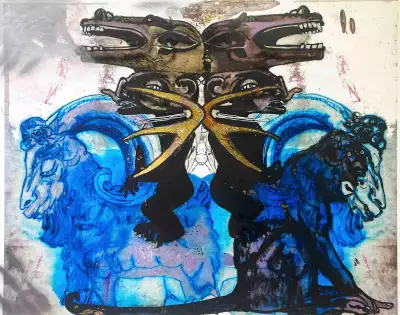
TBT (Revisit:Visitations), by Angelbert Metoyer, 2022, ink, oil, acrylic and gold leaf on printed paper 48 x 60 inches
For all the intellectual complexity of his practice, however, there remains something disarmingly personal about his relationship with art. The questions that animated his earliest experiments have not disappeared with age or recognition. If anything, experience appears to have made him more receptive to their uncertainty.
“What has changed is my relationship to the unknown,” he reflects. “When I was younger, I sometimes felt that I needed to discover the answers. Today, I’m much more comfortable allowing the questions to remain open. I’ve also learned to listen more carefully to the materials, to the work itself, and to the things that happen outside my intentions. But the fundamental impulse is still there.”
It is an observation that offers a useful way into the extraordinary world of The Afrofuturist Impulse. Rather than presenting the definitive resolution of an artistic career, the monograph documents an enquiry that remains very much alive.
In a culture increasingly preoccupied with speed, certainty and the frictionless production of images, Metoyer’s art insists upon the value of contemplation, ambiguity and human experience.
His paintings and sculptures offer no simple answers, nor do they attempt to predict what lies ahead. Instead, they remind us that the future is not merely something to be engineered, acquired or consumed, but something that must first be imagined. And that the most profound forms of progress may begin not with a new technology, but with a different way of seeing.
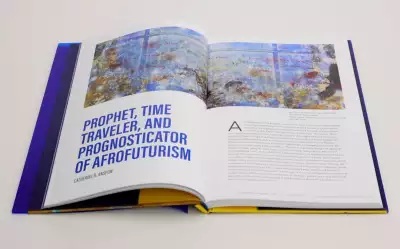
'Angelbert Metoyer: The Afrofuturist Impulse' is published by Marquand Books.