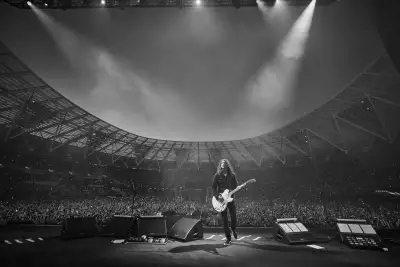
For more than three decades, Scarlet Page has been training her lens on the biggest stars in the music world – shooting gigs, tours, festivals, in the studio, and for album covers.
In 1993, her first ever published picture was of Soundgarden’s lead singer, the late Chris Cornell, for the now-defunct magazine Raw. After assisting legendary rock photographer Ross Halfin for a year, she struck out on her own and hasn’t looked back since.
She shot stunning album artwork for The Verve (A Northern Soul) and Robbie Williams (Swing When You’re Winning); documented tours by the Rolling Stones, Placebo and Red Hot Chili Peppers; and has photographed iconic musicians such as Iggy Pop, Ozzy Osbourne, the Gallagher brothers from Oasis and John Cale of the Velvet Underground.
Her work has included a 2008 commission by MTV to document the UK music scene, the 2025 book Exposed: 3 Years with Placebo and a two-year project RESONATORS – a series of photographs of some of the world’s leading guitarists, including Steve Jones from the Sex Pistols, Queen’s Brian May, Jeff Beck, Jimmy Page, Noel Gallagher, Mark Knopfler, Hank Marvin, Paul McCartney, Chrissie Hynde and many others.
She’s talking to me via WhatsApp from her back garden in South Oxfordshire at the tail end of a day in which she was in London for a series of meetings. Like RESONATORS, her latest project is also guitar-based. It’s an exhibition that runs at the Gibson Garage, London, from 22 September 2026 through to February 2027 and features dozens of famous guitarists wielding their Gibson axes.
In the early 1990s, music photography wasn’t so saturated. It was before the digital revolution
Square Mile: Was there a lightbulb moment when you decided to pursue photography as a career?
Scarlet Page: There was. I knew I wanted to do something arty and I did a foundation course. As part of the course, they said you should have a camera. I was very enthused by having a bit of kit, learning how to use it properly. This was 1989 or 1990. I remember it more by my fellow students’ band T-shirts, so there was a lot of James and Happy Mondays T-shirts.
I really enjoyed capturing what I saw rather than trying to paint what I could see. My painting was a bit too realistic, but it was photography that really did it for me. I built a portfolio with the help of my tutor and then went to do a degree at the Polytechnic of Central London. I did all the usual sort of teenage angst projects. I assisted a news photographer, but then got a lucky break assisting a music photographer, Ross Halfin.
When I was starting out, in the early 1990s, music photography wasn’t so saturated. It was before the digital revolution in terms of music, there was a lot of print media and there weren’t so many photographers. There were budgets for assistants to get flown around the world to do cover features and things like that – so that was a really great time.
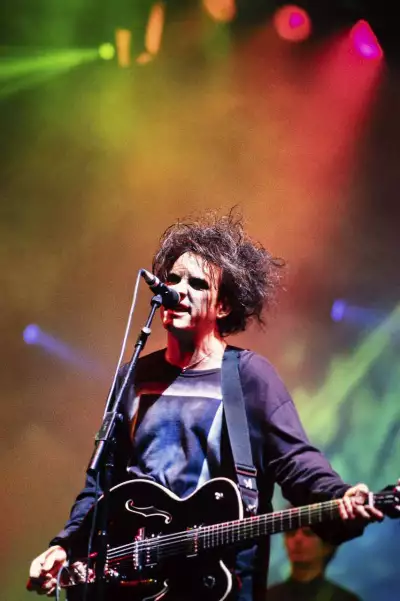
Robert Smith of The Cure, Glastonbury, 1995
SM: When did you first get published?
SP: I started taking more photos on my own, while I was assisting. My first published image was of Chris Cornell from Soundgarden for Raw magazine and it was an “in” with magazines. You’d go in and pick up a copy with your image in it and then have a conversation with the editor and the art editor and that was it – it happened quite organically.
Then I started getting regular commissions for Raw. That magazine later collapsed, but I started working for the music magazines Kerrang!, Q and MOJO. These days you have to be a lot more aware of marketing, etc, but it was a nice way to work. You’d be taking the film to the lab and not having to do any real post-production. You’d choose some prints and send them to the magazine. Quite a different process compared to today. Not necessarily better, but just really different.
SM: Do you have a favourite artist or band you’ve worked with?
SP: This year, Placebo are at the front of my mind. I started working with them around 1996 and one of the images that I took of the singer, Brian Molko, is in the National Portrait Gallery collection, so that was incredible. Placebo have just re-released their first album and used so many of my old images from 1996 and 1997.
There are concert promotions, picture discs, the “angel wings” image [of Brian Molko]. They’ve really beautifully re-used the images. It’s been really exciting for not only the fans, who already loved that work, but it’s also lovely to see it again. I’m trusted because of the archive and that history.
I don’t like over-thinking too much before a shoot. I have a bit of a plan
SM: How do you ensure your work stands out from other photographers?
SP: I don’t like over-thinking too much before a shoot. I have a bit of a plan of what I want to do but, ultimately, I enjoy the process of what comes together. I feel it’s very much a two-way process, particularly when you’re doing press shots or you have to create imagery for a campaign for bands. It’s really about capturing their soul, doing it quickly, making them feel comfortable, and catching something that feels real.
I love photographing people and gaining their trust. A lot of people don’t like being photographed, so I come at it from that angle – and enjoy picking up on their sensitivities or sensibilities. Also, in the edit, it’s a case of knowing which shot has the right feeling.
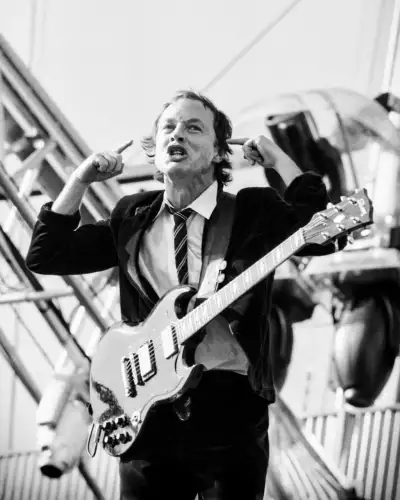
AC/DC’s lead guitarist Angus Young
SM: You’re arguably best known for your reportage-style approach to photography. Is that your favourite style?
SP: I enjoy reportage, but it’s also fun to be in a photographic studio environment, too. For example, when I shot Duran Duran, who had been teenage pin-ups on my wall when I was younger, it was a surreal moment to direct them, and say “Hey, John, Simon, could you go there?” And they were saying, “Oh, you know all our names?” I thought they were being funny with me, but, at the end, I thought, “I can make all my own posters now.” That felt kind of weird, but it’s nice to be in control.
SM: Do you listen to a band or artist’s music before you photograph them?
SP: Yeah, I do. I also enjoy listening while I’m editing. If I’m not listening, I’m definitely singing it in my mind, particularly if it’s live shots, I’ll sort of sing through the set list. Earlier on in the year, I went to shoot Geese and Westside Cowboy. That’s really fun, because I think Westside Cowboy are going to be quite big. Their first album is out soon, so it’s nice to have captured them when they’re on the rise.
You don’t know if you’re going to sell these images
SM: Magazines, portraits, concerts, album covers… which one do you prefer?
SP: I enjoy them all. I go through phases of concentrating on one thing more than the other, just because of the nature of the business. In the last couple of years, my focus has gone back to shooting live. I returned to Glastonbury after a 25-year “I’m definitely not doing that again” attitude, after all the muddy years and hating it. Then, by default, I went back because I was working with the Foo Fighters, who were appearing as a surprise band in 2023.
As a freelancer, you have to make things happen and use your contacts. I quite enjoyed getting back into that and making things happen. It’s hard work. You don’t know if you’re going to sell these images.
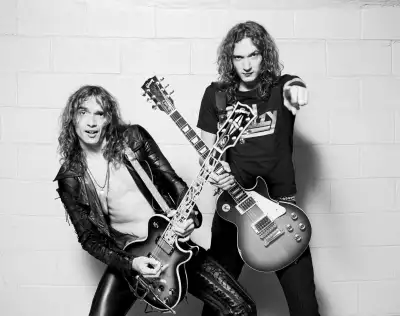
Justin and Dan Hawkins, The Darkness
SM: How did the new exhibition at the Gibson Garage come about?
SP: It was my idea. I’d done a book signing earlier this year at Gibson for my Placebo book and an “in conversation with”, which was really good fun. They are a lovely team at Gibson and they have regular exhibitions of all sorts of things. They’d invited me to do an exhibition, but I think that any exhibition has to make sense to me, in terms of “what’s the ‘why?’”
I decided to look through my archive and pick out images where people have a Gibson guitar. Why would I have an exhibition at Gibson if it wasn’t celebrating Gibson? There were some I knew I wanted to go in and there were some that were a little bit of a hunt. It’s a really interesting mix of images of studio and live shots.
I’ve got The Cure from 1995 at Glastonbury, then a picture of Westside Cowboy from this year, and some of the legendary, well-known Gibson players like Slash, Angus Young and Paul Weller.
SM: How did you choose the images?
SP: There are 30 images in a mixture of different print sizes. One of the really big ones is probably going to be Dave Grohl. They are going to be available as a limited release of prints.
These pictures are predominantly ones that haven’t been released before and they will only be available throughout the time of the exhibition through the Gibson Garage gallery. That’s it!
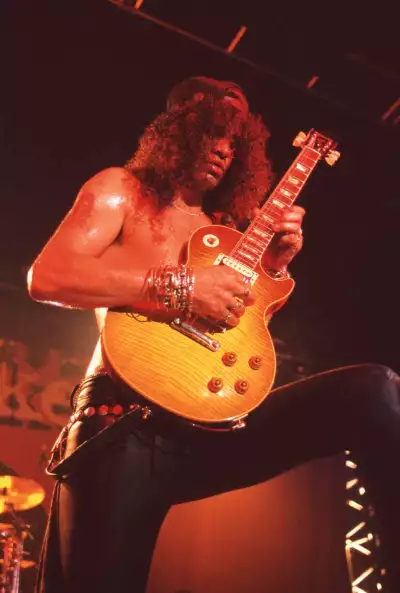
Slash
SM: What have been the biggest creative challenges during your career?
SP: Admin. Seriously, because it takes up so much of my time and you end up not having the room to be creative. If you’re working with a band for a period of time, you can really start playing and creating. You don’t have that restriction of “I’ve got to get those shots tonight and that’s it”. The whole thing is about getting back to playing, because I didn’t get into this for admin.
Back in the film days, you’d shoot and then go on to the next shoot. Now it does feel a little bit stickier because a lot of the production responsibility lands on you. You can get other people to do things for you, but then it’s your responsibility as well, so you have to make the decisions on the edit, on digitising the archive. I have to go through it and take my time.
The most recent shoot I did was an evening shoot and I got back home at about 11.30pm, watched a bit of the World Cup, got up in the morning and started my edit, because I somehow managed to shoot over 3,000 images. Then, at about 9.30am, I got a message saying, “Can we have a picture for the press release that needs to go out at 10?”
To choose one image from the previous night when I hadn’t even had the chance to look at all 3,000 was tricky. I managed to pull one out, but it took about four hours to edit everything. I tend to keep most of what I’ve shot, so then there’s a bigger trawl. I’m not using AI to cut that process down.
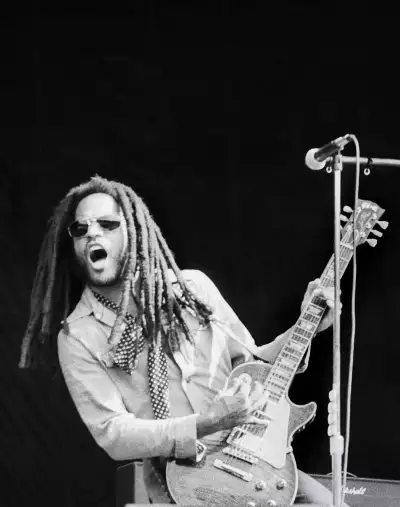
Lenny Kravitz
SM: How big is your archive these days?
SP: It’s big. I could just spend all of my time working on archive stuff. I’ve got all of the RAW [digital] archive as well since 2005, but what I really enjoy is going back to the really old stuff. You’d get commissioned and you’d go and do the shoot, pick the prints and then you’d “shelf” the shoot. When you go back to these shots you’re looking at them with fresh eyes and so much has happened since. Maybe some of the band members aren’t here anymore.
I have an assistant who comes and, for two days a week, we are digitising [film images]. That’s been going on for years, so my archive is in a really good place – certainly the negatives are. The transparencies filing cabinet is pretty much untouched. But, as daunting as it is, it is also quite exciting.
I used to shoot transparencies on Kodachrome and being able to do this exhibition is due to having my archive. A lot of photographers now don’t walk away from shoots with their copyright. There are a lot more stipulations these days. I’m very lucky and grateful to have managed to do what I do for so long and keep hold of my copyright.
SM: Is there any act you’d like to shoot who you haven’t worked with yet?
SP: Obviously big, scary people like Madonna. I would have loved to have shot Prince, even just live, and I nearly did. He was doing a very secret show and I had a call from his PR company, but it didn’t come together, so I was really annoyed.
I’ve been really lucky to have shot people like Paul McCartney, the Rolling Stones, David Bowie and Duran Duran, but the really big people like Lady Gaga I’d find it quite terrifying to shoot, but also exhilarating and exciting. I’d love to do that. But I’m really lucky. A lot of what I do is great – and I love it.
See the exhibition at Gibson Garage London, 61-62 Eastcastle St, W1W 8NQ. See more of Scarlet’s work at scarletpage.com