Italian bespoke houses are often imagined as temples of tradition, where formality reigns supreme and tailoring follows ritual and rigour. For a house as storied as Rubinacci, one might expect strictly structured formality.
Instead, Luca Rubinacci arrives for our conversation in a washed cotton T-shirt, crisp white Japanese denim, and boat shoes – each piece Rubinacci, yet styled with effortless ease.
The look reflects the house itself: rooted in centuries of craft, yet alive with a modern sense of sprezzatura
Rubinacci stands as a benchmark of Neapolitan tailoring, a reputation earned since 1932 when Gennaro Rubinacci founded the house, later passing it to his son, Mariano.
Today, under Luca Rubinacci, the house remains faithful to its heritage while embracing evolution.
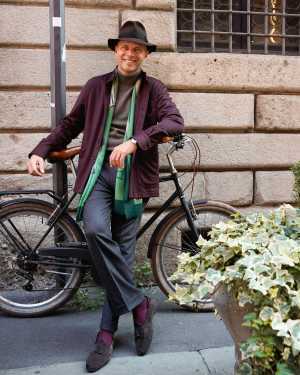
Square Mile: Rubinacci is often called the guardian of Neapolitan tailoring. How do you personally define the Rubinacci identity?
Luca Rubinacci: Rubinacci is the modern voice of men’s elegance. It’s been that way since my grandfather first pioneered the Neapolitan jacket – fully functional yet intentionally deconstructed.
During the 1960s, my father was the first to take a suitcase and travel around to his clients. The world looked very different then, and international travel was costly and challenging. He was the first to bring Neapolitan elegance beyond Naples.
Now, with the third generation, we approach our craft with an ‘everything-is-possible’ mindset. We specialise in Neapolitan structure, yes, but if a client wants a more sophisticated, padded jacket, we deliver it.
To prepare me for this, my father sent me to London at 18, where I completed a two-year apprenticeship on Savile Row. I learned everything about tailoring from a local master and then passed that knowledge on to our tailors, who at the time preferred to stick to traditional methods. My role was to encourage them to be open to new ideas. This was essential for Rubinacci to evolve and expand. This is how I see Rubinacci’s identity.
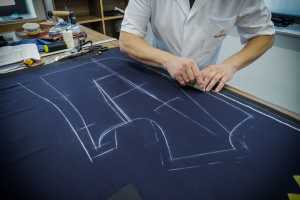
SM: Rubinacci is both a bespoke house and a ready-to-wear brand. How do you navigate these two worlds without compromising the brand’s DNA?
LR: We have two lines – ready-to-wear and bespoke, which Rubinacci is most known for. Ready-to-wear is the cake, and bespoke is the cherry on top.
Working with these two lines makes the balance between heritage and modernity possible. We change. We adapt like chameleons. We live the trends.
Today, we cannot only make the best product. The best product is the first thing clients expect when they come here – that’s our starting point. Then we move through experience, know-how, service. That’s how we keep our century-old heritage while evolving with the ready-to-wear, which responds to the trends and demands. It comes from the ideas of our clients, from the necessities of people who wear clothes every day.
Ready-to-wear is the cake, and bespoke is the cherry on top.
SM: The giacca napoletana is central to Rubinacci’s story. What does this piece represent to you beyond its construction?
LR: Giacca napoletana is our key product. The jacket is made completely unconstructed, with spalla camicia and as little canvas as possible. No padded shoulder. No horsehair. No fused collar. These are all the technical elements that define it.
People sometimes think it’s about the barchetta pocket, or the small ripples at the sleeve, but that’s not the essence. Those details can change. What makes the giacca napoletana unique is what you don’t see – the lightness of its inner construction.
I could cut it with straight pockets or give it a more formal shoulder, but it will always retain that lightness. The experience of wearing it matters more than how it looks from the outside. When you put it on, it should feel like a pullover, like a second skin. It’s not a jacket forced into the mould of formality. Giacca napoletana is relaxed – it moves with you.
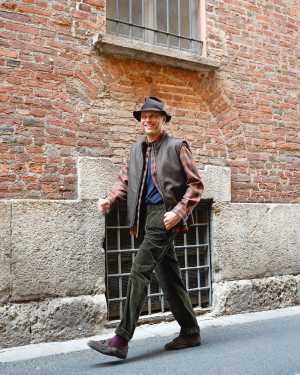
It remains our signature piece, but it’s not for every occasion. We dress many politicians, for example. Naturally, they can’t appear in parliament with a spalla camicia and a barchetta pocket. But that doesn’t mean they should be excluded from Neapolitan tailoring. For them, we create something discreet: Neapolitan in structure, yet English in appearance.
This is why I say the giacca napoletana is more of a philosophy than a garment. Like its construction, Rubinacci’s work begins with how the wearer feels. How it appears to others comes second. A jacket is always a jacket. It’s only when you wear it that you discover its true difference.
Rubinacci’s work begins with how the wearer feels. How it appears to others comes second.
SM: When you begin creating a piece, where does the process start for you? With the cloth, the cut, or the client in mind?
LR: It all begins with speaking to the client. Before I show any style or fabric, I sit with him. We take a coffee or a glass of water and talk for half an hour about his daily life. I want to know where he lives, his context, why he wants to dress in a certain way, where he will wear the clothes, when, and how often.
Only after that do I narrow it down to two – never more than three – options. Because if you open Pandora’s box with too many fabrics and too many styles, the client gets lost. He’s not here to be overwhelmed. He’s here to be guided, to discover what he truly wants.
This is why, despite Rubinacci’s strong presence on social media, the house’s most powerful publicity remains word of mouth. Nothing is more effective than one client speaking to another, because it connects us directly to the people we want to reach. Time and again, clients tell me that every time they wear a Rubinacci jacket, people ask where it comes from. Our bespoke pieces carry no labels, no obvious markers. There is nothing inside the jacket to give us away. The only way to know is to ask.

SM: Younger generations are used to quick, affordable fashion. How do you convey the worth of a Rubinacci piece, where the value lies in craftsmanship and longevity rather than price alone?
LR: Unfortunately, you have to consider budgets – it’s always been that way. It’s not so much about age. When I began working with my father in the early 2000s, the average age of our clients was 60. Today, it’s closer to 30. We now even have clients who are 18 or 20 years old. When I was that age, none of my friends were buying luxury clothing. But today, younger generations have more access than we ever did.
I wouldn’t try to convince the younger generation to buy Rubinacci – I don’t promote it on my personal social media platform either. I suggest they go to the market and look for an investment piece. That doesn’t necessarily mean something expensive. Many fashion houses sell T-shirts at a higher price than Rubinacci, yet they are still machine-made. What you’re paying for is the logo, not the quality.
What I encourage is conscious buying. If you buy something just because it’s trendy or fashionable, that’s fine. In this case, you’re buying it to be seen. But when you buy for craftsmanship, for how a piece is made, you’re buying something with enduring value. You’re not buying to be seen, but to be remembered. And that is very different.
You’re not buying to be seen, but to be remembered. And that is very different.
SM: With so much discussion around sustainability in fashion, how does Rubinacci approach longevity and craftsmanship as answers to fast fashion?
LR: I’ll tell you something from a conversation I once had with my father. Years ago, I suggested we should publicise that our products are handmade, that we use only natural fabrics, that our clothes are guaranteed for life. All of that is sustainable, I said. My father looked at me and replied: “In 70 years of my career, I never had to publicise that. Why should I start now?”
What he meant is this: at the highest level, in true family brands, sustainability should be embedded in the product from the beginning, not turned into a marketing slogan. Today, it’s used as little more than marketing.
Take this jacket I’m wearing. It’s made from recycled cotton, washed in aloe vera. But we don’t label it ‘green’ or ‘certified sustainable.’ We don’t need to. Our clients know.
For me, real sustainability is giving the client the right product, which they will keep in their wardrobe for years, even decades. That is where sustainability lives. Not in brands pushing campaigns about being ‘eco-friendly’ while still overproducing and discounting at the end of every season. That’s just storytelling for sales. I believe the industry is reaching a point where it will have to step back and be more sincere with its clients.
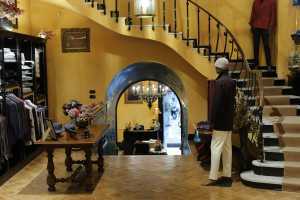
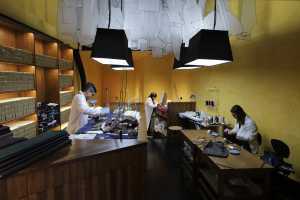
Inside Rubinacci's flagship store in Milan
SM: You’re known for embodying sprezzatura. How do you personally interpret this effortless elegance in a modern world obsessed with fast fashion?
LR: Sprezzatura is often misinterpreted. Many think it’s wearing loud clothes. But really, it’s the art of making something that shouldn’t work, work simply through attitude. Sprezzatura is comfort, confidence, knowledge. It’s about understanding what you’re wearing, and then combining it in your own way.
As a creative director, my role is to dress people differently. But how could I do that if I always dressed the same? That’s what Rubinacci is about.
Many tailoring houses specialise in one way of dressing, just as many modern style icons are defined by a single look. I’ve never wanted that. I love to experiment, both in my personal style and through Rubinacci. It’s hard to pin down my style because it’s always evolving, and so is the house.
I believe style is not something you’re born with. It comes through experience, through testing yourself, testing your way of dressing, making errors, changing, growing, passing through the years.
SM: What do you think is the key to developing a personal style that feels authentic?
LR: From the age of 20, I was very lucky to have Sergio Loro Piana as a mentor. One of his exercises was simple but profound: when I walked down the street, he never wanted me to point out what I didn’t like. He wanted me to focus only on what I did like. Not the whole look, but the details. Why did I like it? Was it the shoulder? The cut of the trousers? The colour? He taught me to identify those elements and then make them my own.
That’s the way to build a personal style. Because we are all trained to see the flaws first, not the beauty. The same thing happens online: we scroll past what we dislike so often that it becomes our reference point. And when something finally catches our eye, instead of analysing why, we tend to copy it wholesale. The exact same jacket, the exact same trousers. But maybe it isn’t the outfit as a whole. It could be the cut of the shoulder, the shade of the fabric, the proportion of the trousers. Those are the details that, once claimed and reinterpreted, become uniquely yours. That is style.
SM: Outside the atelier and the suits, who is Luca Rubinacci?
LR: I’m an extreme sports lover. Surfing, kite surfing, snowboarding, hiking – these are the things that keep me alive. I love being barefoot on the beach as much as I love hiking a mountain. Now, with two children, I’m also living the life of a father, hoping they grow quickly enough to share these passions with me.
I’ve always needed nature, because I believe it’s the source of my creativity. My eyes are never still; they always look far. And only when your eyes go far can your mind, your colours, your imagination really work, instead of being closed in by your surroundings. Milan, for example, is a city where, if you let your eyes wander, all you see are buildings. That’s why every weekend we escape to the lake, to the mountains, to the beach.
I’m not a man of pure sartorialism. I share my personal style on social media. It reflects my passions and my hobbies. It supports my lifestyle. I’m dressed in Rubinacci, but it feels effortless and natural.
My eyes are never still; they always look far.
SM: Where do you see Rubinacci in the next decade? What’s next?
LR: We have 35 tailors in the house, all between 30 and 45 years old. It’s a relatively young team making some of the most famous tailoring in the world. That’s exciting because it ensures that, for the next 15 to 20 years, Rubinacci will remain at the top of its craft. The real challenge in tailoring isn’t style or technique, it’s passing the craft to the next generation. Our motivated group of young tailors guarantees that continuity.
Bespoke will continue to be the heart of the house. It cannot expand beyond what we already do. Today, we have a capacity of 800 pieces per year, yet requests exceed 1,000. Bespoke is a meticulous, crafted product that must remain limited. That won’t change in the next ten years.
Ready-to-wear, on the other hand, serves another purpose. It’s the entry point, the way we nurture future bespoke clients, while keeping the integrity of our heritage intact. It is already growing, and we are moving quickly toward global expansion in that area.
See more at marianorubinacci.com