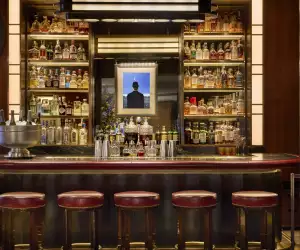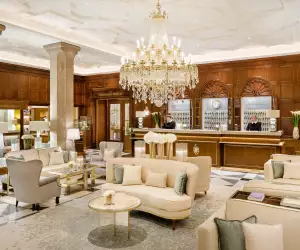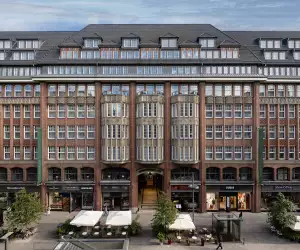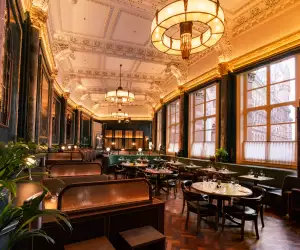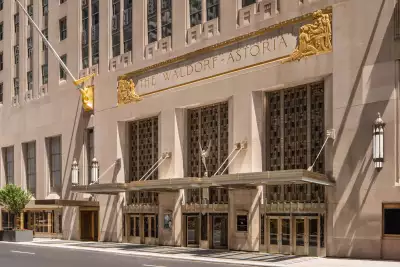
Grace Kelly got engaged here. Frank Sinatra, Marilyn Monroe, Nikola Tesla and Bugsy Siegel all lived in the residential towers. (Not together, I should add, but there’s a thought.) Celebrated guests are too numerous to mention – pick, like, anybody – and include every US president from Herbert Hoover to Barack Obama.
Need I go on? The Tony Awards and the Rock and Roll Hall of Fame held their inaugural shows in the ballroom, the same ballroom which hosted the UN General Assembly for many years. It has heard speeches from Winston Churchill and Martin Luther King. The bars have created several celebrated cocktails, and the kitchen spawned the world's most famous salad. No wonder it pioneered the concept of room service, too.
Suffice to say, the Waldorf Astoria New York long ago transcended hospitality to attain iconic status, its name a byword for glamour and luxury, the pinnacle of aspirational accommodation. Nearly a century after opening, it is probably the most famous hotel on the planet.
Indeed, I'm doing its venerability a disservice – there has been a Waldorf Astoria hotel in New York since the 19th century. The original Waldorf Hotel was opened by William Waldorf Astor on Fifth Avenue in 1893. Four years later, his cousin John Jacob Astor IV opened the even larger Astoria Hotel directly next-door in what must be one of the more expensive cases of familial rivalry. (Although infinitely more baller than rescinding their invite to Christmas dinner.)
Happily the Astors reconciled and decided one hotel is better than two. They joined their formerly competing buildings via a 300ft marble corridor known as Peacock Alley, and thus the Waldorf Astoria was born. In 1931, the Waldorf Astoria relocated to its current location on Park Avenue. The original hotel was demolished and a skyscraper constructed on its site – like the Waldorf, the Empire State Building also endures to this day.
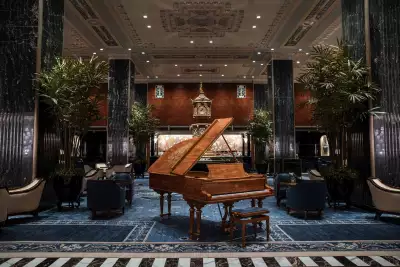
A section of Peacock Alley. The piano belonged to Cole Porter
Both Astors, however, were long gone by the time of the move. William moved to England, purchased Hever Castle and died of a heart attack on a toilet. (In Brighton, as it happened, where he owned a seafront property.) A memorable end but again eclipsed by John, who went down with the Titanic seven years earlier. Incidentally, the first Senate hearings into the Titanic disaster were held at the Waldorf before relocating to Washington DC.
Perhaps one of the Waldorf’s biggest fans was legendary hotelier Conrad Hilton, who called the hotel “the greatest of them all” and kept a photo of it on his desk. (You hope alongside his family.) Being one of life’s doers, Hilton acquired the management rights to the Waldorf in 1949 and the Hilton Group took sole control in 1972. Conrad Hilton died seven years later aged 91, his lifelong ambition to own the world’s preeminent hotel finally fulfilled.
Recent years have proved eventual. In 2014, the hotel was bought by Chinese company Anbang for $1.95bn, the most expensive hotel purchase in history. In 2017, the Waldorf closed for extensive renovations scheduled to take a couple of years. In 2020, Anbang went bankrupt. Another Chinese company took over – Dajia Insurance, although Hilton still manages the property – and the hotel finally reopened in 2025, five years later than planned and a reported $1bn over budget. (Total costs are estimated at $2bn.)
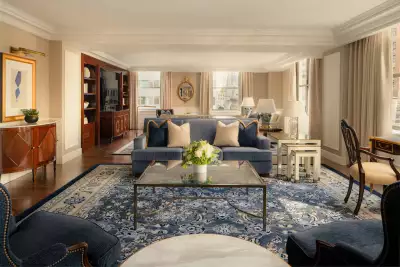
The Empire Suite costs a little less than $2bn.
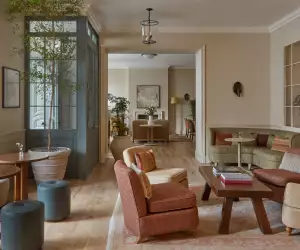
Here’s the part where I say, “you know where the money went.” Except I have absolutely no clue what constitutes $2bn well spent. I can say, as someone with a sliver of expertise in the area after a decade in luxury publishing, the Waldorf Astoria is the most magnificent hotel that I’ve ever experienced. I claim little in common with Conrad Hilton but on the Waldorf, we speak with one voice. (I’d put a photo on my desk except there isn’t really space with all the clutter.)
As a journalist, hotel tours are typically something you swallow as a tradeoff for staying in the hotel. Someone gestures at a sauna and you nod obediently. At the Waldorf Astoria, I was genuinely excited to be shown around. It’s not simply an opportunity to ogle the overwhelming beauty of the interiors. It’s a trip through history.
We start at Peacock Alley, a ludicrously opulent walkway that stretches through the hotel from Park Avenue to Lexington. There are elevators to the rooms at either end, and a lounge bar in the middle hosted by a variety of very tall and beautiful women who wear gowns straight out of Star Trek. Every Waldorf Astoria has its own version of Peacock Alley, although I doubt any comes close to the Manhattan incarnation in terms of size and splendour. Hey, let’s go check out the clock!
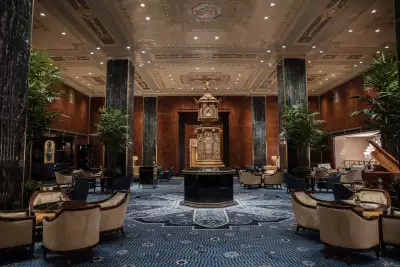
The famous clock, and more Peacock Alley
Every Waldorf also has a clock as its centrepiece. However, here we find the original, the one commissioned by Queen Victoria for the World's Fair. It's quite the timepiece, 35 years younger than Big Ben (1858 plays 1893), considerably smaller at a mere nine foot, but perhaps even more ornate. The Statue of Liberty stands at the top, and busts of notable Presidents encircle the base, plus William Henry Harrison who somehow made the cut.
A few metres from the clock is a piano that belonged to Cole Porter. It's utterly gorgeous, dating from 1907 and decorated with watercolours of various pastoral scenes. Porter lived here from 1939 to 1964 – did he ever jam with fellow resident Frank Sinatra? The plaque reads: “Some of the loveliest songs in America's musical history were composed on this Steinway.” Live jazz music is played at Peacock Alley every evening.
On the Lexington side of the Alley, we find the wheel of life mosaic, another hallmark of the original Waldorf. It was painstakingly replicated for the 1931 relocation. The mosaic shows the stages of human existence through various nude and muscular men who resemble Michelangelo's David. Mostly they are embracing robed women – mothers? wives? – although there's one image where they appear to be cuddling each other, which I suppose is the youthful experimentation stage.
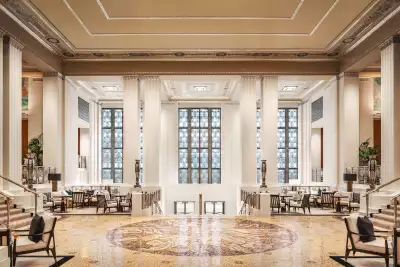
The mosaic
Head upstairs to the Silver Corridor, which looks exactly like it would have done in 1931. Think chandeliers, more chandeliers, and countless ceiling murals of women and babies floating in clouds. There are more ceiling murals in the adjoining Basildon Room although these ones are considerably darker, depicting such niceties as three-headed dogs, winged she-devils and the damned writhing in hell. I liked the Basildon Room best.
The grand ballroom lives to its moniker and then some. It's essentially a small theatre, complete with a stage and silver boxes running around the upper perimeter, all featuring red velvet curtains and their own chandelier. Every party and gala you can imagine has been hosted here over the years, including the inaugural Rock & Roll Hall of Fame ceremony in 1986 where Elvis Presley was posthumously inducted. Of course, nine years earlier, Elvis had surpassed William Waldorf as the most notable American to expire on the loo.
What of the grub? Well, there’s a Wendy’s in the basement… only kidding. Signature restaurant Lex Yard is overseen by chef Michael Anthony, a four-time James Beard winner. Here we enjoyed dinner with Danny Harpaz, the extremely youthful assistant director of marketing who told us about plans to host a tennis match in the ballroom ahead of the US Open. (Tommy Paul vs Ben Shelton, if you’re wondering. Let’s hope they mind the chandeliers.)
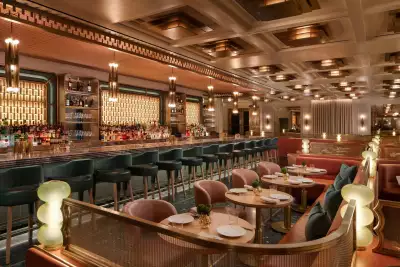
Lex Yard
The seasonal menu focused on local ingredients. If possible, opt for the seafood platter, a suitably grandiose dish featuring oysters, jumbo Tiger prawns and lobster rolls sprinkled with caviar. The black fish was also incredible, served whole with minimal garnish. And I suppose you must order the reimagined Waldorf salad, slightly lighter on the mayonnaise, the exact ingredients changing with the seasons to ensure maximum freshness.
There’s so much more to eulogies: my extremely luxurious room, the size of a small studio flat, overlooking Park Avenue. A spa offering numerous treatments and saunas both hot and cold. The food cart across the street that apparently serves a banging breakfast sandwich, if you’re looking for something a little less refined. The fact you’re right in the centre of Midtown, perfectly situated for basically any attraction you wish. Times Square and Central Park are both a 15-minute walk; I certainly recommend the latter.
Naturally, the Waldorf has been featured in multiple TV shows and films. Mad Men even named a season four episode Waldorf Stories; while Conrad Hilton briefly became a client of Don Draper in season three. The fictional Hilton proved a demanding taskmaster and ultimately deemed Draper’s work to be short of the required standard. “When I say I want the moon,” he explains, “I expect the moon."
Waldorf Astoria has yet to reach the moon. It still offers everything but.
Hotel rooms start £1,110, residences start from £1.388m. 301 Park Ave, New York, NY 10022; Waldorf Astoria
How to do NYC right...
OK so you have the hotel sorted. How are you spending your days? Here's a guide to the ultimate luxury NYC vacation.
Where to Eat
David Burke Tavern
Manhatta
Sixty floors up, this is where you go to drink dirty martinis while pretending you own the financial district. The food is fantastic – order the monkfish – and the skyline views make your regular dinner spot look like a cellar. Not one for anybody with vertigo.
28 Liberty St, 60th Floor, New York, NY 10005; manhattarestaurant.com
Tavern on the Green
Situated in Central Park, this iconic spot first opened in 1934. It offers classic American fare and an atmosphere straight out of a movie. Indoors is charmingly rustic while the courtyard is covered by fairy-lights.
67th St & Central Park West, New York, NY 10023; tavernonthegreen.com
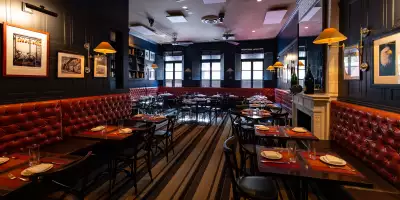
David Burke Tavern
You’ll want the bacon, which comes hanging off a metal clothesline. The cheeseburger is also a banger. Not subtle but hits the spot and then some.
135 E 62nd St, New York, NY 10065; davidburketavern.com
Crown Shy
An extremely cool spot that recently won a Michelin star. The flatbreads are superb – but then so is basically everything on the menu. Be warned, there’s an open kitchen and the chefs are pretty vocal. It won’t ruin your meal but you might jump now and then.
70 Pine St, New York, NY 10005; crownshy.nyc
What to Do
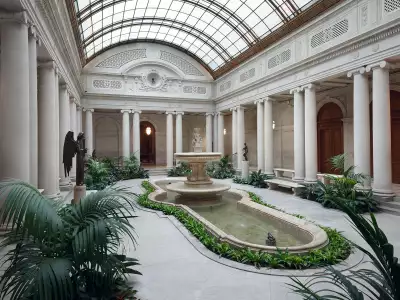
Frick Collection
Frick Collection
One of the most beautiful art galleries in the world. It’s situated in a golden-age mansion and feels a little like you’re visiting an extremely wealthy relative with an exquisite taste in both decor and art.
1 E 70th St, New York, NY 10021; frick.org
Mercer Labs
An extremely fun journey through gigantic light installations and immersive soundscapes. Trippy as hell. Incidentally, recreational marijuana is legal in New York. Just saying.
21 Dey St, New York, NY 10007; mercerlabs.com
The Lincoln Center
A gigantic complex that showcases some of the finest classic musicians, operas and ballets in the world. Don your gladrags and get your cultural fix.
Lincoln Center Plaza, New York, NY 10023; lincolncenter.org
Dizzy’s Club
Jazz with a view. Enjoy cocktails and soul food while listening to musicians backed by a floor-to-ceiling glass window framing the Manhattan night.
10 Columbus Circle, 5th Floor, New York, NY 10019; jazz.org/dizzys
Where to Shop
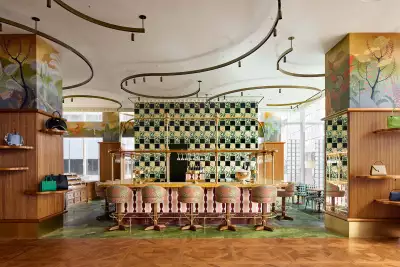
Printemps
Madison Avenue
Well obviously. The historic street is moving with the times, however – notable recent openings include our very own Thom Sweeney.
Madison Ave (57th St to 86th St), New York, NY 10022; madisonavenuebid.org
Sotheby’s
Essentially a gallery that also serves an auction house, Sotheby’s is worth visiting even if you don’t intend to bid on anything. Across multiple floors you’ll find dazzling artwork and unique collectables. The brutalist building is very Barbican.
945 Madison Ave, New York, NY 10021; sothebys.com
Printemps
Paris lands in Downtown Manhattan. Housed inside the landmark One Wall Street, this storied French department store is an absolute riot of colour, cool and extremely costly garments. Brilliant if totally bonkers.
1 Wall St, New York, NY 10005; printemps.com
How to get there

United Polaris
We were fortunate enough to be flown business class with United Airlines, a prospect almost exciting as NYC itself. I would love to say business is rubbish but sadly it's amazing. There are the lounges at either end, a special check-in line just for you. Later, Muggles!
Once onboard you get a little pod that extends into a bed and a constant supply of drinks and snacks. The food is genuinely good, not even 'airplane' good. It's a seven-hour flight and I was slightly disappointed to land.
It ain't cheap but, like the Waldorf, you know where the money goes. And considering the fate of John Jacob Astor IV, can you really risk going by boat?
Economy: £600.29; United Premium Plus: £1,333.29; United Polaris business: £3,971.29