Integrated sports watches are a crowded market these days. Every watchmaker worth its name seems to have its own version, all circling the same collection of references from the 1970s, your Oaks Royal, your Nautili, and so on. And yet one of the finest of the bunch and certainly the most individual, wasn’t actually born in the 1970s at all. In fact, like all good watch writers (ahem), it’s a 1990s child. I’m of course talking about the Vacheron Constantin Overseas.
The general perspective these days is that the Overseas is the spiritual successor to Vacheron’s 1970s 222. And that’s a story that makes a lot of sense; both are integrated bracelet sports watches, both have instantly recognisable bezels and both house the horological heft of a grand watchmaking maison. The reality, however, is slightly different.
For one, the 222 wasn’t even Vacheron’s first attempt at a luxury sports watch. That honour goes to the slightly earlier, 1975 Royal. It’s also a model whose importance is somewhat retrospective. Only 500 of them were ever made, replaced by the weirder – and very 1980s – 333. Indeed, while Vacheron obviously learned a lot with the watch, it’s fairer to say that the launch of the Overseas in 1996 was less about building a successor to the 222 and more about finally nailing the concept for a new era.
At the time of the Overseas’ launch, Vacheron did have a line with an integrated bracelet, the tragically underrated Phidias. But a quick glance at a catalogue illustrates that, even with chronographs and tachymeters, these weren’t sports watches. They were full-gold, often diamond-set and curvaceous. In the era of the Royal Oak, Vacheron needed a genuine challenger.
In the era of the Royal Oak, Vacheron needed a genuine challenger.
“We saw steel coming back at the beginning of the 1990s,” says Vacheron Constantin’s Head of Heritage, Christian Selmoni, “and not just in sports watches but dress watches, too. This led to the resurgence of sport elegant watches in steel. So, we decided to come back to steel.”
The person picked to lead the charge was Dino Modolo, a man largely responsible for Vacheron Constantin’s clean designs of the 1990s. His brief: to design an entire collection of elegant sports watches from scratch. That’s a big ask, so Modolo, a man who at the time was living and breathing Vacheron Constantin, looked to the maison’s previous sports watch in steel, the 222.
“First,” says Selmoni, “he took what we call the ‘flat table’. When you look at the 222, you see the case is totally flat and very thin. Then there is the bezel, which is screwed from the inside and really jumps out of the flat case. These were the two elements Dino decided to take from the 222 and that’s the whole link between the two.”
Everything else was new for the 1990s. Dino left a prominent bezel, but it was completely redesigned. Gone were the small gear-tooth notches in favour of a dramatic interpretation of the maison’s Maltese cross logo. The bracelets were completely new and the way they tapered into the case was less the gradual integration of the 222 and more a sharp broadening out into the rounder Overseas case. The two certainly shared the same DNA, but were closer to cousins than siblings.
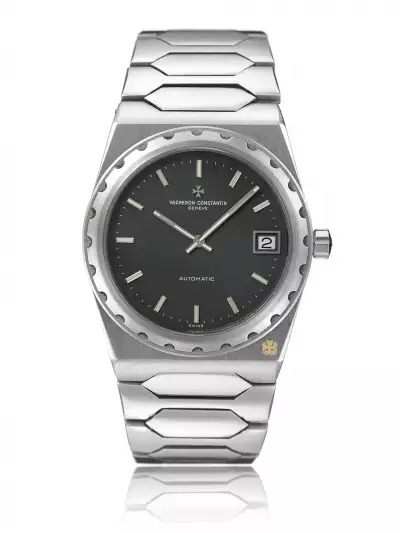
Vacheron Constantin 222, Reference 44018/411 – the original 222
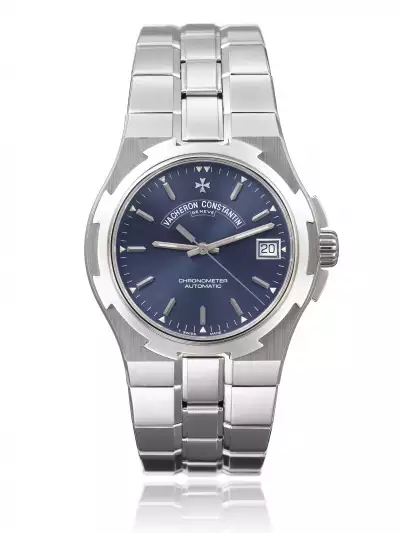
Vacheron Constantin Ref 42040/423A – the first Overseas
“It’s tricky because there’s always a risk when you come out with a brand-new collection that’s not in the usual gold or platinum. But at the time we had great expectations for the Overseas, we really thought the momentum was right for this kind of watch,” he continues. “We were really ambitious and launched with quite a few references. We had the very small model, I think it was 24.5mm diameter for ladies, what we called the midsize 35mm, and finally the jumbo, enormous at 37mm, which became the most successful model.”
It’s not hard to see why the Overseas was an immediate success. This was a prestige brand launching something genuinely cool. It was less formal, less conservative than Vacheron’s broader collection. It was sportier in style than the Phidias and was in steel, representing not just a new look but a new entry-point for Vacheron Constantin. It even had a crown protector, something no previous Vacheron would have even needed.
Because this was the 1990s, there were even some quartz versions, which are incredibly cool if you see them today. In short, if the grand old maison was looking for a way to recruit fresh blood into the cult of haute horology, the Overseas was it.
The initial launch was followed in 1999 by the Overseas ref. 49140, a chronograph model that doubled down on the sporty silhouette. At 40mm across, it was massive for the time but cemented the Overseas’ place not just as a passing nod to everyday wearing from a prestige watchmaker, but a proper, usable sports watch.
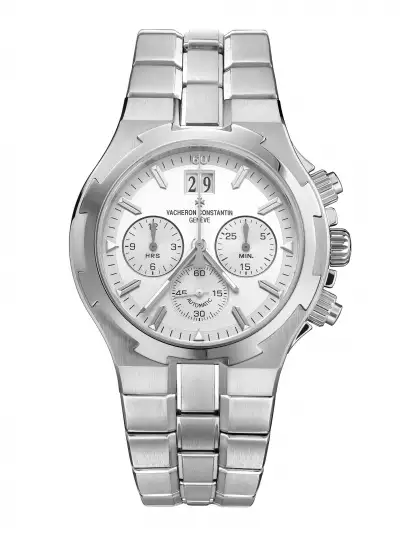
Vacheron Constantin Overseas Chronograph Ref. 49140 from 1999
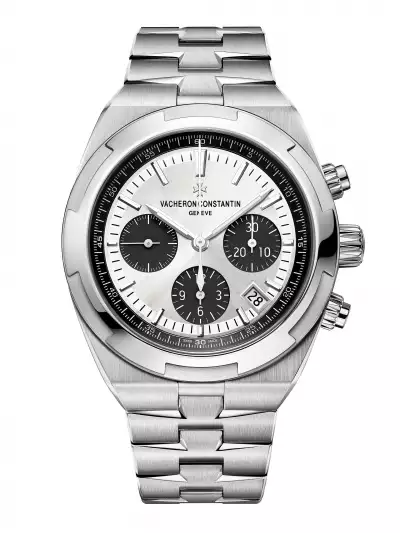
Vacheron Constantin Overseas Chronograph Ref. 5520V/210A-B686 available now.
“The Chronograph was a game changer for the collection,” says Selmoni. “It helped us escape that ‘dress watch on a bracelet’ idea and for me remains the most important piece in the first Overseas generation.”
Most watchmakers would leave it there. God knows we’re still talking about many a sports watch first designed in the 1970s with, let’s say, light-handed changes since then. But just as the original launch captured the 1990s horological zeitgeist, Vacheron wanted to move with the times. And so, despite the Overseas success – especially in the USA and Asia – 2004 saw some dramatic changes brought to the collection.
“In 2004, the context was completely different,” explains Selmoni. “Fine watchmaking was booming; diameters were increasing a lot and there was demand for a much sportier line compared to the classic Overseas. So, we decided to create a kind of disruption with the second generation.”
That disruption came not from the case or bezel, which were kept largely the same, but the bracelet. Instead of the classic three-link number from the 1996 Overseas – itself a sportier evolution of the Phidias bracelet – the new Overseas came on the now-signature Maltese cross-inspired bracelet. The overall size of the watch was also increased, up to 42mm across, a size that’s still on the upper edge for traditional watch houses. It was bigger, sportier and more “brutal”, as Christian puts it, than anything Vacheron had done before – perfect for the early 2000s.
While Gen 2 went big in size, it nonetheless streamlined the Overseas profile. Gone were the flanges either side of the crown, the case was slightly less dramatically curved and the whole thing felt more confident.
The brushed and polished finishing across the board helped emphasise the shape, while a new soft-iron inner cage meant it could weather electromagnetism.
Compared to the bracelet these are all incremental improvements, but all genuine – and led to one of Selmoni’s favourite Overseas models: “For the 10th anniversary of the collection, we launched a dual time in rose gold [pictured below], on a bracelet, 250 pieces. It was a killer fabulous watch.”
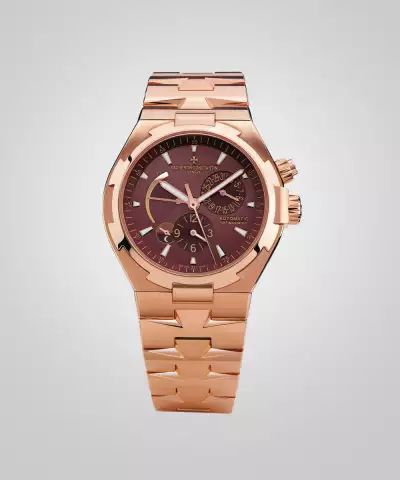
Vacheron Constantin Overseas Dual Time Ref. 47450/B01R-9229.
This brings us to the third generation of Overseas. Launched in 2016, the third generation is what we still have today. The biggest change was actually to pull back from a lot of 2000s’ “brutal” design choices and bring back a touch more elegance.
Visually, that meant dressier dials, more intricate bracelets and a second layer to the bezel, creating a softer transition zone and an additional area of contrasting finishing. The end result is a watch that actually lands between gens 1 and 2 aesthetically, while bringing in a bit of refinement from earlier Vacheron watches, the 222 specifically.
That was the thinking that led to what Selmoni considers the ultimate grail Overseas: “We wanted to recreate the link between the Overseas and the 222 by creating a neutral, thin third generation model with the reference 2000V. I think we made 150 of them in white gold, only two hands and no date. We thought we were crazy. We thought, ‘Come on, nobody’s going to buy this, looking like a steel watch.’ But now it’s certainly the most collectible Overseas ever made.”
However, aesthetics wasn’t the real reason for a new generation. Until then, Vacheron had used some third-party movements which simply wouldn’t do for a maison of their gravity. Thus, the calibre 5000 made its way into every Overseas – the 5200 for chronograph versions.
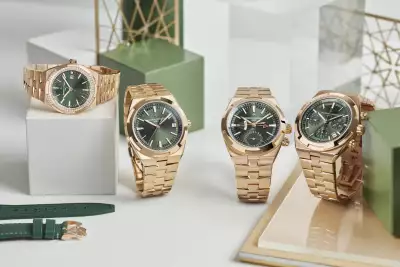
Vacheron Constantin Overseas collection with green dial
Today, the Overseas is more popular than it’s ever been. As Christy Davis, co-founder of preowned watch specialist Subdial, puts it: “The Vacheron Constantin Overseas has grown in collectors’ minds in recent years. Through the pandemic, as Royal Oaks and Nautiluses became increasingly difficult (and expensive) to source, the Overseas became an alternative modern sports watch, with prices steadily escalating. In a world where stealth wealth is the new flash, an Overseas has become an alternative choice that shows you’ve thought about your purchase a little more than the average Nautilus wearer.”
This interest has led to more emphasis on the Overseas from Vacheron than ever before. Now it’s not just home to time-only and chronographs, but tourbillons and calendars of all forms. It’s available in a host of different dial colours and metals (including the supremely cool titanium Everest edition) and with its nuanced, multi-layered construction, just keeps finding new ways to reinvent itself. That’s not bad for a watch essentially conceived to capitalise on the 1990s love of steel.
And the love for the modern Overseas seems to have translated to the vintage models too: “Early Overseas are a very different type of watch,” explains Christy. “Highly versatile, wearable as a sports model or a daily wearer with a shirt. We’ve seen a growing interest in Neo-Vintage watchmaking, a hark back to a time when watch design felt more ambitious and risk-taking, and the Overseas sits squarely within this.”
Past or present, the Overseas stands apart from other integrated bracelet sports watches, not because of the exceptional watchmaking behind it, though the Poinçon de Genève speaks for itself. It doesn’t even stand out for its prestige; most collectors would opt for a Nautilus or Royal Oak over Vacheron’s equivalent. Instead, what sets it apart is that it’s one of the few luxury sports watches that was created for the modern era. It was born in the 1990s, not the 1970s, and has had the freedom to define itself on its own terms for each successive generation.
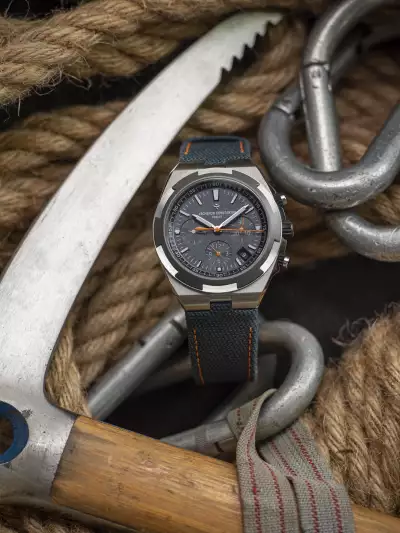
Vacheron Constantin Ovreseas Everest Ref. 5510V/000T-B923
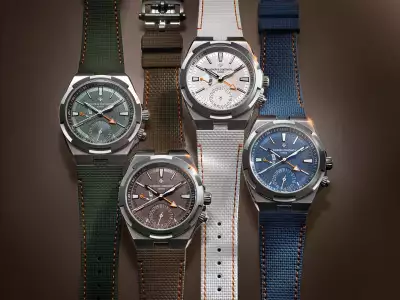
That exceptionally versatile horological platform has this year ushered in its sportiest iteration yet in the Dual Time ‘Cardinal Points’ series.
Based on the obscenely cool 2019 ‘Everest’ prototype, these 41mm titanium models pair dark, lightweight metal with orange highlights and grained dials. They still have all those Overseas hallmarks, from the Maltese Cross bezel to the integrated bracelet, but in a way that lands firmly on the more practical side of the sports-luxe paradigm.
While many of us were expecting a brand-new generation of Overseas for the collection’s 30th anniversary, that’s not what we got – and that’s OK. Even within a single generation, Vacheron’s sportiest collection continues to reinvent itself. And if the past, relatively short history of the collection is anything to go by, when we finally do get an Overseas Gen 4, it will be something very special indeed.
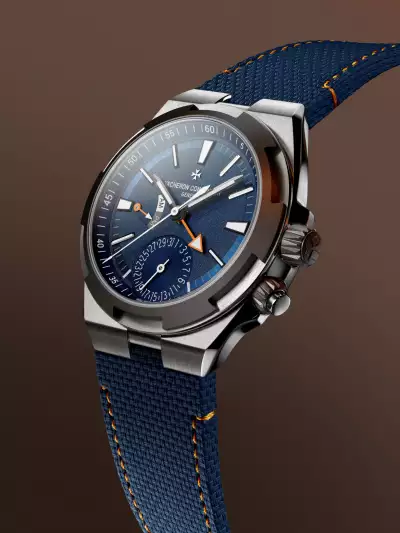
Vacheron Constantin Overseas Dual Time "Cardinal Points"
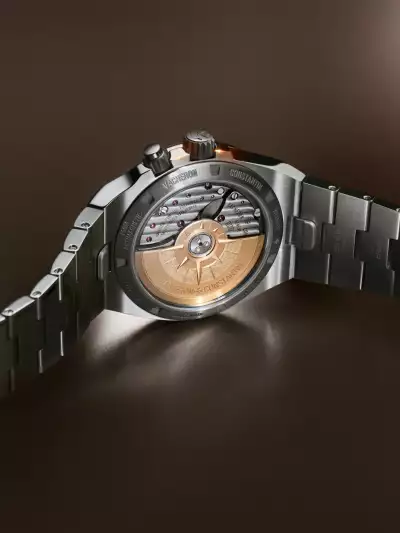
Vacheron Constantin Overseas Dual Time "Cardinal Points"
See more at vacheron-constantin.com