I grew up a Mustang man. My father owned one from new after working in Boston early in his career. He had his 1970 Mach 1 shipped over to the UK and it remained our sole car until the family grew too large for it.
It was undeniably the coolest ride on the street. (Admittedly, we lived in Commuterville, Home Counties in the early 1980s, so the bar wasn’t set too high.) But that all changed when our nextdoor neighbour rocked up in a 1966 Corvette Stingray.
This sleek silver bullet was like a different species entirely. It was lithe and streamlined – with its pinched waist, hidden headlamps and long, low nose. It even had independent rear suspension – something the Mustang noticeably lacked back then, especially on a bumpy B road at speed.
But it was the combination of the Stingray’s elegant, sweeping bonnet, muscular rear fenders and tapered tail that really did it for me.
It was beauty to the Mustang’s beast. And because we didn’t have it, I wanted it.
Well, it’s only taken me 40 years, and finally I’m behind the wheel of one. But this particular Stingray is an entirely different kettle of fish.

Corvette’s most evocative model has come on a lot in four decades – but the lineage is still clear. The C8 generation marked the biggest change in Corvette history when Chevrolet finally moved the engine from the front to behind the driver.
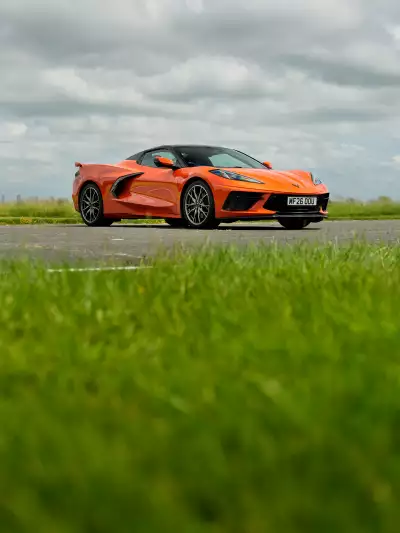
As a result, the Stingray’s proportions are now more junior supercar than American muscle car: cab-forward, reassuringly low, and broad across the rear.
Yet there are enough visual cues to connect it with its ancestors. The pointed nose remains, as do the heavily sculpted flanks and exaggerated rear haunches. It doesn’t fall into the retro-mod trap of simply photocopying its greatest hits, though. Indeed, from certain angles there’s more than a whiff of Ferrari or McLaren about it.
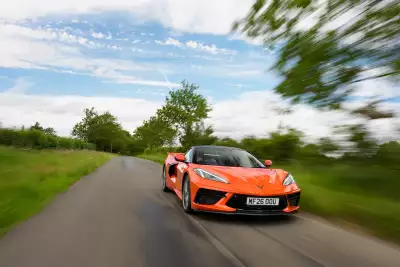
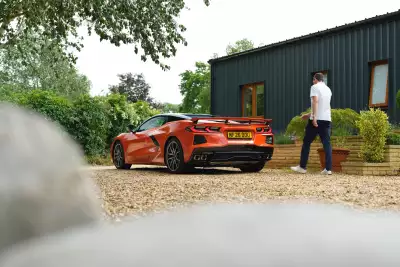
That might upset a few purists in Kentucky, but it is undeniably striking – especially in the Sebring Orange tintcoat of our press car. And, crucially, it has presence. Lots of it. Just ask all the people taking photos of it on their phones.
What sits behind your head remains defiantly old-school American. No turbochargers. No hybrid assistance. No downsized engine pretending those extra two missing cylinders don’t matter. Instead, there’s a naturally aspirated 6.2-litre V8 producing 482hp and 637Nm of torque, connected to an eight-speed dual-clutch gearbox and driving the rear wheels. Amen to that.

It will dispatch 0–62mph in 3.5 seconds and run on to 184mph, but the numbers only tell half the story. Modern performance cars have become so obscenely fast that outright acceleration can almost become academic. What matters here is the theatre.
Press the starter and the V8 erupts behind you. Prod the throttle and you get an immediate response accompanied by that unmistakable baritone soundtrack. Pull one of the large paddles behind the steering wheel and the dual-clutch gearbox cracks through ratios with impressive speed.
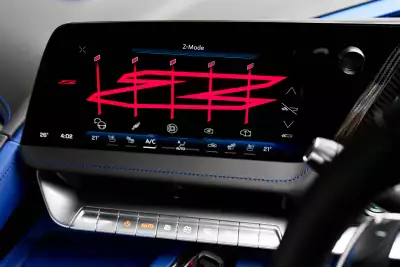
There are Tour, Sport, Track and Weather driving modes, plus configurable MyMode and Z Mode. Each arrives with a wonderfully over-the-top animation across the digital displays, as if you’ve just unlocked another level in Gran Turismo.
Z Mode is particularly enticing. A prominent sliver button on the steering wheel gives instant access to your own performance setup, allowing you to configure everything from steering and engine response to exhaust, brakes and traction management.
There’s also launch control. Possibly because those CarWow videos mean every performance car has to have one these days. The Corvette’s button features a little rocket ship icon – it’s a fun touch. (Literally.)
Once the straight lines give way to corners, the Stingray is remarkably composed. My car was fitted with Magnetic Selective Ride Control 4.0, which uses magnetorheological fluid in the dampers to alter their characteristics almost instantaneously. It sounds like something invented by Tony Stark, but on rickety Yorkshire roads its value becomes very real, very quickly.
This is a low, wide mid-engined sports car capable of serious track work, yet it deals with the worst lumps, bumps, divots and geological events our local highways department can throw at it with remarkable composure. Switch everything up and body roll becomes virtually non-existent, yet the car never feels brittle or nervous.
A lot of that comes down to the fundamentals. Beneath the composite bodywork sits an exceptionally rigid aluminium-intensive structure, built around large die-cast sections, while lightweight materials including fibreglass composites and carbon fibre are used elsewhere.
Our specced-up car also came with the Z51 Performance Package, bringing Brembo performance brakes, firmer suspension, an electronic limited-slip differential, performance exhaust, revised rear axle ratio, additional cooling, Michelin Pilot Sport 4S rubber and aerodynamic additions. I can’t speak for each individual element – but together, it’s one hell of a package.
The resulting car inspires enormous confidence. Turn-in is sharp, grip feels almost absurd and the mid-engined balance makes it far more neutral and sophisticated than the Corvettes of old. You can feel the mass sitting close to your hips rather than hanging somewhere far beyond the windscreen.
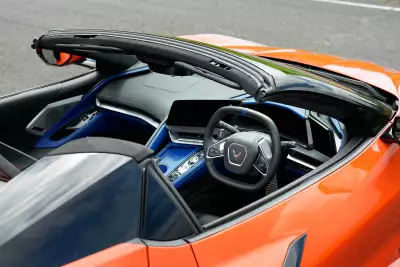
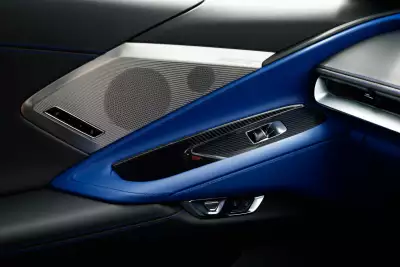
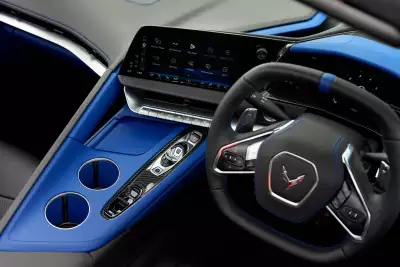
Then there’s the interior. This is perhaps where the 2026 Stingray has made its biggest leap. The previous C8’s long wall of buttons dividing driver and passenger has gone, replaced by a cleaner layout built around three digital displays: a 14in instrument cluster, 12.7in central touchscreen and new 6.6in auxiliary touchscreen angled towards the driver.
Few interiors wrap around you quite so engagingly. It’s proper fighter-pilot stuff. Only Lamborghini comes close to making the simple act of sitting in a stationary car feel quite so theatrical.
And the screens aren’t simply there to provide acreage. The auxiliary display can show everything from tyre pressures to my personal favourite, G-force. (Challenge, accepted.) The Performance App provides live horsepower and torque data and if you want to take it on track days, there’s an integrated Performance Data Recorder capable of recording laps and analysing where you could have gone faster.
The interior quality is equally impressive. Parked in my garage overnight with the roof down, I walked in the following morning and the place smelt like a Bentley dealership – rich, leathery goodness hanging in the air.
That might sound flippant, but it illustrates how far Corvette has come. The stitching, leather, suede, metalwork and (most of the) switchgear feel properly expensive.
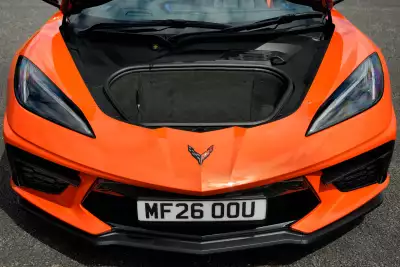
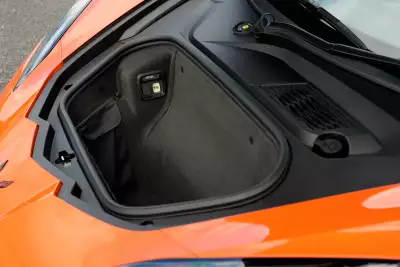
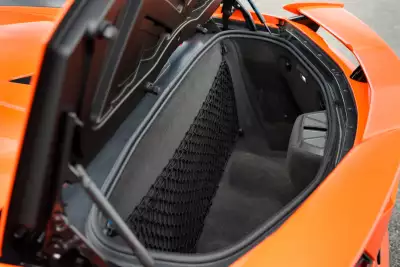
The biggest surprise of all, though, is that this baby supercar is actually fairly practical.
There’s luggage space both beneath the long rear deck and under the bonnet. Together they provide enough room for a weekend away rather than merely a toothbrush and optimistic choice of underwear. The boots even benefit from soft-close mechanisms – a wonderfully luxurious touch on something with a small-block Chevy V8.
And that, ultimately, is what makes the Stingray so compelling. It has the proportions and dynamics of a European supercar, the usability of a proper GT, and an enormous naturally aspirated American V8 sitting in the middle of it.
All for less than £100,000 in 2LT Coupe form. Ours came in at £116,194.69 fully specced – which is remarkable value given all the upgrades/
After 50 years of ownership, Dad has since replaced the old Mustang Mach 1 with the modern Bullitt. It is a beautiful car and handles remarkably well given its size. We even take it to track days to let it stretch its muscles.
But would I buy a Mustang over the new Stingray? Afraid not. Just don’t tell my dad.
Available in the UK now through Corvette’s UK dealer network: Clive Sutton in London; Lookers in Colchester and Essex; Arnold Clark in Glasgow and Manchester; and Cambria in Birmingham. See more at chevrolet.com