Visitors to January’s Retromobile exposition in Paris may well have spotted a very special car on the Mercedes-Benz stand. Mounted on a sloped plinth and framed by a map of the 1955 Mille Miglia route, it looked a lot like the Mercedes 300 SLR that Stirling Moss drove to victory in that year’s race.
The W196 Mercedes-Benz 300 SLR is one of the most famous racing cars ever built and, according to collectable car insurance and valuation experts Hagerty, the ‘722’ version – numbered after Moss’s 7.22am start time – is probably the most valuable car in the world. It’s only a probability because it will never go under the hammer – Mercedes-Benz owns it, and it’s treated with the same reverence as the British regard the Crown Jewels, rarely leaving the company’s museum in Stuttgart.
That said, one of its stablemates – another W196 that was converted into a road-going coupé by the factory for Mercedes design chief Rudolf Uhlenhaut – sold back in 2022 for €135m, making it the most valuable car ever sold on the open market. And last year, a W196 Streamliner (‘Stromlinienwagen’) was sold by the Indianapolis Motor Speedway (IMS) Museum for just over €51m. Gulp.
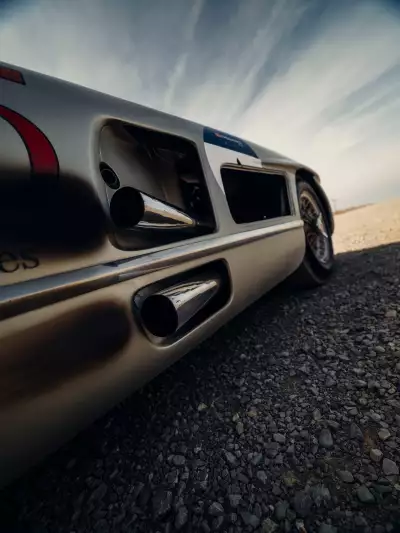
Just 14 of the W196 racing cars of different configurations were built in 1955, and with values as high as this, most other manufacturers would have a model to display at events such as Retromobile – but Mercedes-Benz isn’t most manufacturers. If you looked closely at the car on the plinth, the blackening on the car’s silver flank behind the stub exhausts hinted that this wasn’t just set dressing. I knew for certain that this car was the real deal, as I recognised it from the previous month when I’d been given an extraordinary introduction to this amazing machine in the most unlikely of locations: the top of a desert mountain on the UAE / Oman border.
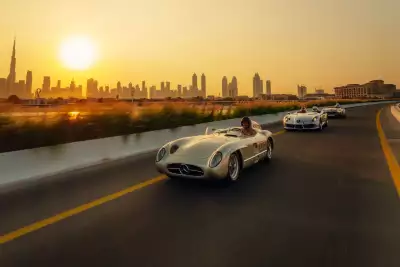
I was there to take part in the 1000 Miglia Experience UAE, a tour spanning the seven Emirates run by the Dubai-based Octanium Experiences and the 1000 Miglia SRL, the organisers of the famous Italian race retrospective.
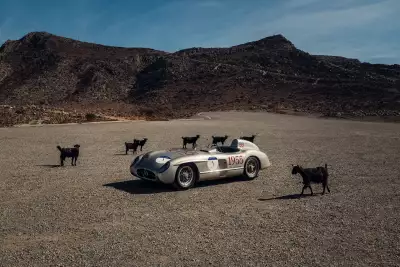
The Holy goat: The Mercedes-Benz W196S 300 SLR was never beaten in a race it finished during its short, dominant 1955 season, securing the 1955 World Sportscar Championship for Mercedes-Benz.
The UAE experience reflects the original in many ways – it’s a four-day, 1,000-mile tour in which drivers navigate using a road book and compete with regularity and timed stages – but the qualifying rules for which cars are allowed are broad, so it has a much more relaxed feel to it. Some drivers remain super competitive, but many are just happy to enjoy the driving, the company and the scenery.
And what scenery it was: although I’ve visited Gulf states before, I’d never spent time in the UAE, and like many people, I had a mistaken preconception of the country. Only Dubai really met those expectations, full of ultra-modern high-rise buildings and visible wealth, including every supercar dealership you can imagine on the main strip. Abu Dhabi is also visibly rich, but the architecture is more typical for the region: huge marble minarets, domes and courtyards of mosques, palaces and universities are offset by carefully designed futuristic buildings.
The rest comprises smaller towns mainly dotted along the coastal strip and a huge expanse of desert in the interior, crossed with roads and featuring the rocky Hajar Mountains to the northeast that run across the border into Oman. It was there I was heading – to Jebel Jais, at 6,345 feet, the highest point in the UAE. And I was travelling in another Mercedes-Benz – a 300 SL Roadster driven by notable classic car dealer Simon Kidston.
It’s moonscape terrain: jutting rocky mountains with light brown scrub, the odd building, but nothing more. Yet the main roads are generally superb, and that includes the twisting switchback that climbs up Jais from the bottom. Today, it was busy – the UAE was celebrating the 54th birthday of its formation in December 1971 and people were out in force.
The 300 SL Roadster’s three-litre inline six sang as we climbed the nine-mile route, until finally we reached a police checkpoint and were waved through, the final couple of miles having been closed just for us. At the top, we pulled into a restaurant car park, and I finally met what I’d really come to experience. The 300 SL was a superb car, elegant, powerful and way beyond its time, but other than the badge and the similar designation, the W196S 300 SLR was a different beast altogether.
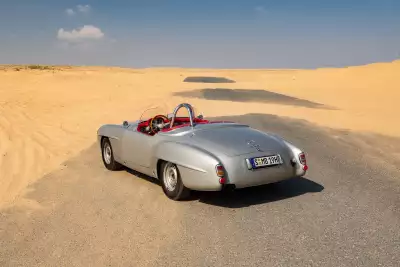
Desert storm: the Mercedes-Benz 300 SL Roadster
Even amongst its siblings, the car is very special indeed: chassis 00010/55 was being built by Mercedes-Benz ready for the 1956 season when the company called a halt to its racing programme. It was a very difficult time; although W196S racing cars had been dominant having won the 1955 Targa Florio, the Mille Miglia and (W196) the F1 World Championship, their attempt to win the Le Mans 24 Hours crown had ended in disaster when Pierre Levegh’s 300 SLR somersaulted into the crowds, killing him and more than 80 others. The company decided to quit, the racing cars were returned to Stuttgart, and the focus shifted solely to developing road cars for decades to come.
The 00010/55 had been built to be almost visibly identical to the earlier 1955 season cars and powered by the same 2,892cc straight-eight, twin overhead-cam engine with two valves per cylinder with desmodromic actuation and Bosch direct fuel injection. However, it was 84kg lighter thanks to a different variant of Elektron magnesium body and various weight-saving measures like a smaller battery and alternator and ditching the air brake. If allowed to race, it would have undoubtedly been competitive: it has recently been dyno tested at 294bhp at 7,550rpm. Today, it acts as one of the Mercedes-Benz historic demonstration cars, touring the globe to represent and celebrate its racing siblings, and happily, it doesn’t just sit on a plinth.
Standing next to the 300 SLR was Uwe Karrer, the mechanic who has looked after this car and previously the Uhlenhaut Coupé for decades, and Sabine Dellnitz of the Mercedes-Benz Museum. I asked Sabine where they wanted me and she replied, with typically German clarity, “In the passenger seat, of course.” It was worth a try.
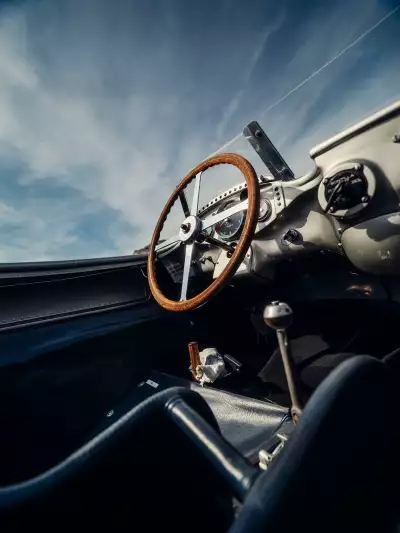
A few moments later, I had climbed over the silver flank of the car and nestled into the blue-plaid squab that was to be my seat. Room was tight, especially as Uwe is a bear of a man and the cockpit was sparse: a small oval dash is dominated by a central Veglia tacho, redlining at 7,000 rpm, but finishing at 10,000 rpm. To its left, a small oil pressure gauge, to its right, water temperature. Light switch, starter, four-spoke alloy, wood-rimmed steering wheel, and that’s about it. In the centre of the car, the gated five-speed gearbox looked complex, and it is: effectively an upside-down dogleg, it sets a trap for the unwary.
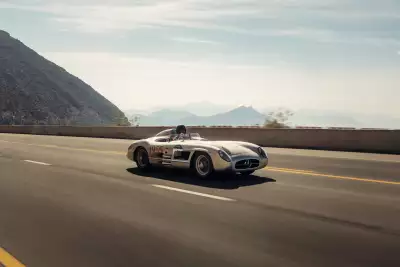
Jewel in the crown: The 300 SLR ‘722’ is treated with the same reverence as the British regard the Crown Jewels
“Hold on!” Uwe said to me in English – the only words I managed to extract from him, and I braced myself as the engine thundered into life. The 300 SL is often called the road-going version of this car, but even that experience of the three-litre straight eight firing up, its two stub exhausts pulsing just inches from my right shoulder, was enough to make me realise that wasn’t a fair comparison.
The engine warmed, Uwe pulled away, heading back down the mountain on the now-deserted road. Where the 300 SL had been powerful and yet smooth, this was brutal: an extraordinary soundtrack of screaming engine and whining gearbox accompanied an assault on the senses. Phenomenal acceleration was mated with a road-holding that took the flowing mountain corners with ease. Each one, Uwe dived into with supreme confidence, danced on the brakes, then pushed again early towards the next. There are very few other people left alive who would have the confidence to push this car this hard; it was a masterclass by someone who had years of living with the machine under his belt.
Without a speedometer, I can’t be sure how fast we went, but the Bentley Arnage on which the 1000 Miglia UAE team had mounted a video camera to record the event was left in the dust, the video editor later proved me with nothing more than a record of a noisy speck disappearing around the corner. My own attempt at recording a video also failed miserably, as I’d accidentally knocked it onto time-lapse, leaving me with a series of rather blurry photographs as the only record of the experience (beyond this report, of course) once we’d finally pulled up to a halt by the barrier manned by the police.
Later, Karrer powered the car back up the mountain for the cameras, the wheels spinning on the tarmac. This isn’t just a show queen or a display piece; Mercedes-Benz sees this as a living, breathing part of its history, and it’s maintained to be driven as the original designers intended.
My experience with the car wasn’t long, but I was left breathless and with so much respect for those who piloted them back in 1955. Stirling Moss drove ‘722’ for 1,000 miles over 10 hours at an average speed of 98mph along roads open to traffic from Brescia, down along the coast to Pescara, crossing Italy to Rome, then returning via the Apennine Mountains. Uwe had been fast, but Moss quicker – and he didn’t know what was going to appear around the next corner.
My admiration grew as much for Moss’s navigator, Denis Jenkinson, as for the famous driver. On the face of it, Jenks was one of us: a bespectacled, bearded motoring journalist, but he had form, having already won the world sidecar championship in 1949 in the passenger seat.
Months of preparation before the race by him and Moss, driving the Mille Miglia route and categorising corners into ‘saucy’, ‘dodgy’ and ‘very dangerous’ were all recorded on what he called his roller, an aluminium box containing a continuous paper feed that was wound by hand as the race progressed. Just holding on, bracing myself against the g-force, taking the assault of the buffeting airflow was enough for me to deal with; Jenkinson did all this while concentrating without pause on navigating every bump and turn for over ten hours. No wonder he took a second pair of glasses with him, just in case.
The other revelation the experience gave to me was why these cars are valued so highly. It’s not just the racing history, or the Boy’s Own stories that go hand in hand with them. It’s not just the deep emotions that the sounds, smells and sights of this car develop in anyone with an ounce of automotive love in their veins. It’s not even the rarity. It’s a narrative that binds all of that together, and every other Mercedes-Benz racing success from the 1950s to the present F1 team, with an honourable mention to their top-of-the-range road cars.
Mercedes-Benz does this more effectively than almost any other manufacturer, and it shows. I’ve fallen for it; the question I’m always asked is if money was no object, what cars would be in my garage? I can now honestly say that it’s one of these. I just need to find around £100m.
The UK Hagerty Price Guide is available at hagerty.co.uk. For more info on the trip, visit 1000migliaexperience.ae