Picture the scene: a musician steps into the spotlight, walks gracefully across the stage and sits down at a chair next to a beautiful, golden-brown cello. They take the instrument off its stand, raise their bow and begin to play. The timbre is beautiful; the melody deep and unhurried. There are no dramatic swells or staccato rushes to enrapture the audience; instead, it washes over them without friction, transporting them somewhere altogether more serene.
If this all sounds a little incongruous, bear with me. What you’re picturing is, apparently, what Dr Bill Lumsden sees when he’s drinking old whisky – or, at the very least, my interpretation of it, with more than a little poetic licence. But when I sit down with Lumsden at Gleneagles’ American Bar in anticipation of trying the oldest whisky Glenmorangie has ever produced later that night, that’s what he tells me. “I always have this idea in my head of a cello playing some lovely mellow music,” he says. “And I think old whiskies like that should always have that lovely mellowness to them.”
The Glenmorangie 50 Years Old is remarkable on several counts. For a start, it’s a very old whisky from a producer not known for very old whiskies. “I knew that Glenmorangie was not necessarily comfortable with very long ageing,” Lumsden says, citing his sizeable experience of the Glenmorangie spirit and of managing its cask programme, drawing on 26 years as director of whisky creation at Glenmorangie and sister distillery Ardbeg. Glenmorangie in particular is known for its floral and fruity character – in large part due to the famously long-necked stills used to distil its new make spirit – which doesn’t always point to the ability to age for five decades. Lumsden, however, wanted to find out just how far it could go.
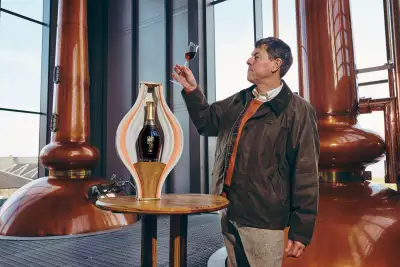
Dr Bill Lumsden with a bottle of Glenmorangie 50 Years Old, in its signature vessel by Pincus Porcelain
“I started to analyse, and started planning for some older expressions,” he continues. A 25 Year Old was released in 2001, using stock from the mid-1970s, but Lumsden knew he wanted to take it further in the decades ahead. “I said, ‘I'm going to see how far I can push the envelope. That's what led to this.’” Working in near secrecy, Lumsden re-racked a handful of casks – mostly first-fill bourbon, with one ex-oloroso sherry – from some of the warehouses’ oldest stock into newly coopered casks he had made up, and simply left it.
A high-octane, instantly memorable fellow with a predilection for using ex-wine casks to develop layers of flavour in younger whiskies, Lumsden had to leave behind his usual credo and let time, not the container, flavour the whisky over the next two and a half decades. “I wanted to be able to hold the liquid for many, many years, but not to give too much wood influence to the whisky, and just rely more on oxidative ageing. I liked the whisky then and I wanted to maintain that character. I was trying to create something that was still recognisably Glenmorangie. But I didn't sample the cask again until 15 years after it was filled.”
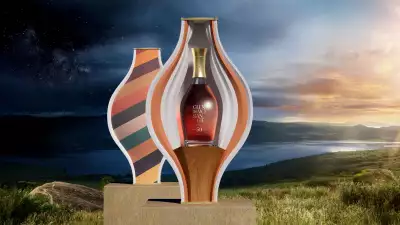
The resulting whisky, the brand decided, needed not just the glass decanter that’s customary for spirits this old, but something more. Cutting-edge ceramics studio Pincus was the one tasked with delivering on a markedly open brief. Globally renowned for its genre-bending work in porcelain, but relative novices in whisky, Peter Pincus and his wife, kilnmate and lead colourist Laurie embarked on a journey over a number of years to create a set of beautiful objets d’art that would do justice to the release.
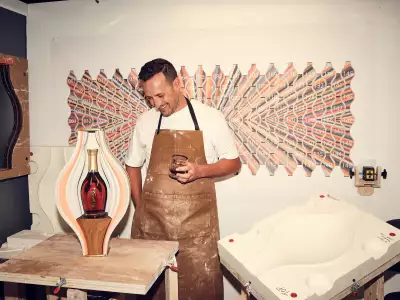
Peter Pincus in the Pincus studio with a glass of Glenmorangie
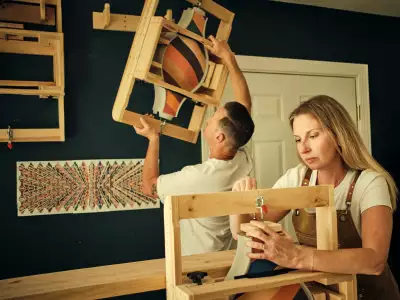
Peter and Laurie Pincus developed new techniques in conjunction with the project
The studio was commissioned for the landmark project in the years running up to the whisky’s release, when Lumsden had finally told the wider Glenmorangie team that he had a small parcel of whisky in its late forties he would be happy to release at 50. Peter and Laurie began their collaboration with an immersion into Glenmorangie, staying at the brand’s luxury hotel Glenmorangie House and visiting the distillery on multiple occasions, before attempting to transmit the intangibles of the brand into the form of each bottle’s accompanying ceramic container, incorporating a raft of new techniques forged in real time over the course of the journey. “We use lasers and templating, but we really had to plough new pathways through,” says Laurie. “We used to think we knew how to make straight lines. And I don't know if we did. But we do now.”
The process was technical but also emotional, especially for Peter, who counts not just Laurie but a team of ceramicists and artists as part of the studio. “I thought a lot about all the people that I was taking along on this thing,” he says. “There are 15 people who say, ‘OK, I think we can do this,’ but ultimately I'm the one who has to figure it out – and they are my resources to get me there. I really care about doing what I think is the best expression of the opportunity that is in front of me.”
Signature Glenmorangie top notes of orange blossom and citrus jostle with deep, rich and rounded oloroso flavours and rancio character
Three of the 149 vibrantly coloured vessels – one for each bottle of the 50 Years Old released – are present in the Drawing Room at Gleneagles that evening for dinner and to taste the resultant spirit, which includes cheese soufflé and venison wellington paired with a couple of Lumsden’s favourite wines. Nonetheless, the Pincus pieces capture the attention. Colour is a central tenet of their process, in this case led by flavour and aroma (something I can happily relate to as someone who often tastes in colours before flavours, apparently referred to as gustatory-visual synesthesia).
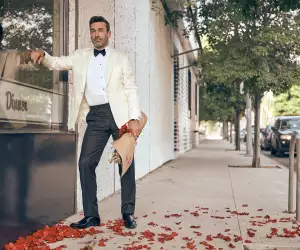
Lumsden is present and correct, dressed in a flawless vintage linen suit from his favourite designer, Cerruti 1881 – a brand he admits a mild obsession with collecting. The 50 Years Old is opened, poured and tasted. Signature Glenmorangie top notes of orange blossom and citrus jostle with deep, rich and rounded oloroso flavours and the rancio character of that oxidative ageing. There are brown spices, orange fruits (told you), dried flowers and candied orange peel. A little tannin from the oak mingles with a hint of white pepper, before black tea and tropical fruit makes itself known.
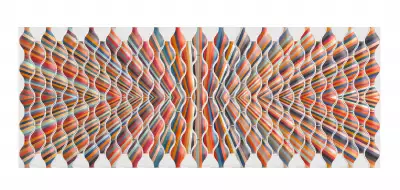
All of the 149 Pincus vessels provide a striking visual
Most interesting is the gentle, almost imperceptible lick of peat. “The subtle smokiness is in this whisky because in those days, the barley was dried with a small peat fire,” Lumsden had explained to me earlier. He’s describing the very process that gave way to peated whisky as a style, but it’s surprising nonetheless for a distillery known for elegant, unpeated spirit.
“There's a flavour I describe as being like birch tar – much more subtle than something like Ardbeg.” A hangover from when a portion of the barley was malted, dried and processed at the distillery’s own floor maltings, which weren’t closed until 1977. It’s a reminder that this is not just a beautiful old spirit; it’s also – as the best old whiskies are – a time capsule to a bygone era of distilling.
As Lumsden tells me, “Once you fill a whisky into the cask, you're in the lap of the gods.” As anyone who tastes the resultant whisky can attest – whether you see vibrant colour or hear a cello as you do so – whisky’s higher powers have clearly smiled on him.
Glenmorangie 50 Years Old is available through the Moët Hennessy Private Client Team, the Distillery Visitor Centre in Tain and select retailers for £26,800. See more at glenmorangie.com