Brought to you by

April 1970, more than 200,000 miles from Earth. An oxygen tank explodes aboard a spacecraft carrying three men towards the Moon, and its onboard systems fail during a critical phase of the mission. Their route home has drifted: left alone, they will meet the atmosphere at too shallow an angle to be safe. The crew, deprived of automated timing, have to execute a precise engine burn by hand – every 14 seconds, no more and no less. The instrument they turn to is not a backup computer. It is a mechanical wristwatch, worn by one of the crew – the one piece of equipment simple enough to keep working when everything else stops.
The burn works. On 17 April, all three men splash down safely in the Pacific.
The choice was no accident. Since 1965, a mechanical chronograph had been standard kit on every crewed NASA mission, a watch that needed neither power nor signal. Space missions run on time in a way almost nothing else does. Every launch counts backward before it counts forward, and every stage is planned, measured and timed, often to the second. When the systems built to keep that time go dark, someone still has to know what time it is.
That watch became one of the most famous in the world, and a generation of space-inspired watches followed it. Most carry a price only a few can afford – the story of that wristwatch stayed closer to the Moon than most people would ever get.
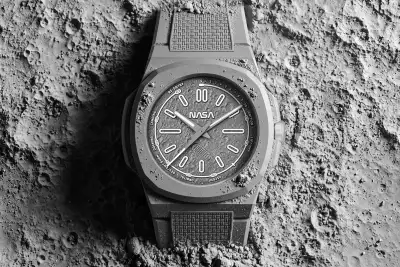
Nuncier is closing that distance. The Arab-born watchmaker became the first Middle Eastern watch brand in the GCC to receive NASA-approved design status. Now, it returns to the Moon with its second NASA-approved watch. Lunar Mission pays homage to humanity's first steps on the lunar surface, bringing the story, textures and spirit of lunar exploration to the wrist.
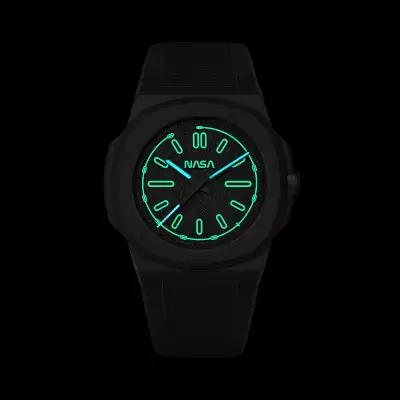
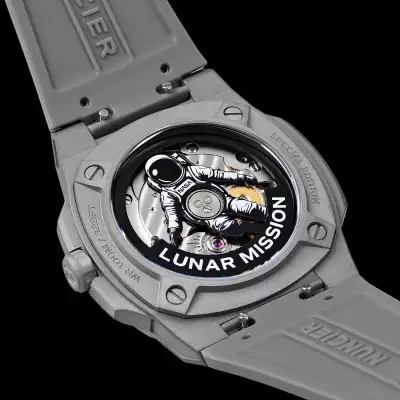
Where the original NASA edition ran on a quartz movement, Lunar Mission moves to automatic – the Miyota Cal.9039, an ultra-thin mechanical movement with a customised, astronaut-shaped rotor visible through an exhibition caseback, turning with every movement of the wrist.
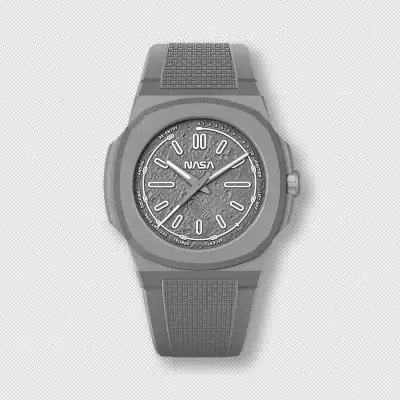
The case is where that ambition shows most clearly. Texturing titanium to resemble raw concrete is not a surface trick. Nuncier created the Titanium Concrete Finish Case in-house, specifically for Lunar Mission, applying the finish to Grade 2 titanium so the case itself echoes the rugged, unpolished character of the lunar surface.
The dial continues the theme with a cratered Moon-texture base, and at six o'clock sits an astronaut's footprint, a quiet reference to the first human steps taken somewhere no one had stood before. Around the dial, a chapter ring nods to NASA's own mission launch sequencing – a detail most people will need to look twice to catch. Sapphire crystal with anti-reflective coating and water resistance to 100 metres complete a watch built for wear, not just display.
Fifty-seven years after humanity first stepped onto the Moon, the fascination with that moment has never really left us. It remains one of the clearest expressions of how far human curiosity, ingenuity and the instinct to explore can take us.
Lunar Mission carries that fascination forward through Nuncier's own design language – in the texture of the lunar surface, the footprint left upon it, and the details drawn from the rituals of space exploration. Somebody, someday, may look up at the Moon wearing it and feel a little closer to the people who first stood there.

Limited to 100 pieces, Lunar Mission is now open for sign-ups ahead of its wider launch expected in October, 2026. Sign-up here. Following the early-access period, Lunar Mission will be available for $999 exclusively at nuncier.com.