
Rolex
Perpetual Padellone

Rolex waited until the middle of September to drop arguably its most noteworthy launch of the year, the Perpetual Padellone. Joining the 1908 in the dressier Perpetual collection (note: not the Oyster Perpetual collection), the Padellone is an instantaneous-jump annual calendar (also note: not a perpetual calendar) that makes use of the brand-new Calibre 7190 movement with Dynapulse escapement and a patent-pending Haplos system in a svelte 39mm x 12.2mm case.
Drawing inspiration from the 1940s Rolex Reference 8171 Triple Calendar Moonphase, affectionately coined the “padellone” or “large frying pan” by Italian collectors, the modern Perpetual Padellone shares the dial composition of its forebear with the day and month at 12 o’clock, a moonphase at 6 o’clock, and a pointer date complication running around the perimeter. The new Haplos system allows the day, date and month to jump simultaneously in a fraction of a second when the watch strikes midnight. It also takes care of the business of accounting for 30-day and 31-day months, only requiring one annual adjustment in February. The clever bit is that Rolex has apparently achieved this with only two additional components, rather than the more elaborate lever/cam arrangements you typically see in annual calendars. The ground-breaking Dynapulse escapement, a high-performance regulating system we first saw in the Land-Dweller’s Calibre 7135, is the icing on the horological cake.
Personally, I dearly wish that Rolex had stuck with the frying pan case shape as a more overt homage to its namesake, but I understand the need for design parity alongside the core 1908 collection. Still, it’s exciting to see the Crown flex its horological chops and dip into the grander side of grand complication watchmaking – something that we haven’t seen outside of the SkyDweller for decades.
It’s available in platinum with Rolex’s customary ice-blue dial with an alligator strap or 18ct Everose gold with a white dial and an optional matching Everose gold ‘Settima’ bracelet. (You’re going to want the bracelet.)
Tudor
Northflag

Like any good younger sibling, Tudor has refused to leave Rolex to bathe in the limelight unaccompanied, heralding the return of the Northflag.
When the original North Flag launched in 2015, it was something of an outlier in Tudor’s collection – an adventure-ready tool watch with roots in the funky 1970s Ranger II – and a welcome deviation from the regularly scheduled Black Bay dive watch-coded releases.
More importantly, it was the first Tudor ever fitted with a manufacture movement, the MT5621, making it something of a landmark in the brand’s modern history.
Now assimilated into one word as Northflag, the new-look collection tightens up the proportions, simplifies the overall aesthetic and adds a handy yellow-arrowed GMT complication for good measure. The stainless-steel case remains 40mm across, but thickness has dropped from 13.3mm to 12.7mm and the lug-to-lug measurement from 50mm to 48.8mm, making for a noticeably more wearable proposition. The black ceramic ring of the original has also disappeared in favour of a cleaner fixed steel bezel, while the black dial gains a subtle sunray finish and luminous monobloc ceramic hour markers.
The biggest upgrade, however, lies beneath the bonnet. Tudor’s automatic MT5652-U is a proper ‘flyer’ GMT, allowing the local hour hand to be adjusted independently when travelling without disturbing the home-time display. It beats at 4Hz, delivers a 65-hour power reserve and carries both COSC and METAS Master Chronometer certification, including resistance to magnetic fields up to 15,000 gauss. There’s also 100m water resistance and Tudor’s excellent T-Fit clasp, offering 8mm of tool-free adjustment.
The dial is cleaner and more legible without the old power-reserve indicator, while the new 24-hour scale and flashes of yellow lend it just enough personality. Crucially, this feels like an evolution rather than a reinvention: Tudor has retained the angular, utilitarian character that made the original interesting while making almost everything around it better.
All in all, the Northflag has matured into a seriously accomplished go-anywhere sports watch – and one with an identity entirely its own.
Longines
Master Monopusher Chronograph

I am a big advocate for the Longines Master collection. First launched in 2005, the line-up tells the story of the brand’s heritage through a series of classically styled, dressy timepieces. To me, it’s always seemed like an authentic way of representing its 1832 roots without the need to ham it up.
Earlier this year, Longines revealed a rather large overhaul of the Master collection consolidating its themes into a cleaner, slightly more contemporary design language: new proportions, new barleycorn dial treatment, sharper typography and hands, improved bracelets, more size options, and so forth.
The Master Monopusher Chronograph is the final piece of the puzzle by raising the complication stakes – and it’s fitting that Longines should look to a complication that it first utilised in 1911. As the name suggests, the monopusher chrono takes care of the chronograph functions via a single integrated pusher located in the crown – unlike a traditional chronograph with separate start-stop and reset pushers. The manually wound Longines Calibre L799.5 takes care of the heavy lifting, beating for a respectable 68 hours of stored power.
Available in a frosted blue or a warmer champagne colourways, the dial and movement feature a bevy of different finishing techniques that make the £3,350 price tag seem like a snip.
A Lange & Söhne
1815 Up/Down Limited Edition in 37.5mm

A Lange & Söhne is on a generational run in 2026 with release after release seemingly going down an absolute storm with enthusiasts. Miniaturisation has been a common thread among recent novelties, chiefly the thoroughly charming 36mm Saxonia Annual Calendar, and it continues into the 1815 Up/Down Limited Edition which now debuts in a petite 37.5mm x 8.7mm case.
If you’re unfamiliar, the Up/Down is a stellar combination of a power reserve subdial at 8 o’clock and a small seconds subdial at 4 o’clock. But the Up and Down in question is half the charm. It refers to the power reserve indicator itself, which uses the German ‘Auf’ and ‘Ab’ to denote whether the movement energy is full or empty, which literally translates as up or down respectively in English.
Available in white or pink gold, with a rich Lange blue dial and contrasting silver subdials, this is a lovely example of pragmatic Saxon timekeeping made beautiful.
Norqain
Wild One Skeleton Titanium

When Norqain launched in 2018, its vision was relatively straightforward: to create contemporary Swiss mechanical watches at a highly competitive price point. Yet, in the intervening years, the independent brand has undergone something of a transformation, evolving from its starting position as promising newcomer into one of the more interesting creators of sports watches on the market.
Much of that evolution can be attributed to the Wild One, whose innovative combination of NORTEQ carbon fibre (an ultra-light and robust composite material created exclusively for Norqain), rubber and shock-resistant construction has given Norqain a distinctive aesthetic identity.
The latest addition to the Wild One collection now introduces titanium to that technical formula for the first time, through three new references featuring Grade 5 titanium top plates. At approximately 45 percent lighter than steel, titanium is a natural fit for a sports watch and it’s executed well across the new models. The range includes a 42mm (pictured) and limited-edition 39mm skeletonised models, alongside a 42mm meteorite edition, each offering a different flavour of Norqain’s signature high-performance sports watch aesthetic.
The two skeletonised models are powered by the new 4K manufacture calibre, developed in partnership with AMT, the bespoke movement manufacture and specialised subsidiary of Sellita. COSC-certified and boasting a 65-hour power reserve, look closely and you’ll spot bridges that are shaped like the jagged peaks of the Swiss mountains – a cute touch.
The Meteorite edition takes a different approach, pairing its titanium construction with a dial cut from an iron meteorite discovered in northern Sweden, and is powered by the COSC-certified Norqain Manufacture Calibre NN20/1 created by Kenissi (for whom much of the success of Tudor’s manufacture movements can be attributed). It comes with a slightly greater 70-hour power reserve.
Our pick of the bunch would be the 42mm Wild One Skeleton Titanium, with its mint green accents and matching rubber strap.
Bulgari
Octo Finissimo Dual Time x Vianney Halter

There are certain watch releases that seem to take on a life of their own. It may be the case that a brand has fulfilled a long-held collector request, executed a movement in a novel way, or sometimes just taken everyone by surprise. Vianney Halter’s collaboration with Bulgari falls firmly into the latter category. In fact, when this timepiece started lighting up my social feed, there were only three letters that came to mind: “WTF.”
The Octo Finissimo is a Gerald Genta original that is all sharp angles and geometric shapes. Vianney Halter, on the other hand, is the king of theatrical steampunk-inspired design that has more in common with Jules Verne’s Nautilus than Genta’s Patek Philippe Nautilus; that is to say, they are polar opposites.
And yet here we are. The Octo Finissimo Dual Time x Vianney Halter somehow manages to avoid a Frankenstein’s Monster of clashing design languages to create a marvelous confluence of watchmaking ideologies. Perhaps it works precisely because it shouldn’t, but either way the Octo Finissimo, something of a modern-day icon, performs a successful supporting role and allows Vianney Halter the space to do his thing on the dial itself.
The dial is divided into four distinct displays: the two larger ‘portholes’ indicate local hours and minutes, while a second hand tracks the second time zone alongside the running seconds. The date is shown in a crescent-shaped aperture and a smaller day/night indicator is tucked into the bottom right corner of the dial.
Micromilspec
Fieldmaster

Independent Norwegian watchmaker Micromilspec may have rose to prominence in 2024 when it first released a range of commercial tool watches for the public, but its reputation for creating tough-as-teak timepieces stretches back a further five years when it began producing service watches for several military outfits.
Its latest collection doubles down on this field-ready expertise as the product of a special research project known as the ‘Field Test Program’. Micromilspec supplied 30 serving military personnel with prototype watches and proceeded to finesse their final design over a three year period as their troops beat the living crap out of their pieces.
The fruit of their labour, showcased at Geneva Watch Days, is the Fieldmaster. This 40mm field watch comes in a lightweight grade 5 titanium case that is both robust and water resistant up to 200m, and is matched to a highly legible dial that utilises oversized Lumicast hands and indexes for visibility in low light.
A wide aperture on the right-hand side of the dial also displays the previous, current, and proceeding date of the month – a design choice that might irk some when the 31st date is staring at you during months with only 30 days – while the small seconds subdial at 6 o’clock was deliberately included after consultation with participating service personnel.
Matching its utilitarian qualities, Horage’s K2 automatic movement offers a 100-hour power reserve, sufficient juice for even the most arduous of adventures, as well as resistance to magnetic fields of more than 15,000 gauss. It comes in either microblasted titanium or Gunpowder DLC on a rubber strap or titanium bracelet.
Starting from £2,220, that’s an appealing proposition for a watch that is primarily built around its long-term resilience.
Alto
Art 02

Geneva Watch Days offers the opportunity to discover smaller, lesser-known brands who are just beginning to make their mark on the industry. Of those on show at the 2026 exhibition, it was the French design-led outfit Alto and its second model, the Art 02, that left the biggest impression on me.
Founded by Thibaud Guittard in 2022, Alto differentiates itself from many other independent watch brands by veering away from the elevation of the horological craft in favour of focusing on stirring aesthetics more in-keeping with art, architecture and concept cars than timekeeping. The design language for the new model was established in the original Art 01: a sharp, faceted octagonal case and a complex textured dial that consists of concentric geometric lines. As if to compound its watchmaking nonconformity, the central seconds hand runs anticlockwise. It is, in other words, an alien among traditional timepieces, but a compelling aesthetic design all the same.
The most important change ahead of the new Art 02 was the arrival of creative director Raphaël Abeillon who spent nearly 12 years working in Cartier’s watch design department before joining up with his long-time friend, Guittard. Having originally studied automotive design at Strate Collège Designers, Abeillon is the perfect man to take Alto’s concept forward – as his work refining the Art collection illustrates.
The Art 01 may have established the brand direction, but to my mind it is the newly launched Art 02 that sees the watchmaker arrive as a bonafide name on the world stage. Abeillon has totally reworked the Grade 5 titanium case, making it considerably smaller in both length and width (42.3 x 36 mm, down from 45mm × 40mm on the original), and added a matching proprietary bracelet with 4mm micro-adjustment and a quick-change strap system for good measure. There’s a new skeletonised hand design, too, as well as a new hours and minutes track for greater legibility. It now looks and wears like an integrated sports watch as opposed to a clunky art piece on the wrist.
In order to achieve these new proportions, Abeillon and Le Cercle des Horlogers, who handles production and assembly for Alto, have completely redesigned the movement from the ground up. The resulting A02 Manufacture calibre is not only smaller but it now beats at a frequency of 5 Hz, with an increased 50 hours of power reserve, and features a free-sprung balance. Seen through the multi-faceted sapphire caseback, the architectural lattice-like movement configuration is just as geometric as the dial itself, with a sandblasted titanium main plate accompanied by satin-finished bridges with polished angles, and an off-centre rhodium-plated microrotor.
All in all, it’s an impressive alternative effort in a market that is often much better at rehashing old ideas than innovation.
Fears
Brunswick 39 Perpetual Calendar

Fears, a Bristol-based watch manufacturer with a history that stretches back to 1846, laid dormant for 40 years before Nicolas Bowman-Scargill resuscitated the brand in 2016. The sixth-generation descendant (or great-great-great-grandson) of founder Edwin Fears, Bowman-Scargill has performed a quite remarkable feat in not only reviving this once-lost brand, but in delivering a masterclass in controlled growth to establish a new player in the independent watch space.
Fears has walked the tightrope between preserving a small corner of Britain’s watchmaking heritage and shaping a watch brand for contemporary appeal, rounding up a legion of enthusiasts along the way. It has done so by sticking to a game plan that typically involved mechanically simple time-only or date-only watches inside handsome, well-finished hardware. However, its latest chapter, marking the 10 year anniversary since the brand’s relaunch, raises the stakes considerably with the Fears Brunswick 39 Perpetual Calendar – a move that sees the Bristol brand move into the high complication space.
The Brunswick model, named after Brunswick Square in Bristol (the address of the company’s export warehouse from the 1920s to early 1940s), was an apt choice for this milestone timepiece. The original Brunswick Series 1, launched in 2017, was Fears' first post-revival mechanical watch and featured an appealing cushion-case shape inspired by a 1924 gentleman’s watch from the Fears archive. Here, the Brunswick silhouette has been newly engineered into a 39mm x 37mm case with a svelte 9.4mm thickness, the slimmest yet on a Brunswick, providing the perfect canvas on which to showcase the brand’s most complicated movement yet.
At the beating heart you will find a Fears-exclusive Dubois Dépraz calibre 55115, which combines a Sellita SW300 base with a perpetual calendar module that specialist Swiss supplier Dubois Dépraz developed specifically for this watch. There will be the inevitable handwringing from certain corners of the enthusiast community who cannot see past the workhorse Sellita base movement and a £26,950 price point, but this belies the level of hand finishing and customisation seen through the sapphire caseback: frosting and bevelling on the movement, anglage finished in a striking dark rhodium, and 18k gold rotor that is engraved with the Bristol Flower.
The handiwork continues on the frosted ‘Silver Mink’ dial, which is coated in pure silver, alongside the large calendar subdials (denoting day, date, month, as well as a leap year indicator) that feature a circular-groove pattern and a moonphase that comprises black lacquer and two silver spheres hand-finished with charbonnage to create a moon-like appearance. The case, too, has higher levels of finishing in comparison to other Brunswick models.
There is something about Fears that brings me out all “Land of Hope and Glory” when it comes to our British watch industry. This is the little microbrand that could – and now it’s playing in the big leagues.
Cavasino
DCT-02 Carbon Opal Edition
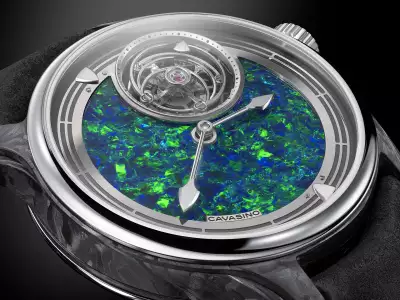
Didier Cavasino’s eponymous brand jumped onto my radar at Watches & Wonders earlier this year when I was introduced to his debut watch, the Tourbillon Inaugural DCR-01. Launched in late 2025, Cavasino is a very young independent Swiss watch brand, but its meticulous construction created by a cohort of elite artisans across Switzerland marked it as a name to firmly keep on the watch list.
An engineer by trade, Cavasino spent 17 years in the watch industry before setting out on his own. He joined Rolex in 2008, ultimately moving into new-product project management (including the platinum Daytona), before moving to Bulgari’s manufacture in Le Sentier where he took on responsibility for some of the more complicated movements inside the Octo Finissimo collection, as well as Daniel Roth pieces. In other words, this man knows his onions.
Leaning on his groaning contacts book, Cavasino’s mission statement is to honour traditional Swiss horology and pay tribute to the art of hand finishing. His latest timepiece, the DCT-02 Carbonium Opal, launched at Geneva Watch Days, takes this concept in a more contemporary direction with the use of both modern and exotic materials to add visual drama to the overall aesthetic.
Like its elder sibling, it features an asymmetrical automatic tourbillon, but the main plate and hand-grained bridges are now reworked in titanium, the twin barrels are finished with hand guilloché, and the white gold micro-rotor features contemporary hammering. It is a movement of great beauty and intricacy.
The biggest and most obvious changes are external: the DCR-01’s titanium case gives way to a lightweight Carbonium construction on the case and lugs, paired with a titanium bezel. Most strikingly, its monochrome hammered-metal dial is replaced by Australian opal, hand selected by Cavasino himself, available with either green/blue or red ‘dots’ in the stone itself.
“What I wanted for this watch was to mix something a bit alive, coming from the earth, with something very inert like Carbonium. The ‘dots’ are constantly moving on the dial and I love how it contrasts with the case,” Cavasino told me.
Limited to just 15 pieces, the Carbon Opal is a more colourful, materially adventurous evolution of Cavasino’s debut – and, in my view, all the better for it. A total of 50 DCT-02 movements, alongside the existing DCR-01 models, will round off the inaugural Cavasino watch collection, before a new movement takes centre stage sometime in 2027-28. However, as opening salvos go, Cavasino’s has proven itself to be particularly compelling.
M.A.D.Editions
M.A.D.3

I’m sure I’ve probably used the “Mad by name, mad by nature” idiom to describe M.A.D.Editions before (actually, hands up, I did just that here), but the truth is that Maximilian Büsser’s more accessible offshoot of high horology outfit MB&F is a very sensible idea, indeed. Not everyone has deep enough pockets to stretch to own one of the brand’s Horological Machines or Legacy Machines, coming in somewhere in the region of £50k-£100k as they do, but democratise some of those same concepts and offer it by way of a limited-release raffle and… well, the only ones going mad are the watch community as they clamour for a piece of the action.
The M.A.D.3 Vincent Calabrese is the third and latest release as part of the M.A.D.Editions line-up, and it’s perhaps the most appealing yet. Launched at Geneva Watch Days, it pays tribute to Vincent Calabrese, creator of the Corum Golden Bridge and co-founder of the AHCI (a non-profit association of independent watchmakers, Académie Horlogère des Créateurs Indépendants), and sees the team reimagine the legendary independent watchmaker’s Baladin wandering hours concept, first developed in 1989.
Jump hours are very a la mode, but the wandering hour seen on the M.A.D.3 is a beautifully simple adjacent idea that has a little more dynamism attached to it. Rather than having the hour jump instantaneously, the hour numeral gradually travels across the dial inside an aperture, slowly rotating away to reveal the next hour at 60 minutes. A disc from which the hour display is cut is printed with an arrow, which acts as the minute hand as it rotates.
Reproducing that mechanism for M.A.D.Editions wasn't straightforward. The original was highly artisanal, so MB&F's technical team redeveloped the wandering-hours module around a La Joux-Perret G111 automatic calibre, retaining the fluid transition while making it suitable for production. The 40mm steel case is designed by Eric Giroud, with sapphire crystals front and back alongside a layered sunburst dial.
It’s certainly the least bonkers in comparison to M.A.D’s previous two editions, but at just CHF 2,900 (approx £2,632) it’s tremendous price point from which to celebrate an unsung hero of horology and one of his finest creations.
Vacheron Constantin
Overseas Perpetual Calendar Ultra Thin

This year marks the 30th anniversary of the Vacheron Constantin Overseas, a watch that has developed from relative collector obscurity into one of the more sought-after names in enthusiast circles.
As an integrated sports watch that began its life in the 1990s, rather than debuting in the prolific 1970s era alongside the Royal Oaks and Nautiluses of this world, the collection has never shirked away from doing things a little differently to its sporty pals. The fact that each model is certified by the Poinçon de Genève as a guarantee of its craftsmanship is the first giveaway, but the second and more overt difference, in my book, is the ease with which it plays with complication.
Most sports watches are best left unfettered from such frippery as a chronograph or calendar complication, but in the Overseas’ case, there’s something about the overall case and dial composition that lends itself gracefully to a little complexity.
It’s why I was delighted to learn of a 30th anniversary limited edition of the Overseas Perpetual Calendar Ultra Thin, featuring a new combination of an 18k white gold case and a splendid azure blue dial that’s topped off by sky blue accents on the periphery minute track and leap year indicator.
Sporting 41.5mm x 8.1mm dimensions, it’s just about as slim as perpetual calendars come. It’s powered by the self-winding calibre 1120 QP/1 with a rather demure 40-hour power reserve. Ordinarily, this wouldn’t be much of a bother – it’s not quite enough juice to put it down on Friday evening and pick it back up on Monday morning, but it’ll be plenty wound should you like to alternate watches every other day – however, when you consider one of the merits of a perpetual calendar is its “set and forget” nature, accurately accounting for the days in each month even in a leap year, forgetting to wind your watch suddenly becomes an important task. It’s not the end of the world, by any means, it just means your next purchase will likely be a watch winder.
But who cares? You’ll never want to take it off anyway. It comes with a satin-finish white gold bracelet, featuring Vacheron’s signature Maltese cross links, as well as white rubber and denim-blue rubber straps, so you’ll have plenty of scope to change things up on a daily basis. Why have a whole collection when you can have one sports watch to rule them all?
Nuncier
Lunar Mission

Nuncier is the new brand name for Bahraini watch brand Nuun Official who we first featured back in 2021. Why the rebrand? Nuncier told us: "What began as a sketch on Nuun (or Noon) Island in the Arabian Gulf has grown well beyond its starting point. The new name reflects that growth and the brand's reach beyond where it started, without leaving the origin behind. It's an evolution, not a departure, and a new chapter about showing up bolder and connecting deeper with our community."
Now, the brand is back with its second NASA-approved timepiece, the Lunar Mission. Limited to just 100 pieces and designed as an homage to humanity’s first steps on the Moon, the timepiece shirks some of the more common space tropes and instead focuses on the lunar surface itself – along with an astronaut footprint at six o’clock.
Rather than leaning on conventional space imagery, Nuncier has translated the lunar surface itself into the watch, with a cratered Moon-texture dial and an astronaut footprint at six o’clock.
The 40.5mm x 10mm Grade 2 titanium case has been treated in-house to create a ‘concrete finish’ that contrasts nicely against the cratered moon-texture dial. As a final flourish, the chapter ring references NASA’s launch sequencing in place of your typical minutes track.
Underneath the hood, the Miyota 9039 automatic movement takes care of business, and is topped with an astronaut-shaped rotor that is visible through the exhibition caseback.
It’s a fitting timepiece for a brand that is experiencing its own lift off.
NASA Lunar Mission is now open for early access. Visit nuncier.com