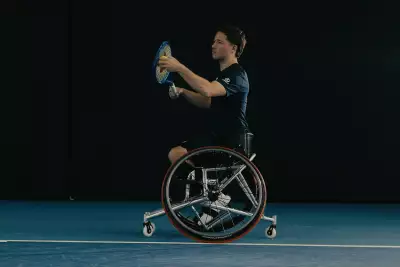
Alfie Hewett is a British sporting great. A pioneer of wheelchair tennis, Hewett has won 35 major titles: ten in singles and 25 in doubles, completing the career grand slam in both. Being invited to train with him at the National Tennis Centre is akin to taking chess lessons from Magnus Carlsen or enlisting Jimi Hendrix as your guitar tutor.
Anyway, thanks to Lexus – official performance partner of the LTA – I had that very opportunity. I was even supplied with my own wheelchair, which came in a fetching shade of green. Three of us had an hour being trained by Hewett and Lee Neale, one of the lead disability pathway coaches at the LTA.
The first battle in wheelchair tennis comes with the wheelchair. These things are rapid once you get the hang of them. They are remarkably aerodynamic and can be manoeuvred more or less to your will. “Sometimes they have a mind of their own,” says Hewett cheerfully as I went careering off court, narrowly avoiding our coach.
Physically it's far harder than you might imagine. Your upper body is getting a fair old workout and your hands must cope with two constantly spinning wheels. Mine were calloused after a few minutes. Don't get me wrong, I loved every second but be under no illusions – this is tough.

We do some movement drills, including a game called cat and mouse where one player must tag the other before they escape the court. Any illusions I have that I'm master of my chair are quickly dispelled when I'm paired with Hewett, who glides away from my despairing lunge before effortlessly catching me as I frantically spin my wheels.
Then there are hitting drills. Oh god the hitting drills. Hell, I'm not adept at aiming a tennis ball when standing upright, and I've had 34 years to acclimatise to my legs. (Only needed a couple!) Trying to position yourself in relation to a moving ball is hard enough – let alone then getting the thing back over the net. I managed a few decent shots when wheeling the exact direction Neale instructed – how on earth anyone does it with a live opponent is beyond my ken.
The highlight of the morning was simply watching Hewett demonstrate some shots, pounding forehands into the corner at a velocity that can be reasonably described as ballistic. His backhand is even more spectacular – technically it's a reverse forehand, turning the racket over before dispatching the ball with a conjurer's flourish. There's nothing more awesome or humbling than watching an elite athlete up close, let alone someone at the pinnacle of their sport.
A pioneer in every sense, Hewitt has partnered with the LTA and Lexus to launch the Get In and Go initiative, encouraging young people to experience wheelchair tennis. I grabbed him for a quick chat after our session.
SM: Tell us about Get In and Go?
AH: So it's a new initiative that a few of us have set up to encourage young people, roughly aged 11 to 16, to have a go in a wheelchair. It's not something many people ever get the chance to experience, so this is about giving them that opportunity and helping to normalise wheelchairs in sport.
The Paralympics and wheelchair tennis are growing, and we think it's a great way for the younger generation to gain a better understanding and perspective of what it's like to be in a wheelchair. We've got 16 sports wheelchairs available to hire, so schools, clubs or any organisation that thinks it would be a great experience can get involved.
SM: Having done it for an hour, I couldn't believe the physicality. My arms are aching. I feel like I'm a lot more knowledgeable than I was an hour ago, if that makes sense?
AH: Absolutely. That's exactly what this initiative is about. Yes, it's about having fun and enjoying the experience, but it's also about learning a new skill and gaining that understanding and perspective.
Like you said, after just an hour you've come away with a much better appreciation of what it's like to play tennis in a wheelchair. That's the educational side we really want to spread across the country. So thank you for giving it a go and helping us share that message.
SM: Presumably you've seen the sport grow a lot over the past decade?
AH: Yeah, massively. A lot of people have contributed to that growth, whether it's the Grand Slams, the ITF or the national governing bodies.
The sport has a much bigger platform now, with wheelchair tennis being played on the main stadium courts and more opportunities to bring people into the game, from grassroots level right through to the professional tour. It's definitely moving in the right direction.
Wheelchair tennis has only been around for 50 years, so I'm looking forward to see what the next 50 years might bring.
For more information, see Get In And Go