Hunter S Thompson was never much of a cricket fan, although he once lost $10 betting on a match in Hong Kong. But there’s a famous passage from Fear And Loathing In Las Vegas that has been on my mind in recent days, the one where Thompson’s alter ego Raoul Duke laments the passing of the 1960s and all its idealist energy.
“There was madness in any direction, at any hour... You could strike sparks anywhere. There was a fantastic universal sense that whatever we were doing was right, that we were winning.…
“And that, I think, was the handle—that sense of inevitable victory over the forces of Old and Evil. Not in any mean or military sense; we didn’t need that. Our energy would simply prevail. There was no point in fighting—on our side or theirs. We had all the momentum; we were riding the crest of a high and beautiful wave.…
“So now, less than five years later, you can go up on a steep hill in Las Vegas and look West, and with the right kind of eyes you can almost see the high-water mark—that place where the wave finally broke and rolled back.”
Bazball always dreamed bigger than achievements – certainly in the mere competitive sense. Why win a match when you can save a sport?
Now then. Does the above remind you of anything? Swap “Evil” for “Archaic” – surely even Brendon McCullum doesn’t consider a run rate of three an over to be actively immoral – relocate Las Vegas to Nottingham, and you basically have the Bazball philosophy summarised by an alcoholic American writer twenty years before Ben Stokes was born.
We are right. We are now. We are irresistible. We will be victorious.
Ultimately both 1960s counterculture and Bazball came a cropper in messy, acrimonious circumstances, one at the Altamont Free Concert, the other when Travis Head smashed 123 off 83 balls in Perth.
Look, we all know what went wrong – with Bazball at least. I’m not sure if the death of the 1960s can be attributed to the loss of a brilliant bowling attack and the refusal to pick the world’s best wicket keeper, although there was certainly no shortage of people getting high off their own supply.
Whatever. The party is over. The wave has broken and rolled back. So – where was the high-water mark?
In terms of achievement, the obvious candidates are stuck in 2022. Chasing down 299 to beat New Zealand at Trent Bridge; chasing down 378 to beat India at Edgebaston; becoming the first team to whitewash Pakistan in Pakistan over three matches. I suppose you could also nominate the 28-run victory over India in Hyderabad, perhaps the single most miraculous triumph of the Bazball era, albeit marred by the team losing the next four Tests.
But Bazball always dreamed bigger than achievements – certainly in the mere competitive sense. Why win a match when you can save a sport? And if in the process of saving Test cricket, you decrease your chances of winning actual Test matches – well, there can be no true heroism without sacrifice. Judged on those terms, there is one moment above all others that fully embodies this mission statement.
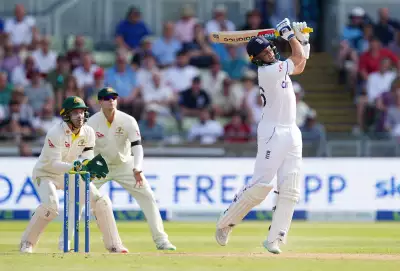
The high-water mark of Bazball occurred just after 6pm on 16 June 2023 when Ben Stokes declared with England 393-8 in the first innings of the first Ashes Test. Stokes raised his arm to call in the batters; the wave crested with a wave.
The declaration was an iconic, WTF moment, as it was intended to be. It also probably cost England the Ashes
This was the moment when vibes took precedence over victory; performance gave way to performative. When the question ceased to be “what do the opposition least want us to do in this situation?” and mutated into “what’s the coolest thing we can do in this situation?”
It was an iconic, WTF moment, as it was intended to be. It also probably cost England the Ashes.
Some mistakes are only visible with hindsight. The declaration was not one of those. A reminder: Joe Root is unbeaten on 118 and seeing it like a beachball. He’s added 43 runs with Ollie Robinson (17*). England are going at over five an over. Sure, the innings could be over in two balls, but against a weary attack in pristine conditions, adding another 30-40 runs before stumps seems a far likelier proposition.
Put it this way: should you tap Pat Cummins on the shoulder and offer him the option of taking England’s last two wickets for no additional runs, with the caveat his openers will have to survive four overs on a balmy June evening, do you reckon he’d accept?
We do require hindsight to know that four days later, Cummins and Nathan Lyon will add 55 runs for the ninth wicket to give Australia a two-wicket victory and 1-0 series lead. They finished on 282-8.
Obviously we’ll never know whether the Aussies would have chased a target of, say, 320, any more than we’ll know how the series would’ve progressed had it been England going one up. We’re in a whole other timeline here. However the events of the existing one strongly suggest the summer climaxes with Stokes brandishing the urn at the Oval if not before, his signature series victory secured – everything that comes afterwards is a bonus.
Of course the true tragedy of the 2023 Ashes is Old Trafford, two days of rain spoiling an nigh-on inevitable England victory and the generational prospect of 2-2 going into the decider. But nobody can influence the weather, not even Ben Stokes. He can, however, influence whether England are 2-1 down or 2-1 up going into the fifth Test; whether the Manchester washout renders the final Test a borderline dead rubber or a sporting event that stops the country.
Here I should stress: I love Stokes. He’s the most inspirational cricketer of my lifetime, and if not the best England captain then certainly the most transformative. Hell, I even kind of love him for that ridiculous declaration, even though it was objectively terrible. And it really was terrible, deserving to rank alongside David Gower’s Tiger Moth flyby, Nasser Hussain opting to have a bowl in Brisbane and Steve Harmison testing the reflexes of second slip in the hall of English Ashes infamy.
We know that 2023 was as good as it ever got for Stokes’s England. There will be no 2027 redemption arc, no grand catharsis
And yet Stokes essentially got away with it. Like Boris Johnson on the zipwire, the Bazball brand was strong enough then to assimilate a spontaneous declaration that leaves you some 50 runs short of a par score and ultimately costs you the match. I suspect the reaction now would be very different but those were different times, heady days when victory was inevitable, the cause was just and everything was fun until it wasn’t.
And here we are four years later. Stokes has retired without ever leading England to victory in a five-match series, and the 2023 Ashes is both the time of our lives and also the greatest missed opportunity. (Last year’s India series was even more winnable, but the Ashes are the Ashes.)
We’ll always have the memories, and what memories they were. But now we also know that 2023 was as good as it ever got for Stokes’s England. There will be no 2027 redemption arc, no grand catharsis. The most influential English player of his generation retires having won the Ashes once, despite having played arguably its greatest innings and orchestrated one of its greatest series. It feels wrong, somehow. It feels sad.
I suspect – I hope – the Bazball era will be remembered fondly in years to come. It never quite delivered what it promised – and God knows the team promised a lot, in every sense – but for a while the cricket was scintillating and the vibes immaculate. Both reached their high-water mark when a blue bucket-hatted Stokes raised his arm on the Edgebastan balcony, a high and beautiful wave that we will be contemplating for years, cherishing the memories, wondering what might have been.
Postscript: “We blew it”
There’s another quote from a landmark work of American counterculture that carries an unfortunate potency; the scene from Easy Rider when Peter Fonda tells Jack Nicholson, “We blew it.”
So did England blow Bazball? Yes, I suppose, albeit not completely and with a couple of caveats.
The promise of 2022 was never truly fulfilled. Winning three consecutive Test series – and a one-off Test match to draw a fourth – shouldn’t be dismissed, especially considering the remarkable manner of these victories. In some ways, 2022 offers fulfilment in itself alone.
Yet tell a spectator watching Root and Bairstow decimate the India attack that this team would never win a five-match series and the reaction would be disappointment, if not outright disbelief. They should have beaten Australia in 2023, and they certainly should have beaten a transitional Indian side in 2025. You could argue they won the first 2-2 and lost the second by the same scoreline; regardless, we are approaching a decade since England claimed a best of five.
For three years, England played the most thrilling cricket ever seen in this county – but only a fraction of the country actually saw it
They also blew a huge opportunity to win the Ashes Down Under, or at the very least win a live Test match or two. Personally I think the dream was already withering when England touched down in Oz; enough wounds had been sustained over the previous two years for players who once thought themselves invulnerable to be aware of their own faillability. Does the Zak Crawley of 2023 thrive in Australia? You would certainly back him over the 2025 incarnation.
But so what? Imagine if England had taken those two home series, and somehow retained the urn last winter. Stokes is hailed as England’s greatest captain, McCullum gets a statue outside Lord’s. Does it change anything? Probably not.
For Bazball was squandered two decades ago, when the sport went behind a paywall. For three years, England played the most thrilling cricket ever seen in this county – but only a fraction of the country actually saw it. The final day at Edgbaston had a peak audience of just over two million; the 2005 Ashes on Channel 4 averaged more than that per hour, reaching peaks of seven to eight million at the climatic moments.
Step backwards and we see that 2005 was the true high-water mark; the place where the wave broke. It’s been rolling back ever since.